 AZ Ultra Adventure
On this page
Nobody packs a beanie for the desert. That's the problem.
Every winter, people come to Arizona for races because it's warm. During the day they're right. The National Weather Service's 1991–2020 normals for Phoenix in January are a high of about 68°F and a low of about 46°F. That's the airport, in the middle of a heat-soaked city. Out at the regional parks on the edge of town, the ground loses its heat fast once the sun drops, and in my experience the trailhead feels a lot colder than the number on your phone.
For a 50K that starts at sunrise, that barely matters. For anything that runs through the night, it's the whole race.
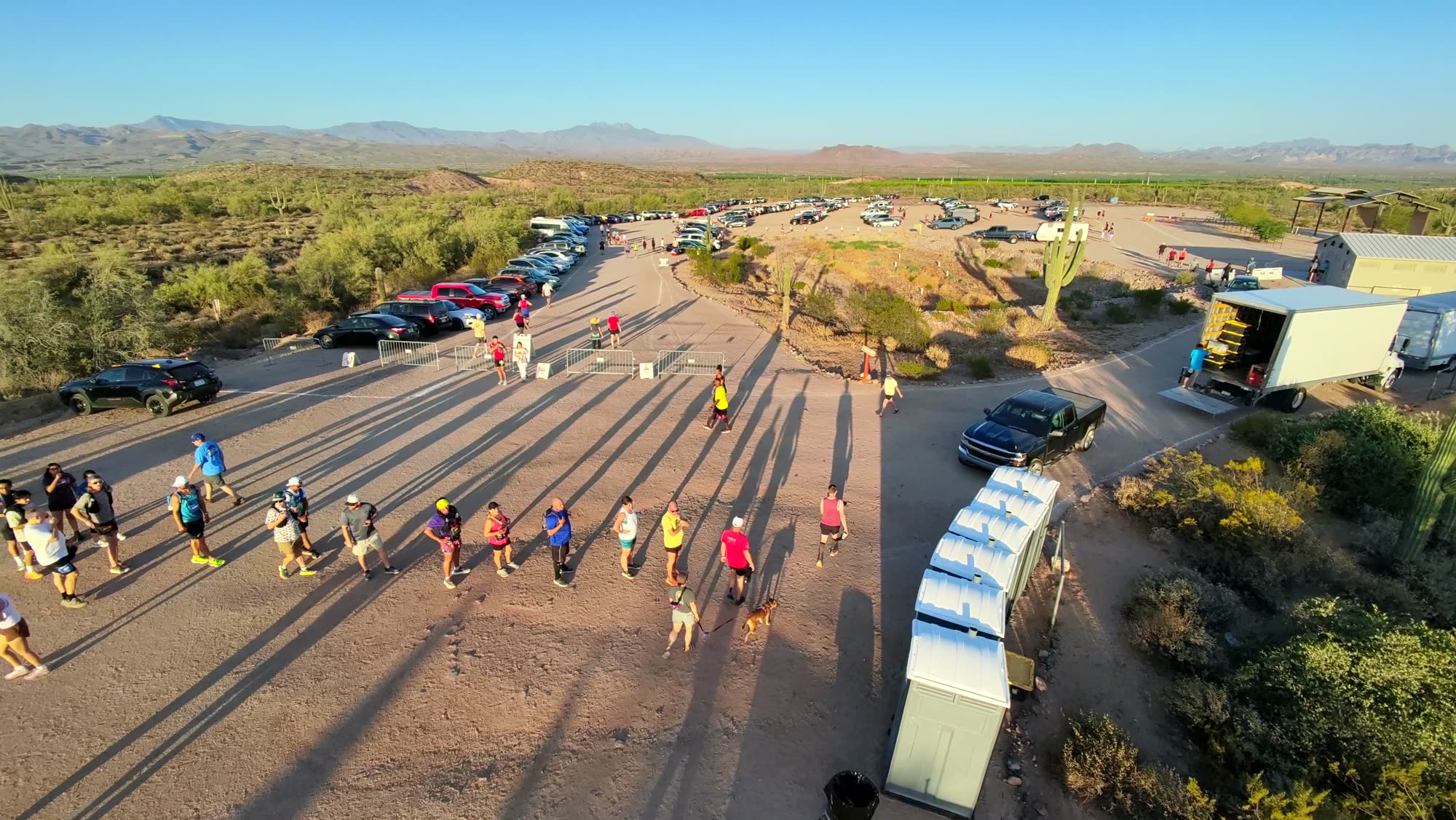
My next one is the Saguaro Showdown Backyard Ultra at Usery Mountain on January 23. The first yard starts at 8 AM. From 8 PM to 8 AM the loop moves to a road out-and-back. If I hit my goals, I'll be running through at least one full January night, stopping every hour and starting again cold. So I've been thinking about clothing more than I ever did for a summer 100.
Here are the myths I hear most often, including a couple I used to believe.
Myth 1: "It's the desert. A long-sleeve is enough."
A long-sleeve is enough at 2 PM. At 3 AM, after 19 hours on your feet and a stomach that stopped taking food two yards ago, your body isn't making the heat it made at noon.
Fatigue makes you colder, not just the weather. Slower pace means less heat. A low-calorie stretch means less heat. A sweaty shirt from the afternoon means the cold gets to your skin faster.
What to do instead: plan clothing by hour, not by forecast. Write down what you'll wear at 6 PM, midnight and 4 AM, and pack a bag for each.
Myth 2: "One big jacket covers it."
One heavy jacket is either on or off. Both are wrong most of the night. You overheat on the climb, sweat into it, then freeze in the chair.
Three thin layers beat one thick one because you can change them a little at a time:
- A base layer that dries fast. Wool or synthetic, never cotton.
- A light insulating layer, like a thin fleece or a packable vest.
- A wind shell on top. In the desert the wind does more damage than the temperature.
Rule: if you're warm in the first five minutes of a lap, you're overdressed. Start a little cold.
Myth 3: "Arm sleeves are for sunburn."
Arm sleeves are the most underrated piece of winter ultra gear. They're sun protection at noon and warmth at dawn, and you can pull them down to your wrists on the move without stopping. Same idea for a neck gaiter: it's a scarf, a headband or a beanie in ten seconds.
The best layers are the ones you can change while still walking.
Myth 4: "Sitting in the chair between laps is how you recover."
In a backyard ultra the chair is part of the race. You get whatever's left of the hour after the 4.17-mile loop. If I run my laps in 50 to 52 minutes, that's 8 to 10 minutes to eat, drink, change and walk back to the corral.
Those minutes are the coldest part of the night. Your heart rate drops, sweat cools, and you stiffen up fast. Then you have to start running again.
What I'm planning:
- A blanket or a puffy jacket on the chair, waiting before I sit, not in a bag.
- Hot food ready when I arrive. Broth, ramen or noodle soup every two or three yards after dark is already in my fueling plan.
- A dry shirt at the halfway point of the night, not when I'm already shivering.
- A pair of running gloves I can take off for food and put back on before I leave.
I'll find out how well it works on January 23.
Myth 5: "If I'm cold, I'll just run faster."
That works for a few minutes on a training run. In an ultra it's a trap.
In a backyard, every yard is the same distance with the same cutoff. A fast lap only buys a longer cold sit. In a point-to-point 100, running harder to stay warm burns energy you'll need at sunrise. Either way you pay later.
The fix is boring: dress for the pace you'll actually be running at 3 AM, which is slower than you think.
What I actually carry for a desert night
This is my list for a cool-weather overnight in the Valley:
- A base layer that isn't cotton
- Arm sleeves
- A light vest or thin fleece
- A wind shell
- A neck gaiter that doubles as a hat
- Thin gloves
- A dry shirt and socks in the crew bag
- A puffy or blanket for the chair
None of it is expensive, and most of it is already in a runner's drawer. The mistake isn't owning the wrong gear. It's leaving it in the car because it was 70°F when you parked.
The bottom line
Arizona winters are why people move here. They're also why runners show up to night races in a singlet and a hopeful attitude. The desert doesn't care that it was warm at lunch.
You can follow my build to January 23 on the training page. The weekly miles come straight from Strava, not from memory.
The cold doesn't end races. Not having a plan for it does.
Some links are Amazon affiliate links. As an Amazon Associate we earn from qualifying purchases, at no extra cost to you.