 AZ Ultra Adventure
On this page
- Bradshaw Brute 100 at a glance (2027)
- The course map
- The course in four acts
- Every aid station: mile, cutoffs, drop bags
- Required gear
- The crew question: there isn't one
- Where poles help
- The finish line is decided here
- Insider knowledge
- Gear and packing list
- The van idea for the Brute
- Bradshaw Brute 100 FAQ
- Who wrote this
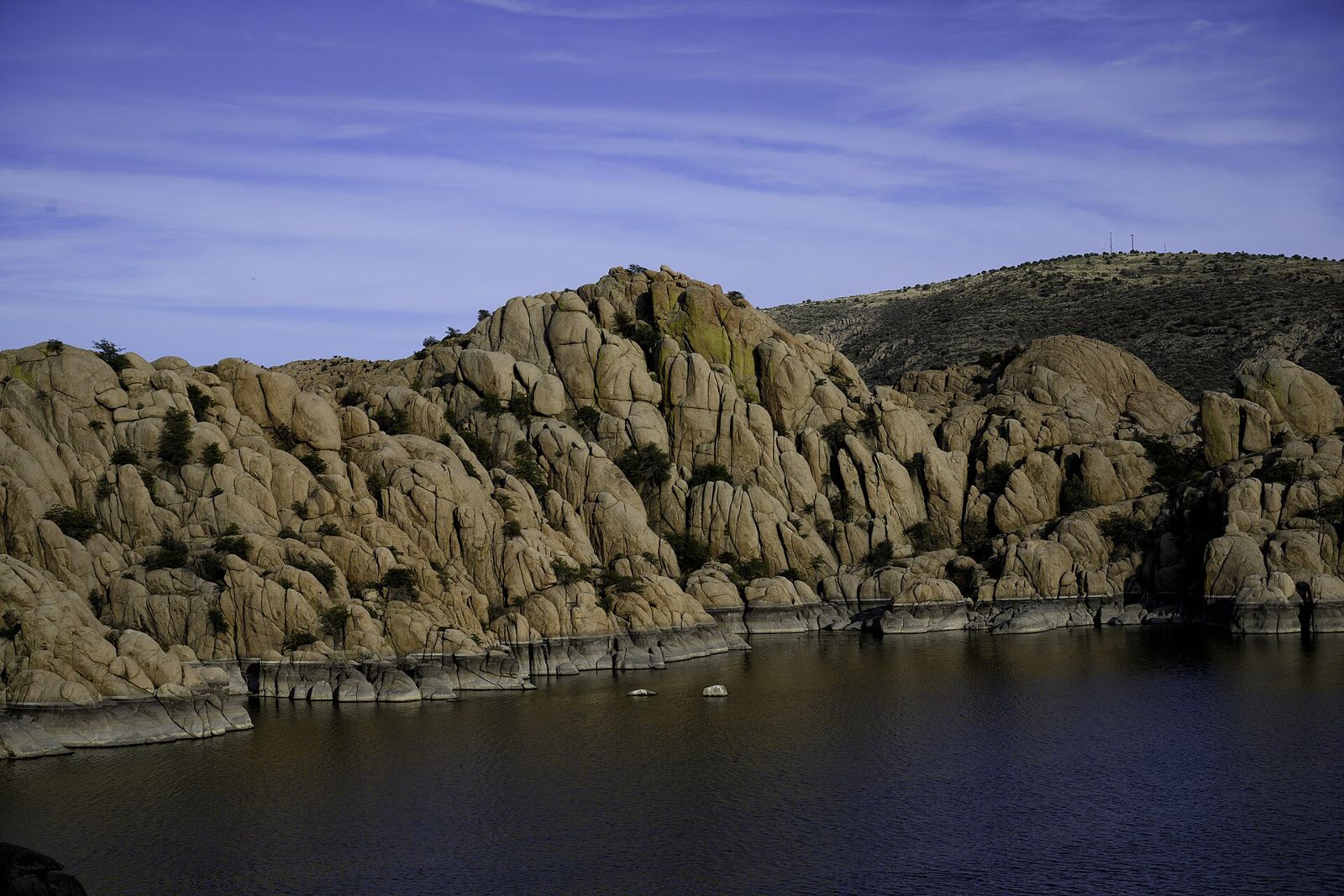
Most 100-milers get easier to manage as they go: more crew stops, a pacer at mile 60, a town you can smell from the ridge. The Bradshaw Brute 100 doesn't. It takes the first and hardest stretch of the Cocodona 250 and turns it into a 100-miler that's yours alone. Your crew can't meet you on course, and you can't have a pacer. Aid stations and drop bags are your only help between the cactus at Black Canyon City and the granite boulders of Watson Lake in Prescott.
Aravaipa itself says the Brute shouldn't be your first 100. The numbers explain why: about 100 miles with +20,838 feet of climbing, a 25-mile section with more than 9,500 feet of gain on loose rock in desert heat, then a cold night crossing the Bradshaw Mountains over Mount Union. The limit is 38 hours. People sign up because it's the most interesting part of Cocodona, it ends at the beautiful Granite Dells, and it gives you a finish with a big name behind it at a fraction of the 250's cost and time.
This guide covers the 2027 race from Aravaipa's official Runner Guide and section-by-section course description (both updated October 1, 2026). Cutoffs and rules get revised, so check the official Cocodona page before race week. For the full 250, see the Cocodona 250 guide.
Bradshaw Brute 100 at a glance (2027)
| Date | Sunday, May 2, 2027, 6:00 AM mass start (one hour after the Cocodona 250) |
| Start | Deep Canyon Ranch, Black Canyon City (private land and an active mine: never visit outside race weekend) |
| Finish | Watson Lake Park, Prescott (Granite Dells) |
| Distance | About 100 miles (99.9-100.0 depending on the source) |
| Elevation | +20,838 ft / −17,565 ft |
| Time limit | 38 hours (finish closes Monday 8:00 PM) |
| Aid | 7 aid stations plus 2 water-only stations |
| Crew | Start and finish only |
| Pacers | Not allowed |
| Drop bags | Crown King, Kamp Kipa, Goldwater Lake (plus one start-to-finish bag) |
| Fee | $495 to Aug 31, 2026; $525 to Feb 28, 2027; $555 to Apr 25, 2027 (plus tax and fees) |
| Entry | First come, first served on UltraSignup (shared Cocodona page). No lottery |
| Tracking | SPOT tracker on TrackLeaders, so family can follow along |
| Points | ITRA and UTMB points. The runner guide names only the 250 and 125 as Western States qualifiers, so check the WSER list if that matters to you |
| Buckle | Handmade Arizona copper belt buckle for finishers |
The course map
Export the GPX (not the default GeoJSON) and load it into Gaia, CalTopo or your watch. A GPS device with the course loaded is required gear. You'll need it more on this course than on almost any other Arizona 100, because Aravaipa's own course description keeps warning about confusing dirt-road junctions between Crown King and Prescott. The section-by-section description (PDF) has an elevation profile for every leg.
The course in four acts
Act 1: The desert and the river (miles 0-12). You start in the dark-to-dawn Sonoran desert on the Black Canyon Trail among saguaros and ocotillo. The Brute leaves the 250 route at mile 2.3 to stay on the BCT, and crosses the Agua Fria River at miles 3.7 and 5.8. Plan on wet feet: the course description says there's little chance of staying dry. You rejoin the 250 route at 9.1, then leave the BCT for a rough two-track to Cottonwood Creek (mile 12.2).
Act 2: The pile of rocks (miles 12-37). This is the race. From Cottonwood Creek to Lane Mountain is 25.1 miles with +9,518 / −4,856 feet. It starts on a beat-up old mining road, crosses Cottonwood and Boulder creeks, and then, in Aravaipa's own words, turns into basically a huge pile of loose rocks. It's steep up and steep down on ball-bearing gravel, it's hot, and it's the hardest part of the course to reach by vehicle. There are only two water stops, at miles 15.2 and 29.4, with 1 liter per person max. Near mile 33 the course turns onto the Lane Mountain Trail and climbs about 1,500 feet in 2.5 miles. The good news is that it climbs out of the desert into ponderosa shade.
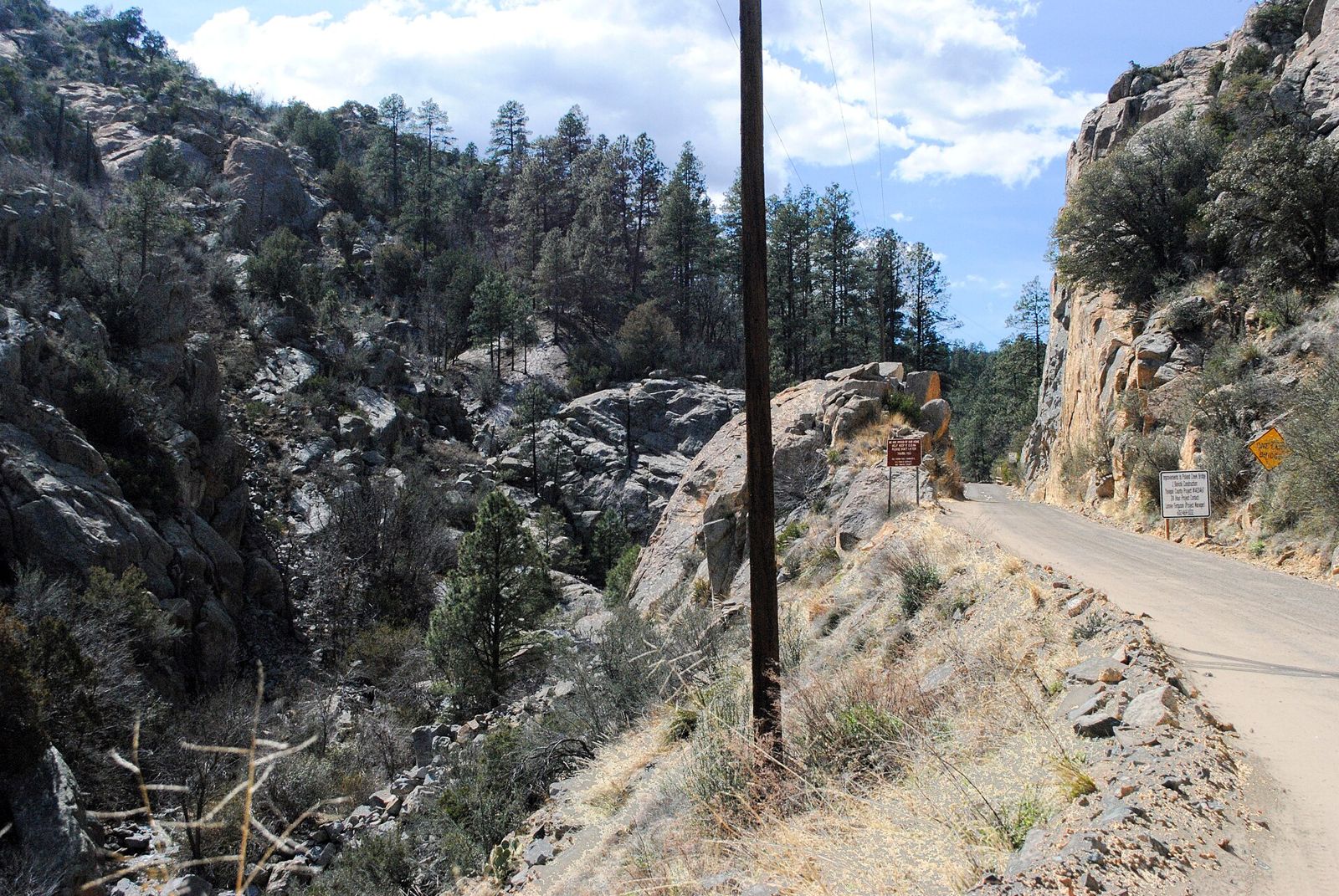
Act 3: Crown King and the crest (miles 37-74). A smooth dirt road takes you down to Crown King (mile 41.4), an old mining town with a general store and the oldest continuously operating saloon in Arizona (according to the race's course description). It has your first drop bag and a mandatory gear check. Then you climb the Wagoner Trail and Escape Route Road onto Senator Highway (not really a highway) as the sun goes down. Arrastra Creek (55.8) leads into the hardest night section: the Arrastra Creek Trail along and in the creek, a steep climb to Longfellow Ridge, the rolling Yankee Doodle Trail, and then a rough, steep, loose three-mile climb toward Mount Union, past old burn scars from the Crooks Fire. Kamp Kipa (67.7) has a drop bag. Then come more confusing dirt-road junctions, a descent on Senator Highway, and the lovely Groom Creek Trail to Camp Wamatochick (74.2), with a fire and warm food in the mess hall.
Act 4: Fast singletrack home (miles 74-100). Six miles past Friendly Pines and around the Goldwater Lakes bring you to Goldwater Lake (80.2), the last aid station and drop bag. From there it's 19.8 miles to the finish. The Ranch Trail climbs for about 3.5 miles, then come about 14 miles of fast, smooth singletrack on rollers and downhills via the Badger Mountain and Sundog trails. You finish with a flat cruise through the Watson Woods riparian area and onto the Peavine, and the last few hundred yards cross the Granite Dells slickrock to the line at Watson Lake. If you have legs left, this is where you can make up hours. If you don't, it's 20 long miles.
Every aid station: mile, cutoffs, drop bags
From the official 2027 Runner Guide. Cutoffs are times of day, followed by hours elapsed since the 6:00 AM Sunday start.
| Aid station | Mile | To next | Drop bag | Gear check | Cutoff | Notes on the next leg |
|---|---|---|---|---|---|---|
| Start: Deep Canyon Ranch | 0.0 | 12.2 | Yes | 4 L capacity | Sun 6:00 AM | Black Canyon Trail, two Agua Fria crossings (wet feet) |
| Cottonwood Creek | 12.2 | 3.0 | No | Must leave with 4 L | Sun 9:50 AM (3:50) | The 25.1-mile Lane Mountain section begins |
| Water stop | 15.2 | 14.2 | - | - | - | 1 L max. Boulder Creek crossing, then the loose-rock rollercoaster |
| Water stop | 29.4 | 7.9 | - | - | - | 1 L max. Lane Mountain Trail climb (about 1,500 ft in 2.5 mi) |
| Lane Mountain | 37.3 | 4.1 | No | - | Sun 10:45 PM (16:45) | Easy downhill dirt road |
| Crown King | 41.4 | 14.4 | Yes (first) | Required + cold-weather gear | Sun 11:55 PM (17:55) | Wagoner Trail, Escape Route Rd, Senator Hwy. Nights near 40°F. 26 mi to the next drop bag |
| Arrastra Creek | 55.8 | 11.9 | No | - | Mon 4:30 AM (22:30) | +4,411 ft: Arrastra Creek Trail, Yankee Doodle, Mount Union. Poles |
| Kamp Kipa | 67.7 | 6.5 | Yes | - | Mon 10:15 AM (28:15) | Confusing dirt-road junctions, Senator Hwy, Groom Creek Trail. Owl habitat: headlamps down, quiet |
| Camp Wamatochick | 74.2 | 6.0 | No | - | Mon 12:15 PM (30:15) | Warm food and a fire in the mess hall. Friendly Pines, Goldwater Lakes |
| Goldwater Lake | 80.2 | 19.8 | Yes (last) | - | Mon 2:00 PM (32:00) | Ranch Trail climb, then about 14 mi of fast singletrack |
| Finish: Watson Lake Park | 100.0 | - | All bags | - | Mon 8:00 PM (38:00) |
How the table plays out:
- There's no crew anywhere except the start and finish. The race enforces it. Plan your drop bags as if they're your crew.
- The first drop bag is at mile 41.4. You'll be on course for 10 to 17 hours before you see it, so everything you need for the desert heat has to be on your back.
- Crown King to Kamp Kipa is 26 miles without a drop bag, through the coldest, darkest, steepest part of the night. The Crown King gear check exists for this reason. You won't be allowed to leave without your cold-weather kit (gloves, warm hat, long sleeve, insulating layer).
- Wamatochick has no Brute drop bags, even though the 250 runners get one there. Aravaipa gives Brute runners brightly colored labels, so use them. Mislabeled bags can end up in Flagstaff.
- Lane Mountain and Crown King share their clock cutoffs with the 250, but Brute runners start an hour later and have run about 5 more miles by then. In practice, the cutoffs that bite are Lane Mountain and Crown King.
Required gear
Required gear for every Cocodona-week distance: a cell phone, a GPS device with the course loaded plus a way to charge it, a headlamp with spare power, a collapsible cup (the race is cupless), a space blanket and a whistle. Cold-weather gear is checked at Crown King: gloves, a warm hat or buff, a long-sleeve top and an insulating layer. A waterproof hooded jacket is required when rain or snow is forecast. Carry one anyway: in 2025, hail and freezing rain hit this exact section before jackets were required.
The water rule matters most. You need the capacity for 4 liters at the start, and you must leave Cottonwood Creek carrying at least 4 liters. The course description adds that most Cocodona veterans carry more than that and suggests a filter flask.
The crew question: there isn't one
Since the Brute doesn't allow crew on course, the logistics are about the start and the finish:
- Point-to-point. Black Canyon City to Prescott is about a 1.5-hour drive. Aravaipa sells a $60 pre-race shuttle on Saturday, May 1, from Watson Lake Park to the start (departs 2:30 PM, timed for packet pickup and the race briefing). That way you can leave your car at the finish. Aravaipa doesn't run post-race shuttles.
- Parking. Long-term parking is available at the start (cars must be picked up by Sunday, May 9) and at Watson Lake Park. Watson Lake charges $5 per car, and overnight cars need the City of Prescott pass printed and on the dashboard, or you'll get a ticket. Park in the lower lots so 250 crews can use the space near the aid station.
- Camping. You can camp at the start from 1:00 PM Saturday (cars, vans, trailers and RVs). Watson Lake Park has 19 paid sites at $25 a night, though the city blocks some of them during Cocodona week. The Hampton Inn in Anthem is the official start-line hotel.
- Following along. Brute runners carry SPOT trackers on TrackLeaders, so your family can follow along from Prescott. Cell service is generally good on the course, but your runner won't need it for the tracker to work.
- Supporter timing. Watson Lake is also a Cocodona 250 aid station (mile 82.8), so the finish area is busy on Sunday night and Monday. Supporters can wait at the finish with a chair, a warm jacket and real food. That's the only "crewing" you'll do.
Where poles help
The official course description tells you to start with poles, which says a lot. Here's where they matter:
- Cottonwood Creek to Lane Mountain (miles 12-37). Very steep rollers on loose rock. Poles keep you upright on the descents and spare your quads for the 63 miles after it.
- The Lane Mountain Trail climb at about mile 33, a 1,500-foot grind in the heat of the afternoon.
- Arrastra Creek to Kamp Kipa (miles 56-68). The steep climb to Longfellow Ridge and the rough three-mile Yankee Doodle climb toward Mount Union, at night. The guide calls this "yet another section" where you'll appreciate poles.
There's no crew to hand poles to, so either carry them the whole way or put a spare set in a drop bag. Crown King or Kamp Kipa works well if you want to swap to a lighter pair. The last 20 miles from Goldwater Lake are mostly runnable singletrack, so collapse them and run.
The finish line is decided here
Lane Mountain and Crown King decide the Brute. Everything else in the race depends on how you get through the 25 miles from Cottonwood Creek. Aravaipa warns, in so many words, that depleting yourself there can have disastrous consequences. Runners who go out hard on the Black Canyon Trail to bank time reach the loose rock overheated, short on water and with blown quads. Some hit the Crown King cutoff (11:55 PM, almost 18 hours in). Others make it but leave for the night crest with nothing left.
The second danger point is the night between Crown King and Kamp Kipa. It's 26 miles with no drop bag, cold air (near 40°F), the steepest climbing of the night toward Mount Union, and the creek-bed trail. Runners who reach Arrastra Creek tired, cold and alone are the ones most likely to quit.
The point after which a finish is almost certain: Goldwater Lake (mile 80.2). You get there by 2:00 PM Monday at the latest, which leaves at least six hours for 19.8 miles, most of it fast downhill singletrack. Get out of Goldwater with a full bottle and a headlamp, and the Granite Dells will take care of the rest.
How not to DNF the Brute
- Hold back for the first 12 miles. The desert at dawn feels easy. Leave Cottonwood Creek feeling like you've barely started.
- Carry more than 4 liters if you drink a lot, and bring a filter flask. Two 1-liter water stops in 25 miles in May heat is a real constraint.
- Use electrolytes and sun gear early: a sun hoodie, a hat with a neck cape, sunscreen. Dip your hat or buff at the creek crossings if there's water.
- Fix your feet at Crown King. The course description says it plainly: put wet wipes and fresh socks in that drop bag, clean off the desert dust and the Agua Fria grit, and deal with foot problems right then. The next drop bag is 26 miles away.
- Have a chair rule. With no crew, nobody will get you out of the chair. Set a timer: 10 minutes at Crown King, 5 at the others. The fire at Wamatochick is the coziest trap on the course.
- Plan for the cold before Crown King. Pack the night bag with a warm layer, gloves, a fresh headlamp battery, caffeine, and food that sounds good at 2 AM.
- Navigate on purpose. From Kamp Kipa to Wamatochick and Goldwater the description keeps mentioning confusing junctions. Check the GPX after every intersection, especially when you're sleepy.
- Close every gate you open. It protects the race's permits.
- Just get to Goldwater. After that, it's downhill singletrack.
Insider knowledge
The Brute is younger and smaller than the 250, and we found no Brute-specific threads on r/ultrarunning or r/trailrunning that we could verify. The best insider knowledge comes from the 250's runners, who run the same terrain first:
- The Lane Mountain section is the hardest part of Cocodona. That's a consistent theme in 250 race reports and coach write-ups. Runners who started too fast in the heat paid for it for days. On the Brute you only pay for one night, but you have no crew to fix things.
- Gear-heavy early. 250 finishers note that you see crew only twice in the first 80 miles, so the vest has to carry everything. Brute runners never see crew at all, so this matters even more.
- Wet feet early, blisters later. The Agua Fria crossings in the first six miles soak your shoes, and the grit comes along. Veteran advice from the 250 is the same everywhere: change socks and wipe your feet every 20-30 miles.
- Expect weather. The 2025 Cocodona had rain, hail and freezing temperatures between Black Canyon City and Crown King. A Brute runner caught in that, with no crew, depends entirely on what's in the pack.
Gear and packing list
These are picked for a self-supported, hot-then-cold mountain 100:
- Trekking poles you can carry for 100 miles. Folding carbon trail running poles
- A vest that really carries 4+ liters comfortably, with room for a jacket and layers. Trail running vest 12L with bladder
- A filter flask for the long dry miles, as the course description suggests. Filter soft flask
- Sun hoodie plus a hat with a neck cape for the Black Canyon Trail and the loose-rock miles. UPF sun hoodie
- Electrolytes, early and often. Electrolyte capsules
- A bright rechargeable headlamp for a long night on Senator Highway and Mount Union. Rechargeable running headlamp
- Gaiters for gravel, grit and cholla. Trail running gaiters
- Toe socks and anti-chafe for wet feet in the first six miles. Injinji trail toe socks and Squirrel's Nut Butter
- A light, packable puffy and gloves for the gear check and the 40°F crest. Packable down jacket
- A slim power bank to keep your GPS and phone alive for 38 hours. 10,000 mAh power bank
The van idea for the Brute
With no crew access on course, a race van is about the two ends of the race. Sleep at Deep Canyon Ranch the night before, since start-line camping opens Saturday afternoon, and skip the 4 AM drive from Phoenix. While your runner crosses the Bradshaws, your supporters drive to Prescott and set up at Watson Lake, then wait at the finish with a bed, a hot meal, compression boots and a fridge of cold drinks. There's also room for a long, cold Monday night if the finish comes late. AZ Ultra Vans is collecting reservation interest for Cocodona week. The card above isn't a booking or a promise of availability.
Bradshaw Brute 100 FAQ
When is the 2027 Bradshaw Brute 100? Sunday, May 2, 2027, at 6:00 AM from Deep Canyon Ranch in Black Canyon City, one hour after the Cocodona 250. The finish at Watson Lake Park in Prescott closes at 8:00 PM Monday (38 hours).
Can you have a crew or pacer at the Bradshaw Brute 100? No. Crew is allowed only at the start and finish, and no pacers are allowed anywhere on the course. Drop bags at Crown King (41.4), Kamp Kipa (67.7) and Goldwater Lake (80.2) are your support.
How much elevation gain is the Bradshaw Brute? About +20,838 feet and −17,565 feet over roughly 100 miles. Nearly half of the climbing happens between Cottonwood Creek (mile 12.2) and Lane Mountain (mile 37.3).
What are the cutoffs? Cottonwood Creek 9:50 AM Sunday, Lane Mountain 10:45 PM, Crown King 11:55 PM, Arrastra Creek 4:30 AM Monday, Kamp Kipa 10:15 AM, Camp Wamatochick 12:15 PM, Goldwater Lake 2:00 PM and the finish 8:00 PM Monday. Confirm them in the current runner guide.
Is the Bradshaw Brute a good first 100? Aravaipa says it shouldn't be your first. It has very rough terrain, desert heat, a 25-mile section with more than 9,500 feet of climbing on loose rock, and no crew or pacer support. Javelina or Coldwater are friendlier first 100s in Arizona.
How do I get from the finish back to the start? Leave your car at Watson Lake Park and take Aravaipa's $60 pre-race shuttle to the start on Saturday afternoon. Pay the $5 park fee and display the overnight pass. Aravaipa doesn't offer post-race shuttles.
Is it a Western States qualifier? The 2027 runner guide lists the Cocodona 250 and Sedona Canyons 125 as Western States qualifiers but doesn't mention the Brute. Check the official Western States qualifying race list before you count on it.
Who wrote this
Johnathon Lawson is a trail runner from Gilbert, Arizona, and the person behind AZ Ultra Adventure. He has finished the Mogollon Monster 100, the San Diego 100 and the Zion 100. He hasn't run the Bradshaw Brute. This guide was researched from Aravaipa's 2027 runner guide and course description, plus Cocodona 250 race reports for the same terrain. Corrections from Brute finishers are welcome.
Follow along on Strava, YouTube and Instagram.
Some links are Amazon affiliate links. As an Amazon Associate we earn from qualifying purchases, at no extra cost to you.