 AZ Ultra Adventure
On this page
- The race at a glance
- Start with the cutoff math
- The course
- Aid stations: 50 mile
- Aid stations: 50K
- Crew guide: the parking lot is your whole world
- Where poles help (and where they don't)
- What the fine print and the results tell you
- The finish line is decided here
- Gear for this course
- The van idea
- Dead Horse Ultra FAQ
- Related guides
Most 50-milers give you a day and part of a night. Dead Horse gives you 12 hours and 45 minutes, and about ten of those are daylight.
That is the whole personality of this race. The organizer calls it one of the biggest trail running events in the country, and the numbers back that up (860 people finished the 50 mile and 50K alone in 2026). The trails are Moab slickrock with views into Arches and across to the La Sal Mountains, and the weather in mid-November is usually about as good as running weather gets. It is also a race with no crew on the course, no pacers, one small drop bag, and cutoffs that start biting at mile 15.
So this guide is built around the clock rather than the climbs.
I haven't run Dead Horse. This is a researcher's guide built from the Mad Moose Events race page, the 2026 race guide, the official aid station and FAQ documents, and UltraSignup results. The 2026 edition ran on Saturday, November 14, 2026, the day before this was published. The 2027 date had not been posted yet, so every number below is from the 2026 runner guide. Check the current one before you plan around it.
The race at a glance
- Next edition: expected mid-November 2027. The date was not announced when we published. The 2026 race was Saturday, November 14. Watch the official race page.
- Organizer: Mad Moose Events, a family-owned company that also puts on Canyonlands Ultra, Arches Ultra, Moab's Red Hot and Behind the Rocks.
- Distances: 50 mile, 50K (30.5 miles on the aid chart), 30K (17 miles), 15K (9 miles).
- Start/finish: the Gemini Bridges Road parking lot beside Seven Mile RV Park, on the west side of US-191 about 10 miles north of Moab. GPS in the race guide: 38.65629, -109.67892.
- Start times (2026): 50 mile 6:00 AM. 50K in three self-chosen waves at 7:30, 7:35 and 7:40 AM. 30K 9:00 AM, 15K 9:30 AM.
- Elevation: 50 mile 4,895 ft of gain, between 4,564 and 5,797 ft. 50K 2,805 ft of gain, topping out at 5,768 ft.
- Time limits: 50 mile finish by 6:45 PM (12:45 on the clock). 50K finish by 6:00 PM.
- Crew: not allowed on the course or at any aid station. A crew member who shows up costs the runner a disqualification.
- Pacers: not allowed at any distance.
- Drop bags: one, 50 mile only, at Gemini Bridges (you pass it at mile 15 and mile 34). Maximum 12 x 12 x 12 inches, handed in at Friday packet pickup only.
- Cupless: no cups at aid stations. Bring a bottle, bladder or reusable cup.
- Entry: through UltraSignup. Prices step up through the registration window, and the organizer says the race sells out most years. No lottery and no qualifier.
- Series: one of five races in the Triple Crown of Moab. Finish any three, at any distance, for a hoodie and a series medal.
Start with the cutoff math
The organizer says plainly that the 50 mile cutoffs are meant to be tough, and gives the reason: short winter daylight, cold, and route finding on slickrock after dark. Here is what the 2026 chart demands if you start at 6:00 AM.
| Checkpoint | Mile | Cutoff | Time on the clock | Average pace from the start |
|---|---|---|---|---|
| Gemini Bridges (first pass) | 15 | 9:20 AM | 3:20 | 13:20 per mile |
| 7-Up (first pass) | 18.5 | 10:40 AM | 4:40 | 15:08 per mile |
| US313 | 24.5 | 11:50 AM* | 5:50 | 14:17 per mile |
| Gemini Bridges (second pass) | 34 | 2:30 PM | 8:30 | 15:00 per mile |
| Arth's Corner (second pass) | 40.5 | 4:10 PM | 10:10 | 15:04 per mile |
| Gold Bar (second pass) | 45.5 | 5:25 PM | 11:25 | 15:03 per mile |
| Finish | 50 | 6:45 PM | 12:45 | 15:18 per mile |
*The official chart prints the US313 cutoff as 11:50 in the evening. Sitting between a 10:40 AM and a 2:30 PM cutoff, it can only mean 11:50 AM, but confirm it in the current guide.
Two things jump out.
The first cutoff is the fastest one. You need 13:20 per mile for the opening 15 miles, which include the climb out of the start and the rise toward the high ground past Arth's Corner. A runner who plans to "settle in and build" at 15-minute miles is out of the 50 mile before 9:30 in the morning.
The cutoffs are not evenly spaced. Leave 7-Up right at 10:40 AM and you have 70 minutes to cover the 6 miles to US313. That is 11:40 per mile, on a course where your average so far has been 15. Treat 10:15 AM at 7-Up as your real deadline, not 10:40.
For scale, my own two 50-mile finishes in 2026 were 11:02:40 at Elephant Mountain and 14:14:53 at Pass Mountain, which happened to be the same Saturday as Dead Horse. One of those days fits inside this race's limit. The other misses it by an hour and a half. Different courses, but it tells you who this 50 is for: runners who can hold a steady 13 to 14 minutes a mile on rock, all day.
The 50K is a different animal. From a 7:30 AM start, the only intermediate cutoff is 2:30 PM at Arth's Corner on the way back (mile 21), which works out to about 20 minutes a mile, and the 6:00 PM finish allows roughly 10.5 hours. That is a generous 50K. If the 50 mile numbers above make you nervous, the organizer's own advice is to pick a shorter distance with more room.
Miss a 50 mile cutoff? The aid station document says runners who miss an intermediate cutoff can still drop down and finish a shorter route. How that shows up in the results is something to ask the race directors.
The course
Dead Horse runs on the Magnificent Seven ("Mag 7") trail system, the mountain bike network on the mesa between US-191 and Highway 313. The name comes from the neighborhood: Dead Horse Point State Park is farther up 313.
From the lot, runners climb the Gemini Bridges route up the cliff band above the highway to the first aid station at Gold Bar (mile 4.5), with views from Court Point and down into Bride Canyon. Then comes Arth's Corner (7.5) and a long 7.5-mile pull to the Gemini Bridges aid station at mile 15. The 50K turns for home there. The 50 mile continues north to the 7-Up aid station (18.5) and on to US313 at mile 24.5, comes back through 7-Up and Gemini Bridges, and returns past Arth's Corner and Gold Bar. The organizer singles out the Bull Run Trail after the 15-mile aid station for its views.
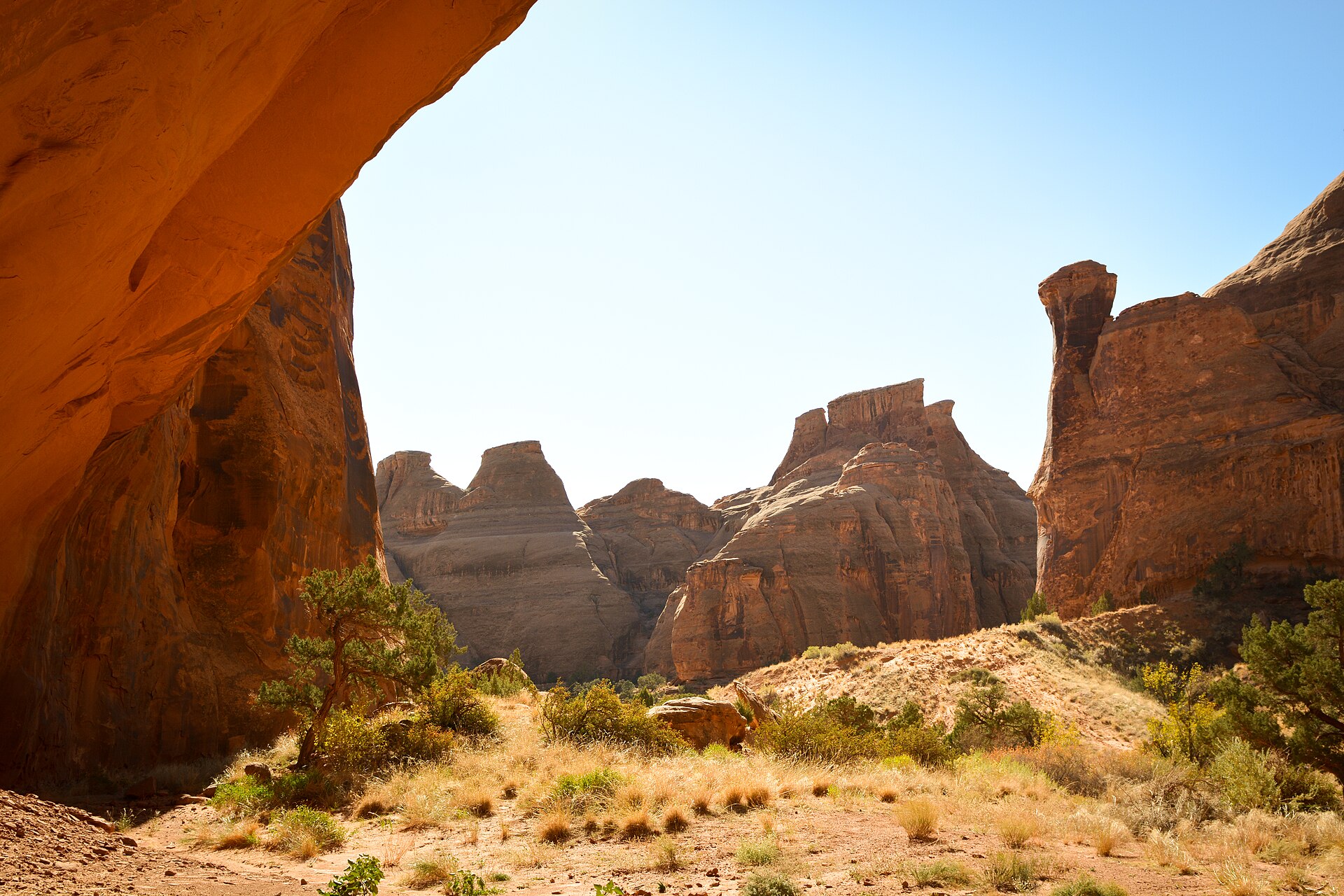
Underfoot it is the Moab mix: tilted slickrock, ledges you step up and down, rocky doubletrack and patches of sand. The race page promises technical slickrock and rocky climbs. Total gain is modest for a 50, under 100 feet per mile, so nothing here is a mountain. The difficulty is that rock never gives your legs a soft landing.
The race publishes a CalTopo map and a GPX file for each distance. Load the GPX on your watch. The course is marked with pink flagging and yellow directional signs, and the rules put knowing the course on the runner.
The 50K has its own official interactive map. Both, plus the GPX downloads, are linked from the race page.
Aid stations: 50 mile
From the 2026 official chart. Crew access is "No" at every single station.
| # | Aid station | Mile | To next | Crew | Drop bag | Cutoff | Notes |
|---|---|---|---|---|---|---|---|
| 1 | Gold Bar | 4.5 | 3 | No | No | — | After the opening climb. Turnaround for the 15K |
| 2 | Arth's Corner | 7.5 | 7.5 | No | No | — | Portable toilet. Fill up: longest gap of the first half is next |
| 3 | Gemini Bridges | 15 | 3.5 | No | Yes | 9:20 AM | Portable toilet. Drop your light and warm layers here |
| 4 | 7-Up | 18.5 | 6 | No | No | 10:40 AM | Aim to be gone by about 10:15 |
| 5 | US313 | 24.5 | 6 | No | No | 11:50 AM (chart says PM) | About halfway. Everything after this is heading home |
| 6 | 7-Up | 30.5 | 3.5 | No | No | — | |
| 7 | Gemini Bridges | 34 | 6.5 | No | Yes | 2:30 PM | Pick your headlamp back up |
| 8 | Arth's Corner | 40.5 | 5 | No | No | 4:10 PM | Portable toilet |
| 9 | Gold Bar | 45.5 | 4.5 | No | No | 5:25 PM | Sunset is around 5:05 PM |
| 10 | Finish | 50 | — | Yes | — | 6:45 PM | Enchiladas |
One small conflict in the official chart: it lists 6 miles from the second Gemini Bridges stop to Arth's Corner, but the mile markers (34 and 40.5) are 6.5 apart. Plan for the longer number.
Aid stations: 50K
| # | Aid station | Mile | To next | Crew | Drop bag | Cutoff |
|---|---|---|---|---|---|---|
| 1 | Gold Bar | 4.5 | 3 | No | No | — |
| 2 | Arth's Corner | 7.5 | 7.5 | No | No | — |
| 3 | Gemini Bridges | 15 | 6 | No | No | — |
| 4 | Arth's Corner | 21 | 5 | No | No | 2:30 PM |
| 5 | Gold Bar | 26 | 4.5 | No | No | — |
| 6 | Finish | 30.5 | — | Yes | — | 6:00 PM |
What's on the tables: water, Skratch hydration mix, sodas, fruit, and salty and sweet snacks such as chips, candy and cookies. The official list does not mention hot food on course, so do not count on broth or quesadillas. If you need real calories at mile 34, they have to be in your vest or your drop bag.
Toilets: portable toilets at the Gemini Bridges and Arth's Corner aid stations. A Grand County ordinance quoted in the race rules requires solid human waste to be carried out, not buried. Put a waste bag in your vest.
Crew guide: the parking lot is your whole world
Read this twice, because it is different from almost every other guide on this site. Crews and spectators are not allowed on the course or at aid stations. The rules spell it out: no driving, walking or biking out to see your runner. Highway 313 is a public road and there is an aid station named for it, and that still does not make it a crew stop. The penalty lands on the runner, not the crew.
So a Dead Horse crew does three jobs: get the runner to the start, stay out of the way, and run a good finish line.
Getting there. From Main and Center in Moab, drive north on US-191 about 10 miles and turn left into the Gemini Bridges Road lot at Seven Mile RV Park. It is paved highway the whole way and any car can do it.
The parking plan (2026).
- The lot opens at 5:00 AM. Traffic inside is one way, counterclockwise. Pull forward into spaces and do not back in.
- The drop-off zone has a 30-second limit. Have the runner ready to step out.
- No cars may leave between 6:15 and 7:30 AM. If you are dropping a 50-miler and heading back to town, either be gone by 6:15 or expect to stay until 7:30.
- Until 10:00 AM, exiting cars may only turn right onto US-191.
- When the main lot fills, parking moves to the overflow lot across the highway. The walk to the start is about three quarters of a mile and uses the pedestrian underpass. Crossing the highway on foot is not allowed.
- Oversized vehicles and campers go to the overflow lot, full stop.
- No parking on the roadside, and no camping in the start/finish lot. Seven Mile RV Park next door takes reservations directly, and its sites are a short walk from the start.
Packet pickup and the drop bag. Friday 2:00 to 6:00 PM at the start line, or race morning from 5:15 AM. Bring photo ID; nobody else can collect a bib for you. The drop bag must be handed in on Friday. They are not accepted on Saturday morning, which catches people who drive in late.
Planning the day. A 6:00 AM starter will finish somewhere between early afternoon and 6:45 PM. In 2026 the winner ran about 6:09 and the last official finisher came in at 12:41. The entrance to Arches National Park is roughly five miles back toward town, and Dead Horse Point State Park and Canyonlands' Island in the Sky are up Highway 313, so the crew can have a real day and still be back with a warm jacket by mid-afternoon. We did not confirm cell coverage at the start or on the mesa, so agree on a meeting time and place before the gun rather than counting on a text.
At the finish. The race feeds finishers enchiladas, water and soda, and suggests bringing your own cooler because the lot is a long way from a store. Have dry warm clothes ready. Once the sun drops behind the cliffs the temperature falls fast.
Getting to Moab. From the Phoenix area it is roughly 470 miles and about eight hours by way of Flagstaff, Kayenta, Monument Valley and US-191 north through Bluff and Monticello (we have not timed it). Grand Junction is under two hours away and Salt Lake City about four.
Where poles help (and where they don't)
The 2026 race guide and FAQ say nothing about poles either way, so if they matter to you, ask the race directors before you pack them.
Honest take from the numbers: this is a running course, not a pole course. With 4,895 feet of gain spread across 50 miles and a 13:20 opening pace requirement, most people will be better off with free hands and a faster shuffle.
If you do use them:
- The climb out of the lot in the first few miles. The official numbers put the start at 4,564 feet and the 15K high point, on the way to Gold Bar, at 5,000.
- The rise between Arth's Corner and Gemini Bridges. The 30K turns around at Arth's Corner and tops out at 5,131 feet; the 50K, which adds only the Gemini Bridges section, reaches 5,768. So the biggest block of climbing on the course sits in that middle stretch.
- Slickrock ledges late in the day, when tired legs make step-downs clumsy.
- The only swap point is the Gemini Bridges drop bag at miles 15 and 34. There is no crew to hand them to, so anything you start with you carry for at least 15 miles. Folding poles are usually 13 to 16 inches collapsed, so check that yours fit the 12-inch bag limit before you count on it.
What the fine print and the results tell you
A note on sources: we could not finish a fresh sweep of Reddit threads and personal race reports before publishing, so this section sticks to what the official documents, the terrain and the 2026 results show. We will add runner-report detail when the guide is next updated.
- It is a big, fast field. UltraSignup's 2026 results list 275 finishers in the 50 mile and 585 in the 50K. The 50 mile was won in about 6:09 and the first woman ran about 8:07. The 50K was won in about 3:18, with the first woman near 3:53. Those are runnable-course times.
- Pick your 50K wave honestly. Waves are self-seeded by expected finish: top third, middle third, back third. The point is to thin out traffic before the trail narrows. Starting too far forward means being passed on rock for an hour.
- You share the mesa. Mag 7 is a working mountain bike system and Gemini Bridges is a popular jeep route. Expect riders and the occasional vehicle on the wider sections.
- Stay off the black crust. The knobbly dark soil beside the trail is cryptobiotic crust, a living layer that takes years to recover from a footprint. The rules treat cutting corners as a disqualifying offense.
- Slickrock is hard on the body in a specific way. There is no give in it, the camber changes every few steps, and the ledges load your quads on the way down. People who trained only on smooth dirt tend to notice it in the hips and feet well before mile 30.
- Cold start, mild afternoon. Mid-November mornings in Moab are typically near freezing and afternoons in the 50s. You will want gloves at 6:00 AM and will not want them at 10:00.
- No outside aid, anywhere. The rules bar receiving aid outside the official stations, and crews cannot be at the stations. In practice you are self-supported between tables.
- Results show finishers only. The posted list does not show how many 50-milers were pulled or dropped down, so we can't give a finish rate.
The finish line is decided here
The first 18.5 miles, and specifically Gemini Bridges at mile 15 by 9:20 AM. In most 50s the danger zone is the long afternoon low. At Dead Horse the race is won or lost before mid-morning, because the tightest pace requirement comes first and the hidden squeeze between 7-Up and US313 comes right after it.
Leave Gemini Bridges the second time (mile 34) before 2:30 PM, and the finish is yours to lose. From there you have 4 hours 15 minutes for the last 16 miles, just under 16 minutes a mile, past two aid stations you already know.
How not to DNF at Dead Horse
- Run the first 15 miles on purpose. Aim for Gemini Bridges by 9:00 AM. That is 12 minutes a mile, and it buys you 20 minutes you will want later.
- Do not linger at 7-Up. Fill bottles and go. Out by 10:15.
- Be fast at every table. With no crew, every stop is on you. Know what you want before you arrive: bottles open, trash out, food in hand, walking.
- Pack the drop bag for two visits. At mile 15, shed the headlamp, gloves and morning layer and take your midday food. At mile 34, take the headlamp back, plus a wind layer and enough calories to get home.
- Or just carry the light all day. A small headlamp weighs almost nothing, and carrying it removes the one mistake that can strand you: forgetting to grab it at mile 34. If you are anywhere near the cutoffs, you will be on slickrock after the 5:05 PM sunset, and following flags across bare rock in the dark is exactly what the organizer built the cutoffs to prevent.
- Eat from your own vest. Aid tables are snacks and fruit. Carry the gels, chews or real food you trained with, at least 200 calories an hour.
- Break it into tables. The longest stretch without aid is 7.5 miles. When the afternoon gets heavy, the job is only ever "get to the next one."
- Know your exit. If the 9:20 AM cutoff gets you, ask about dropping to a shorter finish instead of walking off angry. In the organizer's words, "No matter the distance, you'll earn every mile out here!"
Gear for this course
- A light rechargeable headlamp for the dark first hour and for any finish after about 5:15 PM.
- A hydration vest with two soft flasks big enough for a 7.5-mile gap and a day of your own food.
- A collapsible cup for soda at the cupless aid stations.
- Trail shoes with a rock plate and sticky rubber. Cushion matters more than lugs on slickrock.
- Thin running gloves and arm sleeves for a near-freezing start, both easy to strip off and stuff in the vest once the sun is up.
- A packable wind jacket for the last hour, when the sun is gone and you are moving slowly.
- Trail gaiters to keep sand out of your socks.
- Electrolyte drink mix in single-serve packets if you would rather not switch to the course drink on race day.
- Anti-chafe balm. Dry desert air and salt do the rest.
- A waste bag kit, because the county rule is pack it out.
- For the crew: a folding camp chair and a small cooler for the finish lot.
The van idea
Dead Horse is the rare race where a crew vehicle can't follow the runner at all, which makes the finish line the only place a crew can make a difference. A 50-miler comes off the mesa at dusk, cold, salty and a long way from a hotel shower.
That is where an AZ Ultra Van fits: a warm place to change, a fridge with real food and cold drinks, a bed to lie flat on, and compression boots before an eight-hour drive home to Arizona. Under the 2026 parking rules a van counts as an oversized vehicle and goes in the overflow lot across the highway, about three quarters of a mile from the finish by the underpass, so plan for that walk. It's a reservation-interest waitlist for now while we see which races people want it for, and availability isn't guaranteed. Add your name on the card above or at van.azsvinternal.com.
Dead Horse Ultra FAQ
When is the next Dead Horse Ultra? The 2026 race was Saturday, November 14, 2026. The 2027 date had not been announced when this guide was published. It is held in mid-November every year, so check the official race page.
What is the time limit for the 50 mile? 12 hours 45 minutes in 2026: a 6:00 AM start and a 6:45 PM finish cutoff, with six intermediate cutoffs beginning at mile 15 at 9:20 AM.
Can my crew meet me on the course? No. Crews and spectators are barred from the course and every aid station, and a violation disqualifies the runner. Crew can be at the start/finish only.
Are pacers allowed? No, at any distance.
Are there drop bags? One per runner, 50 mile only, at the Gemini Bridges aid station (miles 15 and 34). Maximum 12 x 12 x 12 inches, dropped off at Friday packet pickup. The 50K has none.
How long is the 50K, really? 30.5 miles on the official aid chart, with 2,805 feet of gain and a 6:00 PM finish cutoff.
How hard is it compared with other 50-milers? The terrain is moderate and runnable, with under 5,000 feet of gain. The cutoffs are what make it hard: you need roughly 15:18 per mile overall and 13:20 per mile for the first 15 miles.
Do I need a headlamp? For the 50 mile, yes. The start is about an hour before sunrise, and anyone finishing in the last 90 minutes before the cutoff will be out after sunset.
Where do I stay? Moab is 10 miles south with plenty of hotels, and Seven Mile RV Park sits beside the start. There is no camping in the race lot.
Related guides
- Moab 240: aid stations, cutoffs and crew, the other end of the Moab spectrum.
- Zion 100 and Bryce Canyon 100, for more Utah slickrock and hoodoos.
- Monument Valley Ultra 50K and Antelope Canyon Ultras, both on the drive up from Arizona.
- A 50-mile calorie budget, useful for a race where you carry your own food.
Who wrote this
Johnathon Lawson is a Gilbert, Arizona ultrarunner, track and cross-country coach and father of three, and a three-time 100-mile finisher: Zion 100, Mogollon Monster 100 (2025) and San Diego 100 (2026). He hasn't raced Dead Horse; this guide is researched from the official race materials and results. Follow his training on Strava, his results on UltraSignup, and AZ Ultra Adventure on YouTube and Instagram.
Sources: Dead Horse Ultra official page (Mad Moose Events); the 2026 race guide; the official aid station and cutoff document and FAQ; Triple Crown of Moab; UltraSignup event page and 2026 results. Pace figures are our own arithmetic from the published cutoffs. Sunrise, sunset and temperatures are typical mid-November values for Moab, not a forecast. Check the current runner guide before race week.
Some links are Amazon affiliate links. As an Amazon Associate we earn from qualifying purchases, at no extra cost to you.