 AZ Ultra Adventure
On this page
- Javelina at a glance
- Why people love it (and why it's sneaky hard)
- The finish-rate story: 12 years of data
- The course: one loop, five times
- Every aid station
- Crew guide: everything happens at Jeadquarters
- Pacers
- Drop bags
- Where poles help (and the rule)
- The finish line is decided here: JQ at mile 61.1
- Western States: qualifier and Golden Tickets
- What finishers say
- Gear and packing list for Javelina
- The van idea: base camp at Jeadquarters
- Javelina Jundred FAQ
Javelina Jundred is the biggest party in American trail running, and about half the people who start the 100-miler don't finish it.
Both are true at once, and the key to this race is understanding why. It's held on Halloween weekend ("Jalloween") in McDowell Mountain Regional Park, just north of Fountain Hills. It's five loops of the same desert trail. Your crew never has to move their car. There's a costume contest, a night rave at the far aid station, and a tent city full of people dressed as bananas. It's also completely exposed, it starts hot and gets cold fast, and every 20 miles it drops you back at the biggest, warmest, loudest aid station you'll ever see, full of chairs.
Over the last 12 years the 100-mile finish rate has ranged from 49.5% to about 66%. 2026 was the lowest of those: 374 finishers and 382 DNFs. At the front it was one of the closest races ever: both 100-mile races were decided by less than 90 seconds.
I'm a Gilbert-based 100-mile runner (Mogollon Monster, San Diego, Zion), and I train on the same Sonoran trails, but I haven't raced Javelina. This guide is built from Aravaipa's 2026 runner guide, the official race page, UltraSignup results going back to 2015, Western States' records and a stack of race reports. Where something for 2027 isn't announced yet, I say so.
If you want the shorter takes we've written over the past month, they're here: our original 2026 race-week guide, a first-time crew's guide to Javelina weekend, the Golden Ticket and Western States lottery explained, rain, forecasts and drop-bag myths, how to follow the race from home, and the 2026 results: 55 seconds. This page puts all of it in one place.
Javelina at a glance
| Next race | Halloween weekend, October 2027. The date wasn't announced when I wrote this. Western States already lists an October 2027 Javelina on its qualifying-race list |
| Where | Four Peaks Staging Area ("Javelina Jeadquarters"), McDowell Mountain Regional Park, Fort McDowell, AZ. About an hour from central Phoenix |
| Distances | 100 mile, 100K, and the Jackass Night Trail 31K (Saturday night) |
| 100 mile | Loop 1 is 22.3 mi, then four loops of about 19.4 mi. About 6,296 ft of gain. 30-hour limit |
| 100K | Loop 1 plus two standard loops (61.1 mi). About 3,956 ft of gain. 29-hour limit |
| Direction | All loops clockwise in 2026 |
| Starts (2026) | 100M wave 1 at 6:00 AM (Golden Ticket contenders and sub-24 hopefuls), wave 2 at 6:30 AM. 100K at 7:00 AM. 31K at 5:30 PM |
| Entry | First come, first served on UltraSignup with a waitlist, historically opening Jan 1. 2026 fees: 100M $525, 100K $375, 31K $195 (plus tax and fees) |
| Western States | The 100M is a qualifier (sub-30). 2026 was a HOKA Golden Ticket race: top 2 men and women, rolling down to 5th |
| Crew | Only at Jeadquarters. $100 canopy reservations |
| Pacers | 100M: after 3 loops or at sunset, whichever comes first |
| Drop bags | Jeadquarters and Jackass Junction only |
| Cupless | Yes |
| Records | 100M: Will Murray 12:10:12, Tara Dower 13:31:47 (both 2025). 100K: Rajpaul Pannu 7:15:53, Anna Louden 8:13:07 (both 2023) |
| Official | aravaiparunning.com/javelina, 2026 runner guide (PDF) |
Why people love it (and why it's sneaky hard)
Javelina was founded in 2003 by Geri Kilgariff. Jamil Coury took it over in 2008, and Aravaipa Running grew out of it a year later. Over twenty-plus years it has become two races in one:
- A fast, deep elite race. Golden Tickets, a course with few technical sections, and a field that now includes some of the best 100-mile runners in the world. The course records fell in 2025, and 2026 came down to 86 seconds for the men (Rob Molke 12:11:31 over Noah Dusseau) and 55 seconds for the women (Heather Jackson 13:48:29 over Carla Molinaro). Singletrack's recap video is called "Both Races Decided By Less Than 90 Seconds?!"
- A Halloween party that happens to have a 100-miler in it. Costumes, a Best Costume award (along with Best Team, Best Ass and Dead Last), a tent city, and the Jackass 31K night race that turns the far aid station into a rave from 6 PM to midnight. Aravaipa's own page calls the weekend "rated R." Take that seriously if you're bringing kids.
That combination makes it one of the best first 100-milers in the country: no big climbs, crew in one place, and loops you'll know by heart by loop 3. It also makes it a race where half the field quits. On a course this "easy," people go out too fast in heat they underestimated, and every loop ends at a warm, loud aid station with their crew and a chair waiting.
The finish-rate story: 12 years of data
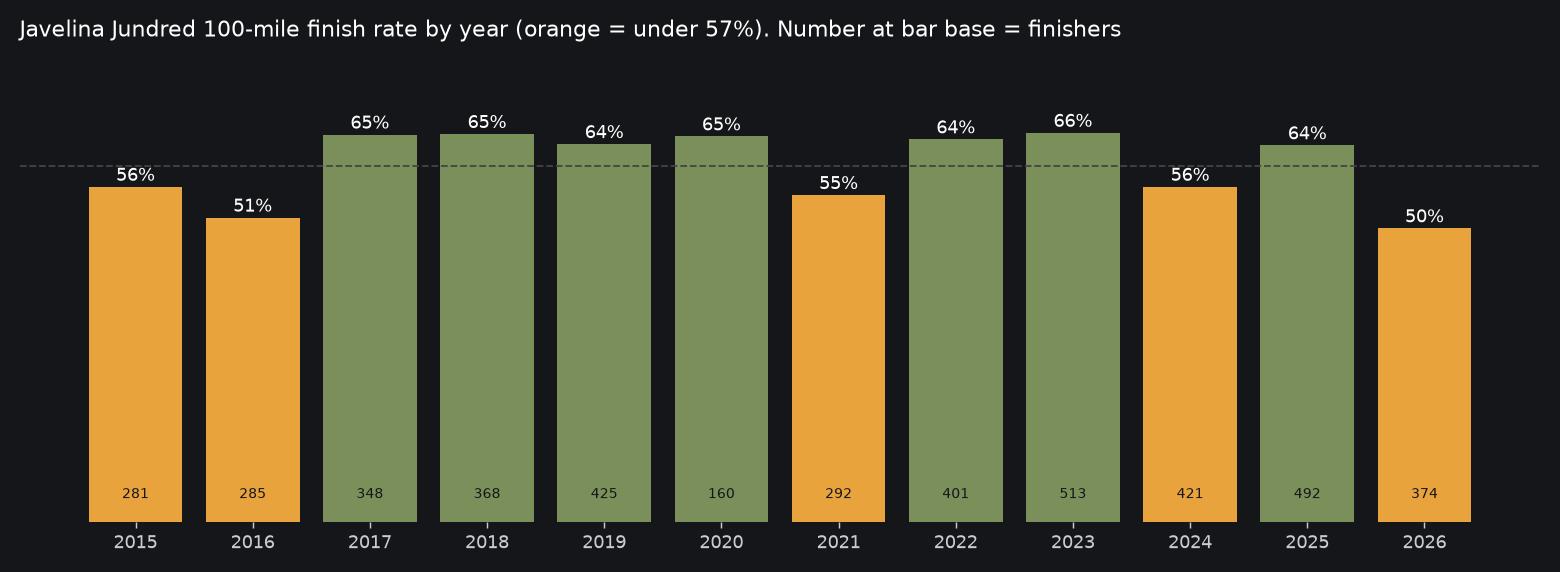
Chart: AZ Ultra Adventure, computed from UltraSignup results. Finish rate = finishers ÷ (finishers + DNF), DNS excluded.
| Year | Finishers | DNF | Finish rate | Sub-24 | Winners |
|---|---|---|---|---|---|
| 2026 | 374 | 382 | 49.5% | 198 | Rob Molke 12:11:31, Heather Jackson 13:48:29 |
| 2025 | 492 | 283 | 63.5% | 218 | Will Murray 12:10:12 (CR), Tara Dower 13:31:47 (CR) |
| 2024 | 421 | 324 | 56.5% | 173 | David Roche 12:45:04, Riley Brady 14:19:01 |
| 2023 | 513 | 269 | 65.6% | 219 | Jonathan Rea 12:43:10, Heather Jackson 14:24:47 |
| 2022 | 401 | 221 | 64.5% | 161 | Dakota Jones 12:58:02, Devon Yanko 14:36:10 |
| 2021 | 292 | 238 | 55.1% | 107 | Arlen Glick 13:14:51, Camille Herron 14:03:23 |
| 2020 | 160 | 86 | 65.0% | 66 | Tim Tollefson 13:28:04, Nicole Bitter 15:17:47 |
| 2019 | 425 | 242 | 63.7% | 151 | Patrick Reagan 13:11:48, Kaci Lickteig 15:32:31 |
| 2018 | 368 | 195 | 65.4% | 141 | Patrick Reagan 13:42:59, Darcy Piceu 18:49:06 |
| 2017 | 348 | 185 | 65.3% | 113 | Patrick Reagan 13:01:14, Larisa Dannis 16:32:17 |
| 2016 | 285 | 271 | 51.3% | 93 | Zach Bitter 13:30:28, Dana Anderson 21:03:13 |
| 2015 | 281 | 216 | 56.5% | 115 | Paul Giblin 13:49:17, Devon Yanko 14:52:06 |
Aravaipa's own guide says the historical finish rate has "hovered around 50%." On a good year it's about two in three. On a bad year it's a coin flip. The guide names the usual causes: heat on a course with no shade, starting too fast, sandy washes, and the temperature crash after sunset. Some years swing hard: the guide lists 98°F (2024) as the record high on race day.
In the 2026 100K, Cassandra De Winter was first overall in 7:44:45, which is faster than the listed women's course record. The official page hadn't updated its records when I checked.
The course: one loop, five times
Here's the official 100-mile map on CalTopo:
Also: 100K map, Jackass 31K map. The race doesn't post a separate GPX file; export it from CalTopo.
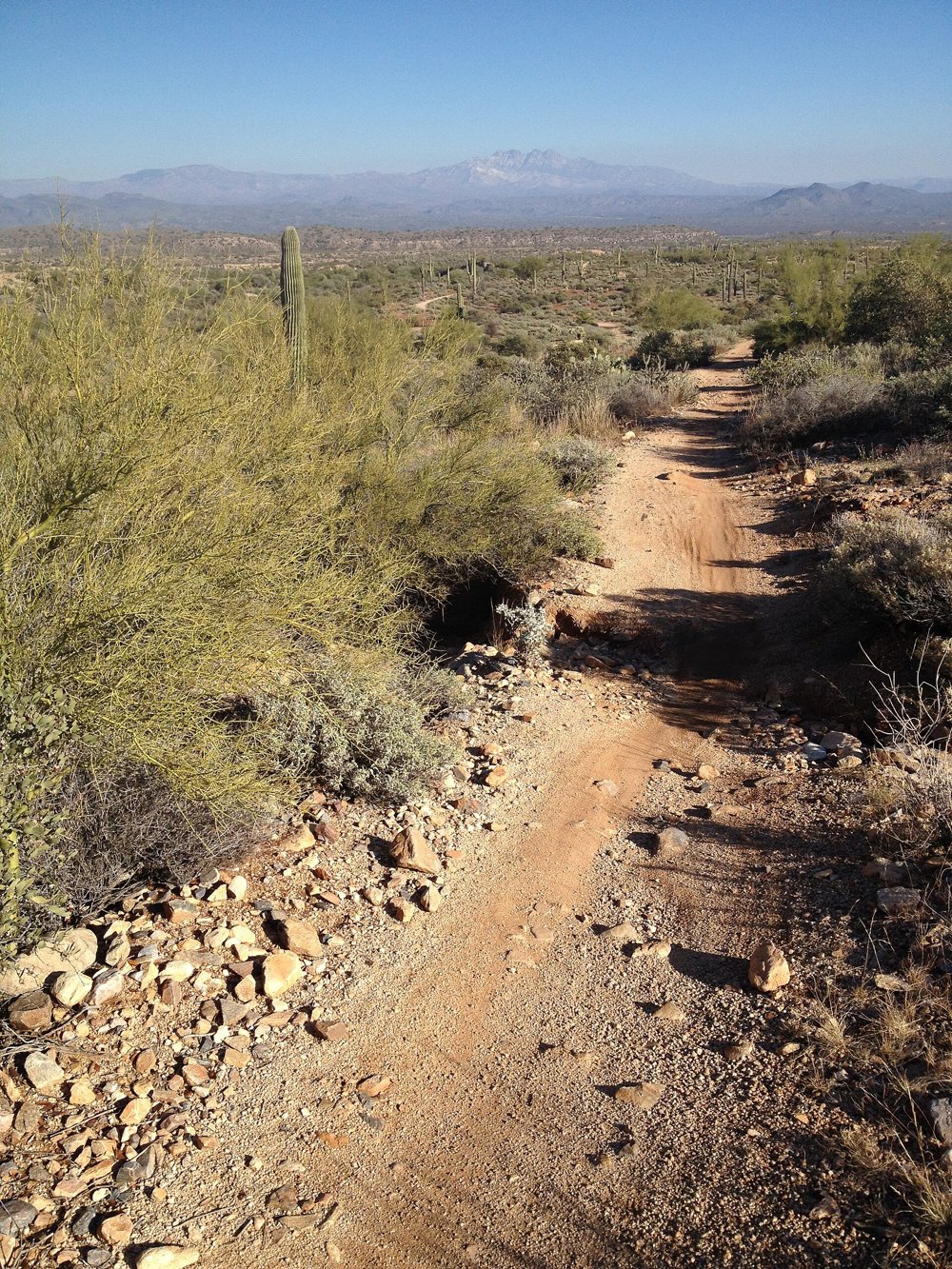
The loop: you leave Jeadquarters and climb gradually, about 800 ft over several miles, on the Pemberton Trail toward the McDowell foothills, through Coyote Camp to the far side of the loop at Jackass Junction, near Granite Tank. Then it drops through rocky sections and in and out of sandy washes past Rattlesnake Ranch and back to Jeadquarters on Pemberton and Cinch. The surface is mostly hard-packed decomposed granite with at least two miles of rocky trail per loop and sand in the washes. High point about 2,484 ft, low about 1,640 ft. The whole course is exposed. There's no shade.
Loop 1 is different: 22.3 miles, adding the Escondido Trail after Rattlesnake Ranch (turn left on loop 1 only). Loops 2-5 turn right after Rattlesnake and are about 19.4 miles.
Direction: the 2026 guide says all loops run clockwise only. If you've read older race reports about "washing machine" loops that alternate direction, or a "reverse loop 4," that format isn't used anymore. I couldn't find the year it changed.
Markings: orange-and-black polka-dot ribbon, blue-and-white checkerboard confidence markers, red "wrong way" signs, yellow junction signs, and reflectors about every tenth of a mile at night.
Every aid station
From the 2026 runner guide. Every loop passes the same four stations.
Loop 1 (22.3 mi):
| Aid station | Mile in loop | To next | Crew | Drop bag | Notes |
|---|---|---|---|---|---|
| Javelina Jeadquarters (JQ) | 0 | 4.0 | Yes (only crew point) | Yes | Start/finish, timing, medical HQ, the big food menu |
| Coyote Camp | 4.0 | 6.5 | No | No | Medical. Longest gap on the course next, climbing on rocky trail |
| Jackass Junction | 10.5 | 5.2 | No (party/spectator zone only) | Yes | About halfway around. Medical. Night party 6 PM to midnight |
| Rattlesnake Ranch | 15.7 | 6.6 (loop 1, via Escondido) | No | No | Turn LEFT onto Escondido on loop 1 only |
| JQ | 22.3 | – | Yes | Yes |
Loops 2-5 (about 19.4 mi): JQ (0) → Coyote Camp (4.0) → Jackass Junction (10.5) → Rattlesnake Ranch (15.7) → JQ (19.4). Gaps: 4.0, 6.5, 5.2, 3.7.
Cumulative 100-mile miles:
| Loop | Coyote Camp | Jackass Junction | Rattlesnake Ranch | JQ (end of loop) |
|---|---|---|---|---|
| 1 | 4.0 | 10.5 | 15.7 | 22.3 |
| 2 | 26.3 | 32.8 | 38.0 | 41.7 |
| 3 | 45.7 | 52.2 | 57.4 | 61.1 |
| 4 | 65.1 | 71.6 | 76.8 | 80.5 |
| 5 | 84.5 | 91.0 | 96.2 | 99.9 (finish) |
Cutoffs (2026, by wave gun time):
- 100M: you must start loop 5 (JQ, mile 80.5) by 6:00 AM Sunday (wave 1) or 6:30 AM (wave 2). Final cutoff 12:00 PM / 12:30 PM Sunday (30 hours). Sub-24 buckle: finish within 24 hours of your wave's start.
- 100K: start loop 3 (mile 41.7) by 6:00 AM Sunday. Final cutoff 12:00 PM Sunday.
- A 100-mile DNF doesn't earn a 100K result or buckle.
Food: GU Roctane and liquid gels, Gatorade, electrolyte caps, fruit, chips, soda, potatoes, bean burritos, PB&J and soup at every station. JQ and the main stations add sandwiches, burgers and pizza. The race is cupless: bring your own cup or bottle.
Carry enough water: the guide recommends at least 50 oz on loop 1 and 70 oz on loops 2-3, because of the 6.5-mile stretch from Coyote Camp to Jackass Junction in the heat of the day.
Medical: MedStar has teams at JQ, Coyote Camp and Jackass Junction. The guide says to call MedStar Command (480-269-4126) instead of 911 on course. Dropping at a remote station means waiting for a shuttle, which can take "up to an hour or more."
Crew guide: everything happens at Jeadquarters
Javelina is the easiest 100-miler in Arizona to crew, and the logistics are still the thing new crews get wrong. Here's the setup:
- Crew is allowed only at Jeadquarters. Your runner comes through about every 20 miles: at 22.3, 41.7, 61.1, 80.5 and the finish. There's no crewing at Jackass Junction. It's a party and spectator spot, and you may see crews out there, but that's not crew access.
- Crew canopy spaces cost $100 to reserve (one 10x10 per reservation, up to four runners recommended per canopy) and are booked at registration. Setup is by time-slot check-in Thursday (12-3 PM in 2026) or Friday from 7 AM. No tents in the crew zones. Decorate your canopy so your runner can spot it at 3 AM.
- No crew? There are two Community Crew Zones (shade, tables, chairs) and a Solo Runner Tent.
- No pets anywhere on site, including in vehicles. Aid station food is for runners and pacers.
Getting in and parking: in 2026, no vehicles could reach JQ on race day, and there was no drop-off zone. Everyone parked along the main park road and rode the race shuttles (Friday 8 AM-6 PM, all day Saturday, until noon Sunday). Plan on carrying everything from the shuttle stop, so a folding wagon earns its keep.
Park entry: one vehicle entry comes with registration. Additional vehicles pay the county park fee (the race page says $7 per day, the guide says $10, so bring $10 cash per car or check Maricopa County Parks).
Camping at the race (reservations open with registration, usually Jan 1):
- Tent City: rent a pre-pitched tent, with cots and sleeping bags optional.
- Bring-your-own tent permit (Fri-Sun).
- RV dry camping from Thursday.
- Car camping in the Competitive Lot (no in-and-out on race day).
- No generators or open flames.
Cell service: a race report noted spotty coverage at the park and glitchy live results when the crowd is biggest. Download the tracker before you go and plan on your runner's estimated times, not live dots. We wrote a whole post on following Javelina hour by hour.
The crew's real job is the 20 minutes their runner spends at JQ each loop. Have a plan for each one (more on that below).
A Javelina crew base is basically a 30-hour tailgate in a place you can't drive to on race day. A crew van that arrives Friday solves the obvious problems: shade at 2 PM, a fridge so ice and cold drinks last until Sunday, a heater and warm layers when it drops into the 40s at night, a bed for the crew between loops, and somewhere for the runner to lie down with compression boots on afterward instead of riding a shuttle.
Pacers
- 100M: pacers can join after three loops (61.1 mi) or at sunset, whichever comes first. In practice, if your runner leaves JQ at 5 PM or later, they can take a pacer on loop 3.
- 100K: after two loops or at sunset.
- Pickup and drop-off only at JQ. A pacer runs a full loop (about 19.4 miles), one at a time, on foot. Pacers sign a waiver and wear a "Pacer" bib. No muling.
- No pacers in the 31K.
If you only have one pacer: loop 5 is the obvious choice for the finish line, but loop 4 (61-80, the middle of the night) is usually the one that decides whether there is a loop 5. If your pacer can do two loops, take loops 4 and 5.
Drop bags
- Only at JQ and Jackass Junction. None at Coyote Camp or Rattlesnake Ranch.
- Jackass Junction bags are due at the start line by 5:30 AM Saturday. They come back to JQ by 1:00 PM Sunday, or earlier if you toss yours in the "Discard" bin. 2026 introduced scannable bag tags.
- No big duffels, suitcases or coolers.
- The guide's advice: drop JQ bags off Friday, because race morning is chaos.
Since your crew is at JQ every loop, the Jackass bag is the one to think about. It's halfway around the loop, 10.5 miles from JQ. Put in a long-sleeve layer and a light for whichever loop you'll be on as the sun goes down. Some runners put a spare headlamp there in case the first one fails.
Where poles help (and the rule)
Poles aren't allowed on the first two loops except in special circumstances (per the official page). After that, they're legal from loop 3 on.
Do you need them? The climb from JQ toward Jackass is gradual, about 800 ft over the first half of each loop. Most runners don't use poles at Javelina. They're worth considering if:
- You hike the climbs on loops 4 and 5 anyway and your legs are shot, or
- You have a history of quad or hip trouble late in races.
If you want them, leave them in your crew tent at JQ and grab them at mile 41.7 (the start of loop 3) or 61.1. Collapsible poles are best because you can stow them for the runnable descent through the washes after Jackass.
The finish line is decided here: JQ at mile 61.1
This race doesn't have a hard climb that ends your day. It has a chair, and it's waiting for you at Jeadquarters.
The pattern that shows up in reports and in the guide's own advice:
- Loop 1, 6 AM-ish to noon: cool, fresh, everyone in costume, the party at the start. People run it like a 50K. That's how it happens.
- Loops 2 and 3, midday to dusk: fully exposed, warm to hot (82°F is the average high; it has been 98°F), and you're now 30-60 miles in. Race reports call loop 3 the slowest and hardest, going from afternoon heat into dark.
- JQ at mile 61.1, around dusk or after dark: you've been out 12-17 hours. The sun's gone, the temperature has dropped 20-30 degrees, the crew has warm food and a chair, the rave is going, and you have two more full loops. This is where "I'll just sit for a minute" becomes a DNF.
How not to quit at Javelina:
- Walk the uphills on loop 1. That's straight from the race's own tips. Every minute you "bank" on loop 1 costs you ten later.
- Ice, every station, every daylight loop. Ice in your hat, ice in a bandana around your neck (former course record holder Patrick Reagan swore by it in an UltraRunning column), ice in your sports bra or pack. Put ice on your skin, not in your stomach: the guide warns that ice-cold water in the heat causes GI trouble.
- Carry 70 oz on loops 2 and 3. The 6.5 miles from Coyote to Jackass is long in the sun.
- Grab a layer for any loop that starts after 3 PM. The guide says plainly that runners get hypothermia every year. Temperatures can fall from the mid-80s to the mid-40s within hours. Sweat-soaked runners in shorts get very cold in the sand washes at 2 AM.
- The 5-minute JQ rule. Your crew should know it: sit if you need to, but a timer starts. At 61.1, eat something hot, change your shirt, take your headlamp and pacer, and go.
- Loop 4 is a "just get to Jackass" loop. Don't think about 39 miles. Think about 10.5 miles to the party, where there's a warm light and your drop bag.
- Leave JQ at 80.5 and you're finishing. If you start loop 5 before the cutoff with any kind of walk left in you, you have 19.4 miles and usually at least six hours. That's 18-minute miles. Walk it in.
Sand and feet: sandy washes on every loop add up. Wear gaiters, and change socks at JQ after loop 2 or 3. The guide's tip is to train on sand before the race.
Cutoff math: the only intermediate cutoff is starting loop 5 by 6:00 AM (wave 1). That means you need to cover 80.5 miles in 24 hours. If you're on the bubble, the time you spend in the JQ chair after loops 3 and 4 is what decides it.
What crews should say at mile 61: "You don't have to feel good. You just have to leave. Your pacer's ready." Then hand them the soup and point at the trail.
Western States: qualifier and Golden Tickets
- Qualifier: a sub-30 Javelina 100-mile finish counts as a Western States qualifier. The October 2027 edition is already on wser.org's qualifying-race list for the 2028 lottery.
- Golden Ticket: the 2026 race was a HOKA Golden Ticket race (top 2 men and top 2 women, rolling down to 5th if someone declines). 2027 Golden Ticket races hadn't been listed yet. We explained the whole system in Javelina's Golden Ticket and the Western States lottery.
- As a Golden Ticket race, Javelina is also testing anti-doping procedures, with USADA links on the official page.
What finishers say
Reddit came up empty for current Javelina threads when I looked, so these are from finishers' race reports, the race guide and UltraRunning coverage:
- Start well back. That's the first piece of advice in Team RunRun's report, and it lines up with the race's own warning about starting too fast. Let loop 1 feel slow.
- Same loop, same spot means easy crew logistics. A first-timer's report makes the point that crewing here is simple. The hard part is the runner's own discipline at JQ.
- Reapply sunscreen and lube at JQ every loop. Thirty hours of sand, sweat and Arizona sun.
- One bottle at night is fine; carry more in daytime. That's from a Team RunRun report, and it matches the guide's fluid advice.
- The descent after Jackass is rocky, and falls happen there at night. Take a brighter light than you think you need.
- Book the race hotel early if you're not camping. The same first-timer report says it books up early.
Video:
More: Aravaipa's 2026 race brief, Mountain Outpost's 2025 film, The Year The Records Fell, Ryan Van Duzer's 2024 race, Des Linden's 100-miler and Brice Ferre's first 100. Written: Team RunRun's "what to expect" report and a first-timer's report. For race photos, use Aravaipa's official galleries linked from the race page.
Gear and packing list for Javelina
Picks for this course. These are Amazon affiliate links; AZ Ultra Adventure earns a small commission if you buy, at no extra cost to you.
- Cooling. An ice bandana and a sun hat with a neck cape. These are the two most useful items for loops 2 and 3.
- A vest that carries 70 oz. A running vest with soft flasks or a 2L bladder vest.
- Collapsible cup. It's cupless. A silicone running cup.
- Gaiters. Sand washes on every loop. Short trail gaiters.
- Headlamp plus waist light. Rocky descents after Jackass. A rechargeable trail headlamp and a waist light.
- Night layer. A long-sleeve sun shirt for day, a packable wind jacket for night.
- Anti-chafe. A stick of anti-chafe balm. Thirty hours of sand and sweat.
- Electrolytes. Electrolyte capsules.
- For the crew canopy. A 10x10 pop-up canopy (if you're renting a space), canopy weights, folding chairs and a folding wagon to get it all from the shuttle.
- The costume. Pick one you can run in for 22 miles, or at least loop 1. Lightweight wins.
The van idea: base camp at Jeadquarters
Javelina is the race where crew comfort decides finishes. Your runner sees your setup five times, and each time it's either a place that gets them back out or a place that makes them want to stay. An AZ Ultra Van set up as a crew base camp means shade and fans by day, a fridge of cold drinks and real food, heat and dry clothes by night, a bed for the crew between loops, and compression boots for the runner on Sunday.
We're testing demand with a reservation-interest list, and nothing is guaranteed yet. If you'd use one at Javelina, the card in the crew section is how to tell us.
Javelina Jundred FAQ
When is Javelina Jundred 2027? Halloween weekend in October 2027. The exact date hadn't been announced when I wrote this (2026 was Oct 31-Nov 1). Registration has historically opened January 1 on UltraSignup.
How hard is Javelina compared to other 100s? About 6,300 ft of climbing and very little technical trail, so it's one of the "easier" 100-mile courses. But heat, exposure, sand and the loop format push the finish rate down to around 50-65%. 2026 was 49.5%.
Can crew go to Jackass Junction? No. Crew is only allowed at Jeadquarters (JQ), the start/finish. Jackass Junction is a drop-bag station and a party/spectator zone.
When can I have a pacer at Javelina? In the 100 mile, after three loops (mile 61.1) or at sunset, whichever comes first. Pickup and drop-off are only at JQ, one pacer at a time, wearing a pacer bib.
Are trekking poles allowed? Not on the first two loops, except in special circumstances. They're allowed from loop 3.
Is Javelina a Western States qualifier and a Golden Ticket race? It's a qualifier (sub-30). The 2026 race was a HOKA Golden Ticket race for the top 2 men and women. Check wser.org for the 2027 list.
Do the loops alternate direction? Not anymore. In 2026, all loops were run clockwise.
Is Javelina good for a first 100? Yes, if you respect the heat and the chair. It's one of the most popular first 100s in the country: crew is in one place, the climbs are small, and you learn the loop by heart. Just walk the uphills on loop 1.
Who wrote this
Johnathon Lawson is a Gilbert, Arizona ultrarunner, middle school track and cross-country coach, and father of three who trains before dawn on the same Sonoran trails as Javelina. He's a three-time 100-mile finisher: Zion 100 (2025), Mogollon Monster 100 (2025) and San Diego 100 (2026, 28:37). He hasn't raced Javelina; this guide is built from the official race materials, results and finishers' reports. Follow his training on Strava, see his race history on UltraSignup, and find AZ Ultra Adventure on YouTube and Instagram. More 100-mile guides: Mogollon Monster 100, San Diego 100, Zion 100.
Sources: Aravaipa Running, Javelina Jundred page and 2026 runner guide (course, aid stations, cutoffs, crew, pacer and drop-bag rules, weather); UltraSignup results 2015-2026 (finish rates computed by us); Western States qualifying races and Golden Ticket races; UltraRunning, "One Hundred Mile Wisdom"; reports linked above. 2027 details may change. Check the race's current runner guide before race week.
Some links are Amazon affiliate links. As an Amazon Associate we earn from qualifying purchases, at no extra cost to you.