 AZ Ultra Adventure
On this page
A 50K is 31 miles. In Arizona that can mean a mostly paved loop just under a mile long with about 22 hours to finish it, or 5,171 feet of climbing in the White Tanks with a 10:30 AM cutoff at mile 14.
Both hand you the same word afterward: ultrarunner. They are not the same first day.
We have guides to more than 40 Arizona and Southwest races. This post pulls the beginner-friendly 50Ks and shorter races into two tables, says which to save for later, and lays out a plan: a 12 to 16 week build, what to eat, and what race morning looks like.
I've run three of the races in here: the Copper Corridor 50K twice, the Adrenaline Night Runs 50K once, and the 50-mile at Pass Mountain yesterday. Where I talk about those, it's first-hand. Everything else comes from our race guides and the official race pages.
What makes a 50K friendly to a first-timer
Five things, in the order I'd weigh them.
1. A clock you can walk under. Divide the time limit by the distance. Nine hours for 31.7 miles is 17:02 per mile, which is a mix of easy running and steady hiking. Fifteen hours for 31.2 miles is almost 29 minutes per mile, which is a slow walk with long breaks. If your long-run pace on trail, stops included, isn't comfortably under the number, pick a different race.
2. Loops through the start/finish. Your car, your drop bag, a real bathroom and anyone who came to cheer are never more than 10 to 15 miles away. The cost is that you pass the finish line before you're allowed to cross it.
3. Smooth trail and modest climbing. The friendly desert 50Ks run 2,000 to 3,900 feet of gain on singletrack you can actually run. Past 5,000 feet it becomes a different sport.
4. The right month. November through February in the low desert. A first ultra is hard enough without heat.
5. Simple logistics. One parking lot. No bus to a remote start, no dirt-road crew drive, no navigation.
No race here gets all five.
The table: eight Arizona 50Ks for a first ultra
"Pace needed" is the full time limit divided by the distance. It includes every aid station stop, shoe change and bathroom line.
| Race | Next date | Miles / gain | Format | Time limit | Pace needed |
|---|---|---|---|---|---|
| McDowell Mountain Frenzy 50K, Fountain Hills | Dec 5, 2026 | 30.8 / 3,020 ft | One start/finish lot, drop bag at mile 22 | Finish by 11:00 PM (about 15 h) | ~30:00/mi |
| Pass Mountain 50K, Mesa | Mid-November (2026 was Nov 14; 2027 not posted) | 31.2 / 2,680 ft | Two 25K loops | 15 h (10:00 PM) | ~29:00/mi |
| San Tan Scramble 50K, Queen Creek | Jan 9, 2027 | 31.7 / 3,876 ft | Three 17K loops, alternating direction | 9 h (4:00 PM); start lap 3 by 1:00 PM | ~17:00/mi |
| Fat Ox 50K, Goodyear | Nov 21, 2026 | 31.1 / about 6 ft per lap | 0.99-mile paved loop | Event ends 8:00 AM Sunday (about 22.5 h) | ~43:00/mi |
| Black Canyon 50K, Mayer to Black Canyon City | Feb 14, 2027 | 32.2 / +2,004, −4,005 ft | Point to point, bus to the start | 11 h | ~20:30/mi |
| Adrenaline Night Runs 50K, Fountain Hills | May 22, 2027 | 30.5 / 2,163 ft | Long loop plus short loop, twice | 10 h (5:00 AM) | ~19:40/mi |
| Copper Corridor 50K, Superior | Feb 27, 2027 | 30.1 / 3,121 ft | One big loop from Main Street | 9 h (4:00 PM) | ~18:00/mi |
| Tucson Marathon 50K, Oracle to Tucson | Dec 13, 2026 | 31.6 / +445, −1,942 ft | Point to point on road | 7.5 h | ~14:15/mi |
Fat Ox doesn't publish a separate 50K cutoff: the 50K starts Saturday at 9:30 AM and everything ends at 8:00 AM Sunday, so confirm with the race if your plan depends on it.
How to read it
The safest trail finish: McDowell Mountain Frenzy or Pass Mountain. Both give a 50K runner until late evening. At Frenzy, our guide describes the 50K and shorter distances as fast, flowing desert singletrack with short punchy climbs. Pass Mountain is two laps of a 25K loop at Usery with one real climb per lap. The catch at Pass Mountain is the stretch from Meridian aid back to the start/finish: almost 9 miles by the aid chart (6.9 to 15.7), and it includes the climb over the pass. Also, sunset in November and early December is around 5:20 to 5:30 PM, so anyone using the back half of those time limits finishes by headlamp.
The easiest day for your people: San Tan Scramble. Three laps, crew and drop bag at the start/finish every 10.6 miles, aid every 2.2 to 5.1 miles, and it's the East Valley's backyard race. The clock is honest, though. You have to leave on your third lap by 1:00 PM, which is 21.2 miles in 6 hours, right at 17 minutes a mile. Our guide says the start/finish at mile 21.2 is where most San Tan 50K DNFs happen: two laps done, your car in the lot, the shorter-distance runners already eating.
Coming from road marathons: Tucson 50K or Black Canyon 50K. Tucson is a road ultra that drops about 1,940 feet and climbs about 445, with aid every couple of miles. It also has the tightest clock in the table, so it suits someone who already runs marathons. Black Canyon's 50K is trail, net downhill by 2,000 feet, with 11 hours and a big-race atmosphere. It costs more ($250 to $280 depending on when you register, with a price step on December 1) and you ride a bus to the start.
You only care about covering the distance: Fat Ox. A flat, certified, mostly paved loop that passes the aid station every lap, with most of a day to get it done. It isn't a trail race, but nobody gets lost or runs out of water.
The honest "it depends" picks: Copper Corridor and Adrenaline. These are the two 50Ks I've actually run, so here's what the results say.
Copper Corridor is a runner's course: about 3,100 feet of gain over 30 miles, a lot of it jeep road and smooth singletrack. I ran 4:28:35 there in 2023 and 4:44:42 in 2025. It's one of the best 50Ks in the state. For a first-timer it has two problems. There's an 11.9-mile stretch without aid between Picketpost (mile 11.4) and Telegraph Canyon (mile 23.3), and you must reach Telegraph by 1:30 PM, which is 6.5 hours for 23.3 miles. It also sold out in 2026 because permits cap the field. If you have a marathon or a trail 25K behind you, it's a great first 50K. If you plan to hike most of it, pick something else.
Adrenaline has the least climbing of any trail 50K in the table (2,163 feet), loops through the start/finish three times, and lets a pacer join you for the last short loop. It also starts at 7:00 PM in late May, and most of Aravaipa's summer night races start in the 90s or hotter. My result there was 6:15:55 in 2026. Compare that with my Copper Corridor times: the same runner was at least 90 minutes slower on the course with about a thousand fewer feet of climbing. Heat and a headlamp cost time. Pick Adrenaline for a first ultra only if you already train at night through the Phoenix summer.
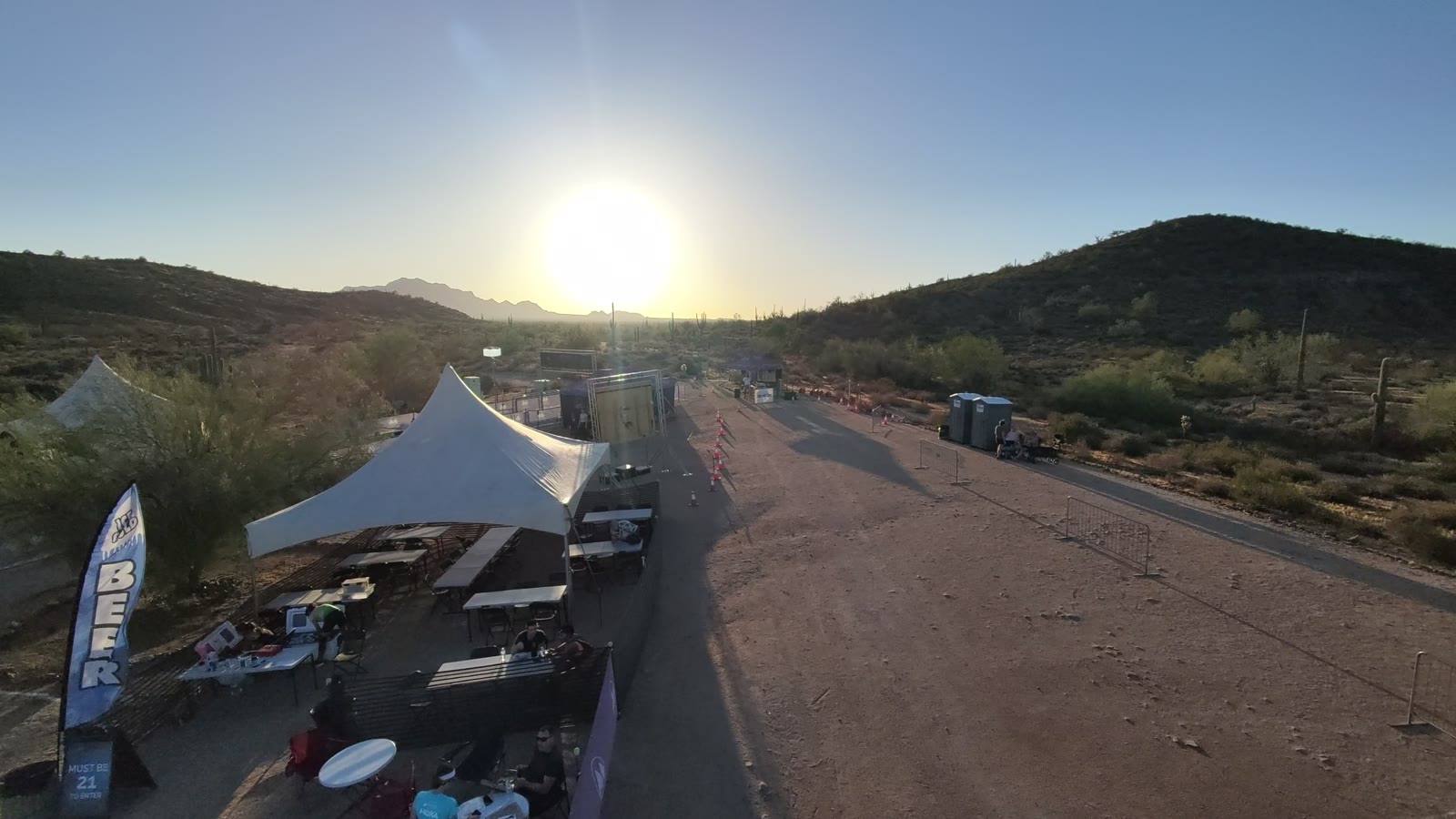
Two more that didn't fit in the table. The Elephant Mountain 50K in Cave Creek (February 6, 2027; 31.0 miles, 3,808 feet) lets you finish as late as 10:00 PM if you leave for the final 7.2-mile loop by 6:30 PM. And for summer, the Big Pine 50K in Flagstaff (June 19, 2027) loops through ponderosa pine at about 7,000 feet, with a 2:15 PM cutoff at mile 22.5 and pacers allowed on the last loop.
Save these for your second or third
- Mesquite Canyon 50K: 5,171 feet of gain, technical washes, and a 10:30 AM cutoff at Goat Camp.
- Crown King Scramble: uphill point to point with strict cutoffs, and your crew can only meet you at the finish.
- PhoMo 50K: 50 runners, mostly self-supported, about 5,500 feet, navigation by GPX.
- Cave Creek Thriller 50K: the Anthem aid station at mile 16 closes at 11:00 AM, 4.5 hours in, and October can still be hot.
- Zane Grey: the roughest trail in the state. Earn it.
Not ready for 31 miles? Start shorter
Almost every race above has shorter distances on the same day, on the same trails, with the same aid stations. A trail 25K is the best rehearsal there is for a 50K: same parking lot, same cupless aid, same rocks, half the distance.
| Race | Date | Shorter distances | Why it's a good start |
|---|---|---|---|
| McDowell Mountain Frenzy | Dec 5, 2026 | 25K (15.3 mi, 1,305 ft), 10 mile (800 ft), 5 mile (500 ft) | The most runnable trails on this list |
| Mayhem Night Trail | Dec 5, 2026 | 25K, 10 mile, 5 mile | A cool-weather first try at running by headlamp |
| San Tan Scramble | Jan 9, 2027 | 26K, 17K (one lap, 10.6 mi), 9K, 5K | Run one lap this year, three next year |
| Arizona Trail Race 8 Mile, Vail | Feb 7, 2027 | 7.7 mi, 771 ft, 3-hour limit | A gentle first trail race on the Arizona Trail |
| Copper Corridor | Feb 27, 2027 | 32K (20.2 mi), 17K, 12K | The 32K is a real step toward 50K |
| Dam Good Run, Lake Pleasant | Apr 4, 2027 | 26K, 13K, 4 mile, 2 mile | A course that crosses the New Waddell Dam |
| Adrenaline Night Runs | May 22, 2027 | 25K (15.2 mi, 1,077 ft), 15K, 10K, 6K | Night running without the full 50K |
| Pass Mountain | Mid-November | 25K (1,336 ft), 10K, 5K | One lap of the 50K course |
The full list by month is in our 2027 Arizona ultra calendar.
Pick the race by counting backward
Today is November 15. From this weekend:
- San Tan Scramble is 8 weeks out. That's enough only if you're already doing 12- to 14-mile long runs.
- Elephant Mountain 50K is 12 weeks out.
- Black Canyon 50K is 13 weeks out.
- Copper Corridor 50K is 15 weeks out.
- Frenzy 50K is 3 weeks out. Run the 25K or 10 mile there instead, as a rehearsal.
So if you're starting a build this week, February is your month. Register early for the two February races: Black Canyon's price goes up December 1 and Copper Corridor has sold out before.
A 12 to 16 week build, in outline
This is an outline, not a prescription. I'm a runner writing down the structure that most 50K plans share, not your coach, and if you have a health condition or you're coming back from injury, talk to a doctor first.
For a reference point, Hal Higdon's free 50K program runs 26 weeks. It starts with a 10-mile long run, builds to 20 miles, then switches to long runs measured in time, peaking at 4 to 5 hours. It steps back every third week and deliberately puts a run on Saturday before the Sunday long run. The outline below compresses that idea for someone who already runs 8 to 10 miles comfortably, three or four days a week. If that isn't you yet, take the longer road.
| Weeks | Phase | Long run | What else |
|---|---|---|---|
| 1-4 | Base | 8 up to 12 miles | 3-4 runs a week, at least one on trail. Make week 4 easier |
| 5-8 | Build | 12 up to 16 miles | Start eating on every long run. Hike the climbs on purpose. Make week 8 easier |
| 9-13 | Peak | 16 up to 20-22 miles, or 4-5 hours, whichever comes first | Two back-to-back weekends (long Saturday, 6-10 easy miles Sunday). One long run in full race kit at race start time |
| 14-16 | Taper | About 12, then 8, then race day | Less volume, same routine, more sleep |
For 12 weeks: start at week 5. That only works if 12 miles is already a normal weekend for you.
A few things matter more than the exact mileage:
- Train on the surface you'll race on. If the race is at San Tan, Usery or McDowell Mountain, do long runs there. Rocky desert singletrack uses your ankles and your attention in a way a canal path doesn't. Our Phoenix trail-by-the-clock post helps you choose where.
- Practice hiking. Nearly every first-timer walks the climbs in a 50K. Walk them fast in training so it's a skill and not a surrender.
- Rehearse the dull stuff. The vest, the shorts, the socks, the breakfast, the 4:30 AM alarm. I wrote about fitting this around a family in 4 AM or never, and about dark-hour running in Arizona doesn't fall back.
- Respect the taper. My own race-week notes are in the Pass Mountain taper post.
Fueling basics, with real numbers
The marathon habit of a few gels and some water doesn't cover six to nine hours. The best single source I know is the International Society of Sports Nutrition's position stand on ultramarathon nutrition (Tiller and colleagues, 2019). Its headline numbers for racing:
- Calories: about 150 to 300 per hour for races up to 50 miles.
- Carbohydrate: 30 to 50 grams per hour.
- Fluid: 450 to 750 mL per hour, roughly 15 to 25 ounces, taken a little at a time.
- Sodium: drinks in the range of 500 to 700 mg per liter.
- How much to drink: the paper calls drinking to thirst the most appropriate way to avoid both under- and over-drinking. More water is not automatically better.
- Practice: it recommends training your gut, meaning you eat during long runs so race day isn't the first time.
Put that into a real day. A 7.5-hour 50K at 200 calories an hour is 1,500 calories, which is about fifteen gels at roughly 100 calories each, if gels were all you ate. Nobody wants fifteen gels. That's why ultra aid stations look like a kid's birthday party. At Aravaipa races the tables carry water, an electrolyte drink, sweet and salty snacks and fruit, and the runner in one Aravaipa blog report from the Pass Mountain 50K ate a PB&J and watermelon at the aid stations. Carry your own base supply of energy gels or chews and a tested electrolyte drink mix, then add real food at the tables.
Now the water math, because it decides what you carry. At 18 minutes a mile, Pass Mountain's long stretch from Meridian to the start/finish takes about 2 hours 40 minutes. At the low end of the ISSN range that's 1.2 liters, which is more than two standard 500 mL flasks. Copper Corridor's 11.9-mile gap at 15 minutes a mile is three hours. Read the aid chart, find the longest gap, and size your bottles to it.
Simple rules that work for most first-timers:
- Eat something every 30 to 40 minutes from the first hour, before you're hungry.
- Sip steadily and drink to thirst.
- Nothing new on race day. If you haven't eaten it on a long run, don't eat it at mile 20.
For a worked example at the next distance up, see my 50-mile calorie budget for Pass Mountain, and for the oddest thing in my own kit, whole chocolate milk.
What race morning looks like
Here's the shape of a morning at a park-based Aravaipa 50K, using San Tan Scramble's 7:00 AM start. Times shift by race; check the runner guide.
The night before. Lay everything out. Charge your watch. Fill your flasks. Put $10 where you can reach it, because Maricopa County parks charge $10 per vehicle and the McDowell Mountain booth is cash only.
About 5:45 to 6:00 AM. Arrive, having eaten the breakfast you practiced before long runs. The lots fill and several distances start within 90 minutes of each other. Park, get your bib if you haven't, and get in the bathroom line before it's long. It will be cold and still mostly dark; in early January the sun doesn't come up until about half an hour after a 7:00 start. Wear a layer you can stuff in your vest or leave in your drop bag.
6:40 AM. Drop bag down at the start/finish. Keep it simple: spare socks, a second set of food for each lap, sunscreen, anything you'd want if the day gets warm.
7:00 AM. Start near the back and walk the first climb even though you feel great. The Aravaipa blog report I mentioned came from a runner who ran her first Pass Mountain lap in 2:53, called it too fast, and then had to fight to keep running the flats on lap two. That is the most common first-50K story there is.
Every aid station. Bottles first, then food, then go. Two or three minutes. Aravaipa's trail races are cupless (our Frenzy and Adrenaline guides both confirm it), so carry a collapsible cup or drink from your own flask.
The start/finish pass. This is the real test on a loop course. Decide before the race what you'll do there: swap food, change socks only if you need to, and leave. Don't sit down. If someone came to help, their whole job at mile 21.2 is to hand you what you asked for and walk you to the timing mat.
That job is easier with a base to work from. On a loop course your crew sits in one spot for most of a day, so shade, a cooler and a chair matter more than a map.
The last lap. It's slower than the first two, and that's normal. Count aid stations, not miles. At San Tan the third lap has full aid at mile 26.2 and water at 29.4. Get to the next table.
What to buy, and what you don't need
You don't need poles for any race in the first table; the Frenzy guide says to leave them at home. You do need a few things that road running never asked for.
- A running hydration vest that holds at least a liter, with two 500 mL soft flasks up front. For the long gaps at Pass Mountain and Copper Corridor, add a third flask or a bladder.
- Trail running shoes with some protection underfoot. Buy them at least six weeks out and do your long runs in them.
- Trail running socks you've tested for four hours, plus a spare pair in the drop bag.
- Anti-chafe balm. Anywhere that rubbed a little at mile 12 will be raw at mile 28.
- A rechargeable running headlamp for dark training mornings, any night race, and any plan that uses the late hours of a 15-hour limit.
- A folding camp chair for whoever is waiting for you. Not for you.
For how I pack a vest for a full day at Usery, see Pack the vest.
FAQ
What is the easiest 50K in Arizona for a first ultra? By the clock, Fat Ox: a flat paved loop with most of a day to finish. On trail, the McDowell Mountain Frenzy 50K (finish by 11:00 PM, 3,020 feet) and the Pass Mountain 50K (15 hours, 2,680 feet) have the most forgiving limits, and San Tan Scramble has the simplest logistics.
How long does a first 50K take? Results at these races run from under 4 hours to the full time limit. Take your comfortable trail long-run pace, add stops, and check it against the "pace needed" column. If you're within a minute or two per mile of it, pick a race with a longer limit.
Do I need to run a marathon first? None of our guides for the races in the first table lists a qualifying race. A trail half or 25K first is more useful than a road marathon, because it teaches you the aid stations, the footing and the pacing.
How many weeks do I need to train for a 50K? Twelve to sixteen weeks if you already run 8 to 10 miles comfortably. Longer if you don't: Hal Higdon's 50K program is 26 weeks.
Do I need a crew or a pacer? No. Every race here has aid stations, and the loop courses bring you back to your own drop bag. Most of these 50Ks don't allow pacers at all; Adrenaline and Big Pine allow one on the final loop.
What comes after the 50K? Another 50K, usually. When you're ready to look further up, we compared every Arizona 100-miler for first-timers and listed the Western States and Hardrock qualifiers within a day's drive.
Who wrote this
Johnathon Lawson is a trail runner from Gilbert, Arizona, and the person behind AZ Ultra Adventure. He has finished three 100-milers: the Mogollon Monster 100 (2025, 30:56:11), the Zion 100 (2025, 28:34:36) and the San Diego 100 (2026, 28:37:12). Of the races compared here he has run the Copper Corridor 50K (4:28:35 in 2023, 4:44:42 in 2025), the Adrenaline Night Runs 50K (6:15:55 in 2026) and the Pass Mountain 50 Mile (14:14:53 on November 14, 2026). The rest is research from each race's official pages. Follow his training on Strava, his results on UltraSignup, and AZ Ultra Adventure on YouTube and Instagram.
Sources: our race guides linked above, which draw on the official pages; the current Aravaipa pages for San Tan Scramble, McDowell Mountain Frenzy and Pass Mountain, checked November 15, 2026; Tiller et al., ISSN position stand on nutrition for single-stage ultramarathon, 2019; Hal Higdon's 50K training program; and an Aravaipa blog race report from the 2015 Pass Mountain 50K. Dates, fees and cutoffs change every year, so check each race's current page before you register.
Some links are Amazon affiliate links. As an Amazon Associate we earn from qualifying purchases, at no extra cost to you.