 AZ Ultra Adventure
On this page
Arizona has a 100-miler with about 600 feet of climbing and one with 20,838. One gives you 72 hours. Another gives you 30 and, in 2026, sent more than half its starters home without a buckle. One has a rave at the far aid station. One doesn't let your crew see you between the start and the finish.
We now have a full guide to every Arizona 100-mile race we could find, and this post puts them next to each other. I've finished three 100s: Zion (April 2025), the Mogollon Monster (September 2025) and San Diego (May 2026). Only one of those is in Arizona, so for nine of the ten races below I'm a researcher who has read the runner guides, cutoff charts and results. For Mogollon I'm also a finisher, and I'll say so where it matters.
The numbers
Sorted roughly from the most forgiving clock to the least forgiving entry. "Average pace" is my own arithmetic: the time limit divided by the listed distance. Real cutoffs are tighter in places, so read each guide before you plan around it. Finish rate is finishers ÷ (finishers + DNFs), counted from the UltraSignup and RaceGoat results pages on November 15, 2026.
| Race | Next edition | Shape | Time limit (average pace it allows) | Climbing | Finish rate | 100-mile fee |
|---|---|---|---|---|---|---|
| Across the Years | Dec 28, 2026 to Jan 3, 2027. Start any morning through Jan 1 | 1.42-mile loop, about 71 laps | 72 h, or 48 h if you start Jan 1 (43:12/mi) | About 1,600 ft (23 ft a lap) | 71% to 76% of 100-mile entrants reached 100 in the last three editions. No intermediate cutoffs | $220 to $270 |
| Fat Ox | Nov 20-22, 2026. Online registration closed Nov 15 | 0.988-mile paved loop, about 101 laps | About 47 h (28:12/mi) | About 600 ft (6 ft a lap) | 58% in 2025 (21 of 36), 82% in 2024 (18 of 22). No intermediate cutoffs | $225 to $265 |
| Route 66 CenturyRun | Second Saturday of November, which would be Nov 13, 2027. Not announced | Point to point on road, about 103 mi | 48 h, no intermediate cutoffs (27:58/mi) | Not published for the 103. One real climb, about 900 ft to Sitgreaves Pass | Not published. New distance in 2026 | Not confirmed |
| Javelina Jundred | Halloween weekend 2027. Date not announced | 5 loops: 22.3 mi, then four of 19.4 | 30 h (18:00/mi) | 6,296 ft | 49.5% in 2026. Range 49.5% to 65.6% since 2015 | $525 in 2026 |
| Coldwater Rumble | Jan 16, 2027 | Red loop (10 mi) twice, Blue loop (27 mi) three times | 32 h (18:57/mi) | 8,687 ft | 62% in 2026, 67% in 2025, 68% in 2024 | $300 to $360 |
| Stagecoach Line 100 | Third or fourth weekend of September. 2027 not announced | Point to point, Flagstaff to Tusayan | 32 h (19:00/mi). Buckle under 31 h | About 7,000 ft. Starts at 7,400 ft and tops out at 8,800 | 58% in 2024 (61 of 105). The 2025 and 2026 results list finishers only | About $290 in 2026, per a third-party listing |
| Saddles 100 | Early October. 2027 not announced | One 100-mile loop around Prescott | 34 h (20:20/mi), with strict leave-by cutoffs | About 12,064 ft | 62% in 2026, 67% in 2025, 56% in 2024 | Check UltraSignup |
| Mogollon Monster | Sept 11, 2027 | Point to point, the Rim to Pine | 38 h (22:30/mi) | 15,900 ft | 57% in 2026, 63% in 2025, 61% in 2024 | $395 to $425 |
| Bradshaw Brute 100 | May 2, 2027 | Point to point, Black Canyon City to Prescott | 38 h (22:48/mi) | 20,838 ft | 70% in 2026 (30 of 43), the only edition with results | $495 to $555 |
| Desert Solstice | Dec 19-20, 2026 | 400 m track, about 402 laps | 24 h (14:24/mi). Entry by invitation or qualifying mark | None | Not applicable | $325 |
The edition-by-edition counts behind these rates are in our finish-rate ranking.
The conditions
| Race | Underfoot | Weather | Crew job | Pacers | Western States qualifier |
|---|---|---|---|---|---|
| Across the Years | A mix of dirt path, concrete and asphalt | Late December. Past editions have ranged from 20°F to 78°F | Easiest. Camp beside the loop, runner passes every 15 to 30 minutes | None. A guest bib covers one lap | No |
| Fat Ox | Paved sidewalk with a few short dirt stretches | Typical highs 70-75°F, lows 50-55°F | Easiest. Free crew spot on the loop, runner passes every 10 to 15 minutes | Not allowed | No |
| Route 66 CenturyRun | Pavement and road shoulder, open to traffic | November nights on the high desert, finishing at 477 ft on the Colorado River | The hardest job in the state. A crew of two to four leapfrogs you in a vehicle, and they are the aid station | Crew members only | No |
| Javelina | Hard-packed decomposed granite, some rock, sandy washes, no shade | Average high 82°F, record 98°F in 2024, cold after sunset | Easy. One location, $100 canopy reservations, shuttle in from the park road | After 3 loops or at sunset | Yes (30 h) |
| Coldwater | Rockier desert singletrack, cholla, up to 2 miles of sand per Blue loop | Days in the 60s to mid-70s, nights near 40°F, about 13 hours of dark | Easy. Rumble HQ plus one drive to Horse Thief | After mile 47 | No |
| Stagecoach | Arizona Trail singletrack and two-track, rocky in places, very exposed | Average highs near 70°F and lows near 35°F. Rain, sleet and hail in 2024 | Hard. AWD or 4WD advised, high clearance for Boundary at mile 58 | From mile 44 | No |
| Saddles | Prescott singletrack, with Granite Dells slickrock in the middle of the night | Highs in the mid-70s, lows in the 40s. Snow and 85°F are both possible | Moderate. Six crew aid stations around town, and illegal parking can disqualify the runner | From mile 50 | Yes (34 h) |
| Mogollon Monster | Steep, loose Rim climbs with grades to 30-45%, and the rocky Highline between them | Low 80s below the Rim, 30s to 40s on top. Storms with hail in 2022, 2024 and 2025 | Hard. One vehicle, four dirt-road zones plus Pine Trailhead, little or no cell signal | From mile 43.1 | Yes (38 h) |
| Bradshaw Brute | Loose rock, creek crossings, old mining roads | Desert heat by day, about 40°F over the Bradshaws at night | None on course. Crew at the start and finish only | Not allowed | No |
| Desert Solstice | Track | Mid-December Phoenix. Usually clear and mild, cold overnight, steady rain in 2011 and 2012 | Easy. Shared canopy at trackside | No outside pacers. Entered runners may pace each other | No |
The Western States column comes from the official qualifying races list, which I checked on November 15, 2026. Javelina, Saddles and Mogollon are listed for both the 2027 and 2028 lotteries. Coldwater, Stagecoach and the Brute are not.
Two things the tables are telling you
1. A generous clock doesn't mean an easy race, and a flat course doesn't mean an easy finish. The two races that allow the slowest average pace on trail, Mogollon (22:30 a mile) and the Brute (22:48), are the two with the most climbing. Javelina has the least climbing of any trail 100 here and the tightest clock: 18:00 a mile, on average, for 30 hours. In 2026 it had 374 finishers and 382 DNFs.
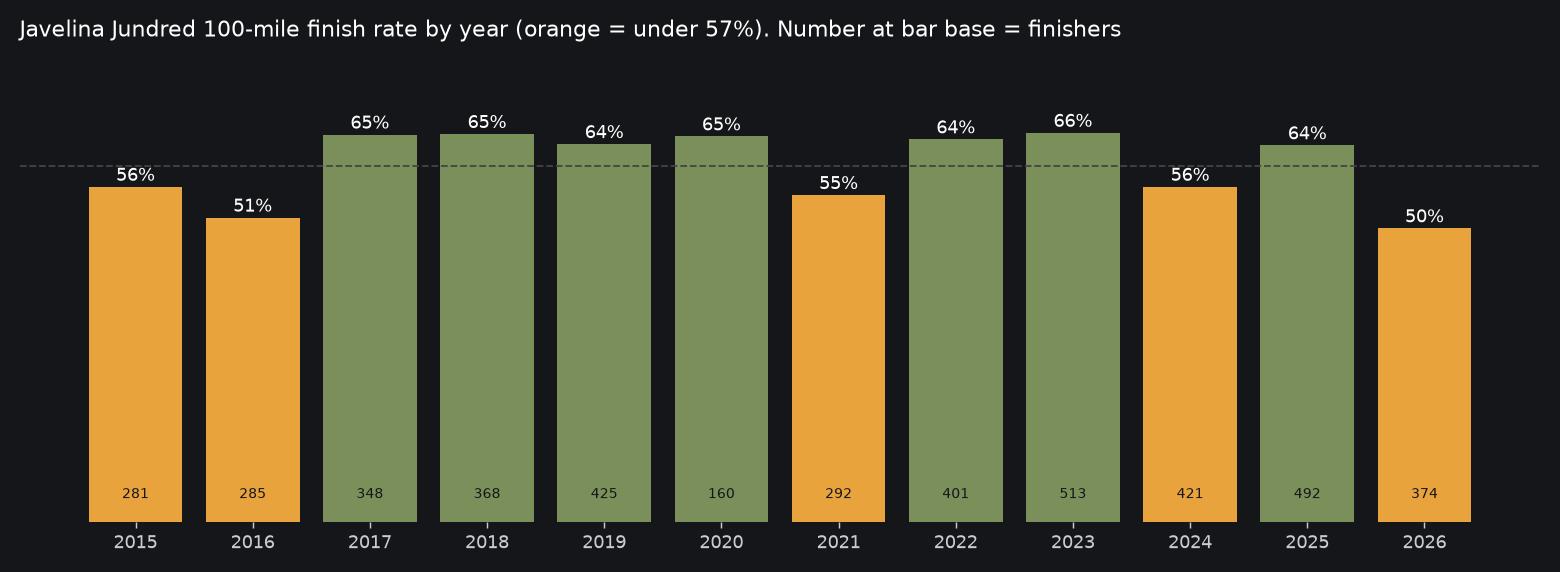
Chart: AZ Ultra Adventure, computed from UltraSignup results. Finish rate = finishers ÷ (finishers + DNF).
Aravaipa's own runner guide puts Javelina's historical finish rate near half and names the reasons: heat with no shade, fast starts, sand, and the temperature drop after sunset. I'd add the layout. Every 20 miles the course returns you to the warmest, loudest aid station in the sport, with your crew and a chair. We covered that trap in Loop or Line?
2. The calendar decides whether you fight heat or darkness. Javelina is a heat race that turns cold. Coldwater is the reverse: mild days, then roughly 13 hours of dark from about 6 PM to after 7 AM. Across the Years has seen 20°F. Stagecoach requires a cold-weather drop bag at mile 58. Pick the problem you handle better.
Pick by runner type
"I want the buckle, and I want the best odds I can get"
Across the Years. Seventy-two hours for 100 miles works out to 43 minutes a mile. You pass a full aid tent every 1.42 miles, there's a napping tent with cots, and you can sleep in your own tent beside the course and go back out. Between 71% and 76% of 100-mile entrants got there in each of the last three editions. That's the best multi-year record of any Arizona 100, and it still means about one in four stopped short on a course with no intermediate cutoffs. There is a separate buckle for doing it under 24 hours if you want a harder target. The honest downside is that it tests boredom and cold instead of terrain, and a good share of every lap is concrete or asphalt.
Fat Ox is the same idea in November with warmer nights and about 47 hours, and Aravaipa's own page pitches it for a first 100. It is nearly all pavement, and the 100-mile fields are small: 21 of 36 finished in 2025 and 18 of 22 in 2024. Bring max cushion shoes and a second pair for either one.
Neither is a trail race or a Western States qualifier.
"I want a real trail 100, with my family there, and I can run"
Javelina Jundred. Still the default answer, as long as you respect the number in the table. You need to average 18 minutes a mile in full sun. The runners it suits are the ones who can run most of a 50-miler, who have trained in heat, and who have a plan for leaving Jeadquarters at mile 61 when everything in them wants to stay. Your crew sets up once at Jeadquarters and never drives between aid stations (in 2026 everyone parked on the park road and rode a shuttle in), which makes it the best trail race here for a first-time crew. Carry an ice bandana and refill it with ice at every aid station.
"I run badly in heat and I don't need a party"
Coldwater Rumble. Same organizer, same desert-loop idea, two more hours on the clock, a January date and a field of under 150 starters. Its finish rate on the current course (62% to 68%) has been steadier than Javelina's. What you pay for that: more rock, about 2,400 more feet of climbing, three gaps of roughly 8 to 9 miles between aid stations on every Blue loop, and the longest night of any trail race on this list. Carry a hydration vest that holds 2 liters and a bright headlamp plus a spare. The entry fee is lower too: $300 to $360, against $525 for Javelina in 2026.
"I'm a hiker. I'm slow, but I don't stop"
Mogollon Monster, with conditions. More on this below, since it's the one I've run.
"I live in Flagstaff, or somewhere else high"
Stagecoach Line 100. It has about the same climbing as Javelina, but the whole course is high: it starts at 7,400 feet, tops out at 8,800 at mile 6 and finishes at 6,600. The early cutoffs are tight: 1 hour 45 minutes for the first 5 miles, which climb toward that high point, and noon at Kelly Tank, about 21 miles in. A RaceRaves reviewer who ran it as a first 100 in 2025 found it tougher than the profile suggests: one big early climb, then rollers and a lot of rock. If you live in the Valley, those two cutoffs are the ones to train for. The only recent year with DNFs published is 2024, when rain, sleet and hail hit and 61 of 105 starters finished.
"I want my first 100 to count for the Western States lottery"
Three Arizona 100-milers are on the current list: Javelina (finish under 30 hours), Saddles (34) and Mogollon (38). The 2028 lottery window runs from November 9, 2026 to November 7, 2027, so all three 2027 editions fall inside it. Of the three, Javelina has the easiest ground and the tightest clock. Our Golden Ticket and lottery explainer covers how the tickets work.
Saddles is a single 100-mile loop on Prescott's trails. Pacers can join at mile 50, crews can reach six aid stations around town, and the race director's manual signs off with "Don't die. Be nice. Listen to Black Sabbath." The catch is the cutoffs. They're set at 3 miles an hour and enforced on when you leave each aid station, with no exceptions. Finish rates have run 56%, 67% and 62% over the last three years. It's a good first 100 for someone with a solid mountain 50 behind them who moves through aid stations quickly, and a risky one for anyone who needs long sits.
"I'm a road marathoner and trails aren't my thing"
The Route 66 CenturyRun, if you have two or more people willing to give you a weekend. It's about 103 road miles from Peach Springs to the Colorado River, with 48 hours and no intermediate cutoffs. There are no aid stations for crewed runners. Your crew leapfrogs you in a vehicle the whole way, and everyone wears a reflective vest and blinking red lights at night. The 100-mile option was new in 2026, so there's no track record to judge it by. If you can't field that crew, Fat Ox is the pavement alternative.
Not for a first 100
Bradshaw Brute. Aravaipa's own registration page says it should not be your first. It has 20,838 feet of climbing, a 25.1-mile section with 9,518 feet of gain and only two water stops limited to a liter each, no crew on course and no pacers. Thirty of 43 starters finished in 2026, which says more about who signs up than about the course. Save it.
Desert Solstice. Entry is by invitation or qualifying mark. The 100-mile A standard is 14:15 for men and 15:50 for women. Go watch.
And one that people still ask about: there is no Antelope Canyon 100 anymore. The last edition we could confirm was March 2024. Our Antelope Canyon guide explains what happened.
Where the Mogollon Monster fits, from someone who ran it
I finished Mogollon on September 6, 2025 in 30:56:11, 39th of 128 finishers. It was not my first 100. Zion came five months earlier. So I can't tell you what it feels like as a debut. I can tell you what it asked of me.
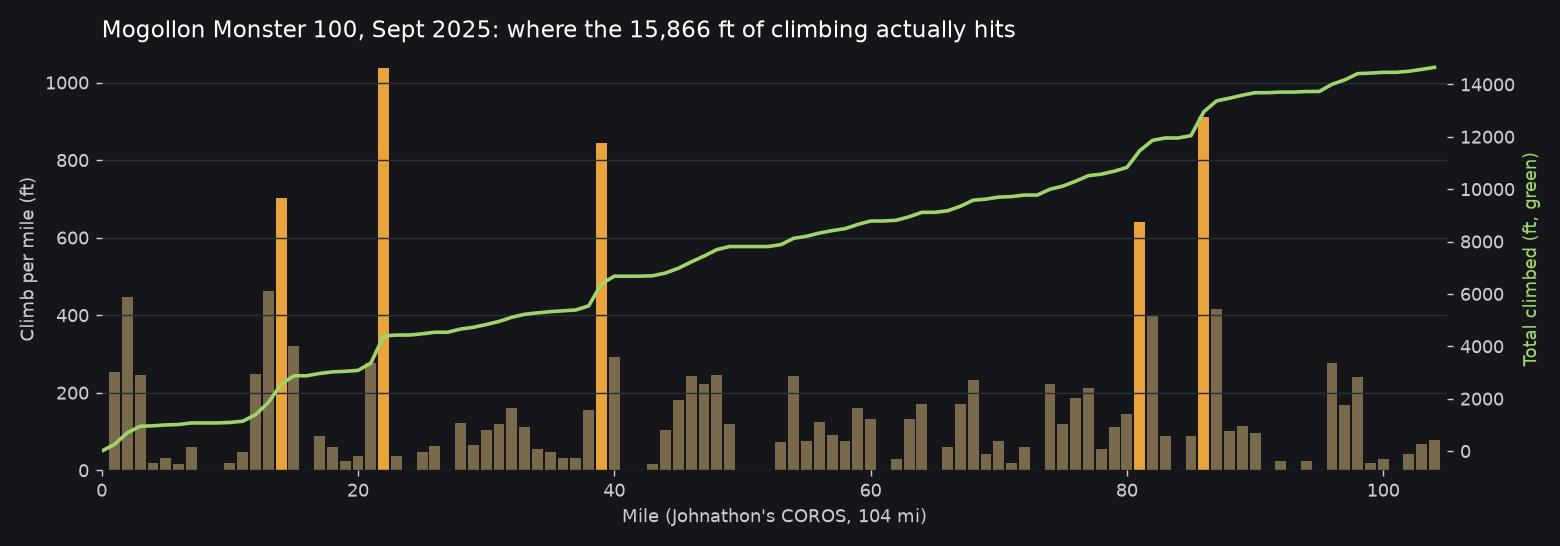
Chart: my own COROS data, Mogollon Monster 100, Sept 6, 2025. Each bar is one watch mile.
- It's my slowest 100 by more than two hours. Zion took me 28:34:36 and San Diego took 28:37:12. My watch logged 15,866 feet of climbing at Mogollon, including a single mile with 1,037 feet on the Horton climb.
- The clock wasn't the problem. I finished about seven hours inside the 38-hour limit. At a first 100, that kind of room lets you have a bad afternoon and still finish.
- Plan on a bad afternoon. Fish Hatchery to Buck Springs, 16 miles, took me close to five hours. It's the hottest part of the day on the exposed Highline, ending with the Myrtle climb. The race's runner guide singles out the 12.5 miles from Fish Hatchery to Myrtle and warns that one handheld bottle won't be enough.
- The back end is slow. My last 30 miles took about 11 hours.
- Point to point is easier on the head than loops. There's no lap to count and no car a short walk away. You're always going somewhere new.
In a 2023 Aravaipa article, four of the company's staff who picked Mogollon as their first 100 made the case for it. Three had finished and the fourth was days from starting. Their points: hiking is expected, the point-to-point layout cuts the mental fatigue, and one of them found the rocks and rollers of the Highline harder than the Rim climbs. One described stomach trouble and chasing cutoffs, and finishing anyway with a crew and pacers. After running the Highline myself, I believe the part about the rocks.
My honest view: Mogollon is a reasonable first 100 for a strong hiker who has already finished a hard mountain 50, trains on steep climbs with trekking poles, and has a crew that can handle dirt roads. It's a poor choice if your longest races have been flat, or if you want your family to see you often. Entry requires a previous finish of 50 miles or longer, plus 8 hours of trail work or volunteering. If you need that 50, our Elephant Mountain 50 and Pass Mountain 50 guides are a place to start. Pack a waterproof shell whatever the forecast says.
Pick the race your crew can handle
The same list from the crew's side:
- Set up once and stay: Across the Years, Fat Ox, Javelina, Desert Solstice. At Coldwater, add one drive to Horse Thief.
- A town loop with parking rules: Saddles. Six crew aid stations between the start and the finish, $5 fees at Granite Basin and Willow Lake, and the manual says illegal parking can get your runner disqualified.
- Dirt roads, maps and no signal: Mogollon (one vehicle per runner, four dirt-road zones, a walk of up to half a mile at Buck Springs) and Stagecoach (about 17 miles of rough ranch road from Chapel Mountain to Boundary).
- The crew is the race: Route 66.
- No crew on course: Bradshaw Brute.
At the set-up-once races, a 10 × 10 canopy, a couple of camp chairs and a cooler make a base camp. A van with a bed and a fridge does it better, which is the idea behind this:
It's an interest list, not a booking, and I can't promise availability for any particular race.
When you train decides more than you think
If you live in the Valley, look at where the big training weeks land before you look at the race date.
| Race month | Races | When the longest training runs fall |
|---|---|---|
| January | Coldwater | November and December. Cool mornings, short days |
| May | Bradshaw Brute | March and April |
| September | Mogollon, Stagecoach | July and August. Phoenix summer, so drive north for long runs or start before dawn |
| October | Saddles, Javelina | August and September. Still hot, so you practice in the conditions Javelina can give you |
| November | Fat Ox, Route 66 | September and October |
| December | Across the Years, Desert Solstice | October and November, the best running weather of the year |
A December or January race puts your hardest weeks in the best months to run in Phoenix, which favors Across the Years and Coldwater.
What I couldn't confirm
- Some finish rates rest on thin data. The Brute has one edition with 43 starters. Stagecoach's 2025 and 2026 results list finishers only. Fat Ox's 100-mile fields were 22 and 36 people.
- Route 66 CenturyRun results. The distance was new in 2026 and the race doesn't publish starter counts, so there's no finish rate.
- 2027 dates for Javelina, Stagecoach, Saddles and Route 66 hadn't been announced. Western States already lists October 2027 editions of Javelina and Saddles.
- Fat Ox's 100-mile limit. The official page doesn't list one. Everything ends at 8:00 AM Sunday, which gives a Friday 9:00 AM starter about 47 hours.
- Fees are from each race's most recent published schedule, before tax and signup fees. The Stagecoach figure is from a third-party listing, and I found no published fee for Saddles or the CenturyRun.
FAQ
What is the easiest 100-mile race in Arizona? By the clock and the terrain, Across the Years: up to 72 hours on a 1.42-mile loop with about 23 feet of climbing per lap, and 71% to 76% of entrants reaching 100 miles in recent editions. Among trail 100s with three years of results, Coldwater Rumble has the highest finish rates (62% to 68%).
Is Javelina Jundred a good first 100-miler? Yes for many runners, because of its loops, single crew location and small amount of climbing. But the finish rate has ranged from 49.5% to about 66% since 2015, and it was 49.5% in 2026. It suits people who can average 18 minutes a mile in heat and who won't sit down at mile 61.
Which Arizona 100-milers are Western States qualifiers? Javelina Jundred (30 hours), Saddles 100 (34 hours) and Mogollon Monster (38 hours) are on the official list for the 2027 and 2028 lotteries. Black Canyon 100K, Cocodona 250 and Sedona Canyons 125 are the other Arizona races on it. Check wser.org for the lottery year you want.
Do I need a crew for my first 100? Not at Across the Years, Fat Ox, Javelina or Coldwater, where aid and drop bags come around often. You must have one at the Route 66 CenturyRun, because the unsupported division is for the 140 only. You can't have one on course at the Bradshaw Brute.
Do any Arizona 100s require a qualifier? Mogollon Monster requires a previous finish of 50 miles or longer plus 8 hours of trail work or volunteering. Desert Solstice requires an invitation or a qualifying performance. The rest were first come, first served when we checked, and Saddles went to a waitlist in 2026.
What about races longer than 100 miles? Arizona also has the Sedona Canyons 125, the Cocodona 250 and the Arizona Monster 300. Run a 100 first.
Who wrote this
Johnathon Lawson is a trail runner from Gilbert, Arizona, and the person behind AZ Ultra Adventure. He has finished the Mogollon Monster 100 (2025, 30:56:11), the Zion 100 (2025, 28:34:36) and the San Diego 100 (2026, 28:37:12). Of the ten races compared here he has run only Mogollon. The rest is research from each race's official materials and results. Follow his training on Strava, see his results on UltraSignup, and find AZ Ultra Adventure on YouTube and Instagram.
Sources: our ten race guides linked above, which draw on the official pages and runner guides for Javelina, Coldwater, Mogollon Monster, Cocodona and the Bradshaw Brute, Fat Ox, Across the Years, Desert Solstice, the Stagecoach Line 100, Saddles 100 and the Route 66 UltraRun; UltraSignup results and RaceGoat's Mogollon Monster results (counted Nov 15, 2026); the Western States qualifying races list (checked Nov 15, 2026); Aravaipa's 2023 article "MOG 100 As Your First 100?"; Aravaipa's Cocodona registration listing on UltraSignup; RaceRaves reviews of the Stagecoach Line 100; and Johnathon's own COROS data and official results. Dates, cutoffs and fees change every year. Check each race's current runner guide before you register.
Some links are Amazon affiliate links. As an Amazon Associate we earn from qualifying purchases, at no extra cost to you.