 AZ Ultra Adventure
On this page
- Where 2027 stands
- The race in numbers (2024 rules unless noted)
- One trail, four times
- Aid stations
- The 14-hour night (and how the race is decided)
- Navigation: cairns, posts and pink flags
- Hunting season
- Poles
- Crew access: two places, both on dirt
- Getting there and sleeping there
- What to pack
- The van idea
- Deadman Peaks FAQ
- More guides
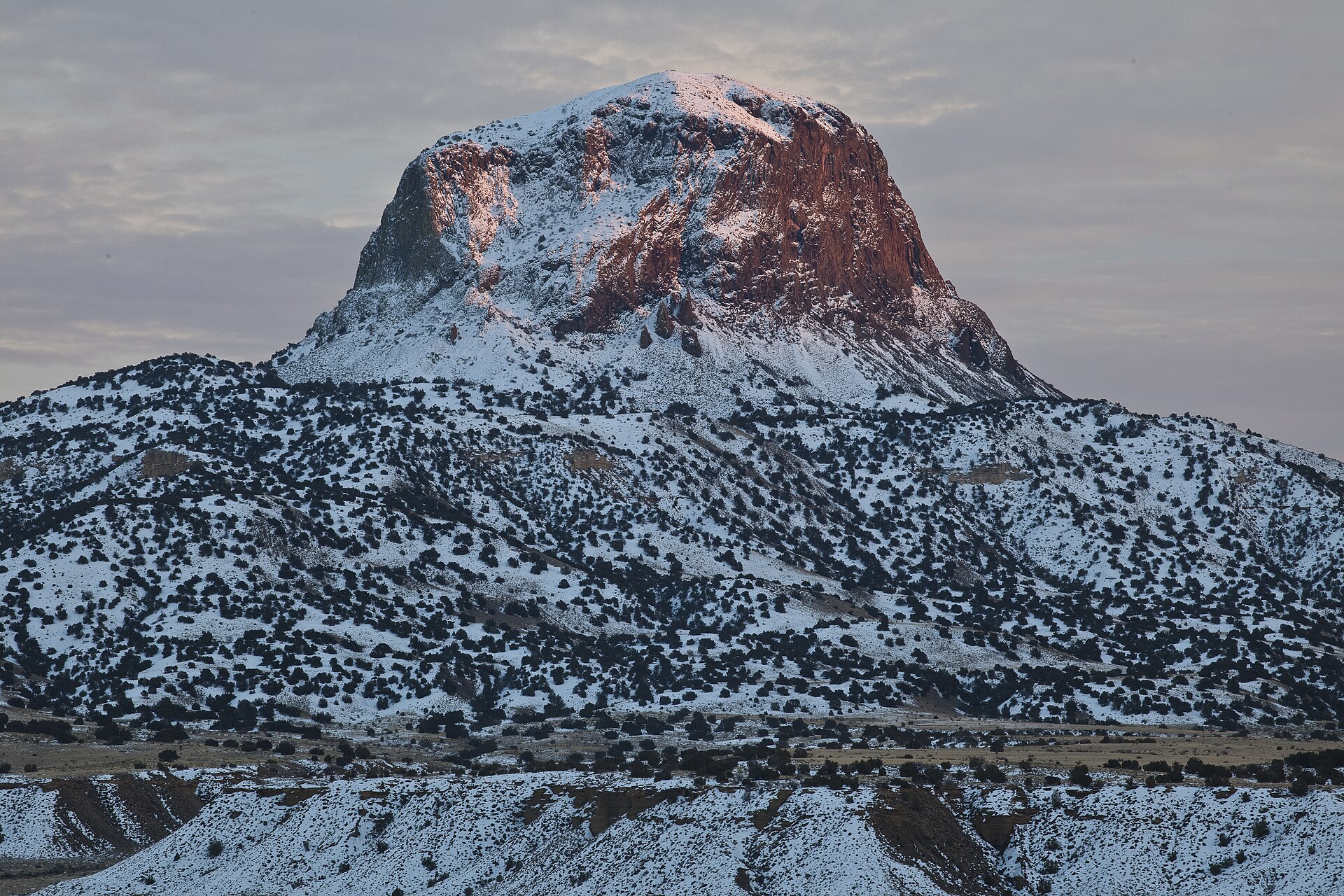
Nine people started the Backbone 100 on November 7, 2026. UltraSignup's results show two finishers.
That isn't a typo, and it isn't a mountain race in the usual sense. The whole course sits between about 6,350 and 7,400 feet, with roughly 10,000 feet of climbing over about 106 miles. On paper that sounds friendlier than Mogollon Monster or the San Diego 100. What makes the Backbone hard is everything around the numbers: aid stations about 9 miles apart, crews allowed at only two of them, a trail marked largely with cairns and posts, November nights that run around 13 hours, and lows that the race's own FAQ puts in the 20s and 30s.
This is the Deadman Peaks Trail Run, put on by RaceNM out of Albuquerque since 2010. Most of the field runs the shorter races: a 53-miler (the original event), a 55K, a 30K and a 10 miler, all on the same stretch of the Continental Divide Trail (CDT) south of Cuba, New Mexico. The name comes from a group of mesas near the course that USGS maps call Deadman Peaks. The race kept it because the date lands near Halloween and Día de los Muertos.
This guide is written from RaceNM's current and archived event pages, the race's older official site, UltraSignup listings and results, and runner blogs. Johnathon hasn't run Deadman Peaks. A lot of the detailed rules below (start times, cutoffs, aid station miles, drop bags, pacers) come from the 2024 event page, the most recent version that spelled them out. Check RaceNM's page when 2027 details post.
Where 2027 stands
As of late November 2026, RaceNM's page says 2027 registration is "opening soon" and doesn't give a date. Recent editions were November 2, 2024, November 1, 2025 and November 7, 2026, always on a Saturday in late October or early November. A third-party calendar lists "October 2027, TBD," which isn't confirmed. Expect a similar weekend, and don't book anything until RaceNM posts it.
The race in numbers (2024 rules unless noted)
| Backbone 100 | 53 mile | 55K | 30K | 10 mile | |
|---|---|---|---|---|---|
| Real distance | about 106 mi | 53 mi | about 34 mi | 18 mi (as labeled) | about 8 to 10 mi |
| Start | 6:00 AM Sat | 7:00 AM | 8:00 AM | 9:00 AM | 10:00 AM |
| Cutoff | 35 h (Sun 5:00 PM) | midnight; 3:00 PM at the turnaround | 10:00 PM | 5:00 PM | 3:00 PM |
| Turnaround | Torreon Road, twice | Torreon Road | La Ventana | Mesa Portales | |
| Gain | about 10,000 ft | not stated | not stated | not stated | not stated |
- Start and finish: off Highway 197, about 4 miles west of US 550 near Cuba. You turn south onto a dirt road from the highway.
- Elevation: about 6,350 to 7,400 feet the whole way.
- Refunds and transfers: no refunds. UltraSignup's 2026 page allowed bib transfers within the same distance until October 31.
- Entry fee: we couldn't find the 2026 fee in a source we could read. Check the UltraSignup page.
- Qualifiers: the Backbone isn't on the Western States qualifier list (we checked in November 2026). We found no Hardrock or UTMB status either.
- Relays: UltraSignup has listed a Backbone 100 relay and a 53-mile two-person relay in recent years.
Official pages: RaceNM's Deadman Peaks page, the 2024 version with the detailed rules, the race's older site at deadmanpeakstrailrun.wordpress.com (FAQ, directions, rules), and UltraSignup.
One trail, four times
The 100 is the 53-mile course run twice. Each 53 is an out-and-back on the CDT: south from the start past Mesa Portales, La Ventana Mesa and the Deadman Peaks mesas, out toward Cabezon Peak, to a turnaround on Torreon Road, and back. So a 100-miler covers every piece of trail four times, twice in each direction, and the second lap happens mostly in the dark.
The race's old FAQ breaks each 53 into roughly 45 miles of singletrack and 8 miles of dirt or jeep road. Runners describe it as everything the high desert has: sand, loose rock, slickrock, piñon and juniper forest, hoodoos and badlands. One 2010 blog account describes a technical drop of several hundred feet off a mesa edge and sandy canyon bottoms. None of the climbs is long, but there are a lot of short ones, and sand costs more energy than the gain suggests.
What this layout means for you:
- You'll see every section in daylight once. Pay attention on the way out. On lap two you'll do the same junctions in the dark.
- The second lap is lonely. With a small 100 field and the shorter races finished, you may go hours without seeing another headlamp.
- The start/finish at mile 53 is the biggest decision point of the race. More on that below.
Aid stations
Mileage from the 2024 event page. RaceNM lists aid about every 9 miles, with food including Tailwind, GU, soda, coffee, hot chocolate, ramen, mashed potatoes and quesadillas. Older editions ran the race cupless, so carry a bottle or a cup.
| Aid station | 100 mile | 53 mile | To next | Crew | Drop bags | Pacer pickup (100) | Notes |
|---|---|---|---|---|---|---|---|
| Start, Hwy 197 | 0 | 0 | 9 | Yes | 6:00 AM start for the 100, in the dark | ||
| Mesa Portales | 9 | 9 | 9 | Yes | Yes | Crew point, graded dirt road | |
| La Ventana | 18 | 18 | 8.5 | No | 55K turnaround. Crews banned | ||
| Turnaround, Torreon Rd | 26.5 | 26.5 | 8.5 | Yes | Yes | 53-mile cutoff 3:00 PM here | |
| La Ventana | 35 | 35 | 9 | No | |||
| Mesa Portales | 44 | 44 | 9 | Yes | Yes | ||
| Start/Finish | 53 | 53 (finish) | 9 | Yes | Yes | Lap two starts here. Warmest, most dangerous chair | |
| Mesa Portales | 62 | 9 | Yes | Yes | Most runners arrive in the dark | ||
| La Ventana | 71 | 8.5 | No | Remote, cold, middle of the night | |||
| Turnaround, Torreon Rd | 79.5 | 8.5 | Yes | Yes | Yes | Last crew point before the finish except Portales | |
| La Ventana | 88 | 9 | No | ||||
| Mesa Portales | 97 | 9 | Yes | Yes | Last aid | ||
| Finish | about 106 | Yes | 35-hour cutoff: Sunday 5:00 PM |
Gaps to know about. A 2017 aid station list for the 53 also had a water-only stop around mile 5.5 and a staffed station at the Deadman Peaks mesas (around miles 22.5 and 30.5). That station isn't on the 2024 list, so plan on the 8.5-mile stretches between La Ventana and the turnaround with no water in between unless the 2027 guide says otherwise.
Intermediate cutoffs for the 100. The 2024 page gives the 35-hour overall limit and a 3:00 PM turnaround cutoff for the 53-miler, but we didn't find mid-race cutoffs for the 100. Ask at packet pickup. The 35-hour limit over 106 miles is about 19:50 per mile, all-in.
Drop bags (2024): 100-milers can leave bags at Mesa Portales and the Turnaround, due by 5:45 AM. They come back Sunday after the Turnaround closes. 53-milers use the same two stations (due 6:30 AM, back by 7:00 PM); the 55K gets Mesa Portales only (due 7:30 AM). Your crew and the start/finish at mile 53 work as a third "bag."
Required gear (100 and 53, 2024): a rain jacket, two lights, and a hydration vest or bottle.
The 14-hour night (and how the race is decided)
UltraSignup's results show how the Backbone treats people. Our reading of the status codes is that the first group finished, the second dropped and the third didn't start.
| Year | Finished | Dropped | Didn't start |
|---|---|---|---|
| 2020 | 5 | 7 | 3 |
| 2021 | 9 | 12 | 5 |
| 2022 | 9 | 10 | 7 |
| 2024 | 5 | 2 | |
| 2025 | 5 | 0 | 0 |
| 2026 | 2 | 7 | 1 |
There was no 100 listed in 2023, and the 2024 and 2025 records may be incomplete. Even so, over the years more starters have dropped than finished. The 53-miler is more forgiving: 12 finishers, 6 drops in 2026.
Here's the trap. Sunset in Cuba in early November is around 5:00 PM, and it's dark until after 6:30 AM. A runner on 30-to-34-hour pace reaches the start/finish at mile 53 around dusk on Saturday. They've run 53 miles of sand and rock, the 53-milers around them are celebrating and heading to their cars, the temperature is dropping fast, and the next stop is Mesa Portales, 9 miles away, in the dark. Then come La Ventana and the turnaround, about 26 miles out into the coldest part of the night, past a station crews can't reach.
The finish line is decided in the first 10 minutes at mile 53. If you get back out of the start/finish with your night gear on and your pacer next to you, you've made the hardest decision in the race.
The second checkpoint is the turnaround at mile 79.5, likely somewhere around 3:00 to 7:00 AM for a mid-pack runner. It's the coldest hour, and there's a crew and a car. But once you've turned at mile 79.5, every step is toward the finish, the sun comes up within a few hours, and the last 26.5 miles have two aid stations and one crew point. Leave the turnaround with a few hours of margin on the 5:00 PM Sunday cutoff and you're very likely a finisher.
How not to DNF the Backbone:
- Run lap one like you have a lap two. Two separate blog accounts of the 53 describe going out too fast and cramping around miles 32 to 35. Lap one's back half is where the 100 is set up or lost.
- Plan mile 53 in advance. Night layers, fresh lights, warm food, and a five-minute stop. Your pacer can join here. Have your crew park near the trail, not at the party.
- Dress for 20s, not 50s. The race's FAQ says expect sunny, windy days in the 50s to 60s and nights in the 20s to 30s, and it gets cold quickly at sunset. Climate averages for Cuba put early November lows near 20°F. Carry gloves, a hat and a real insulating layer for lap two, not just the required rain shell.
- Count water in miles, not hours. Nine miles of sand at night can take three hours. Leave every station with enough to get to the next one if you slow down.
- Eat at every station. Hot ramen, mashed potatoes and quesadillas at 2:00 AM are a big reason to keep going.
- The rule for the night: one station at a time. Get to La Ventana. Get to the turnaround. Turn around.
Navigation: cairns, posts and pink flags
The CDT through this country is marked with white-tipped posts and rock cairns, and the race adds pink flagging. The race's 2016 trail report says the tricky spots are where singletrack meets jeep road. The race director's advice: if you go 10 minutes without seeing a cairn or flag, go back. A 2010 runner lost about 10 minutes by going straight at a mesa-edge turn in the dark at the start.
- Load the CalTopo track on your watch or phone. This matters more on lap two.
- Use a waist light. Cairns are easier to spot with a low light that throws shadows.
- Look behind you on lap one at junctions so you'll recognize them coming back.
Hunting season
The race falls during New Mexico hunting season. The race's FAQ says hunters are few and mostly to the west on the southern end of the course, but wear bright colors and nothing that looks like a deer: no tan or brown jackets, no white hats bobbing through the piñon. Blaze orange is a good idea, especially for crews walking out from their cars and pacers on lap two. Course scouts have also reported bear and cougar tracks.
Poles
We found no pole policy for Deadman Peaks, so confirm at packet pickup. The climbs are short, and most runners won't need poles for them. They're most useful for:
- The mesa-edge descents and climbs, especially on loose rock in the dark.
- Sand. Poles help some runners keep rhythm in sandy washes late in the race.
- Lap two, from mile 53. If you want them at all, pick them up from your crew at the start/finish or out of the Mesa Portales bag at mile 62. You can hand them back at the turnaround (79.5) or Portales (97).
Crew access: two places, both on dirt
Crews may go to Mesa Portales and the Turnaround (and the start/finish). Older race rules say that crews who went to La Ventana or the Deadman Peaks area got their runner disqualified or banned. In the heavy rain of 2010, crews were allowed only at the turnaround. Take that rule seriously.
The directions below come from the race's older official site. Check them against the 2027 runner info.
- Start/finish: Highway 197, about 4 miles west of US 550, then south on a dirt road. RaceNM has allowed free camping here. Packet pickup in 2024 was Friday 4:00 to 9:00 PM and race morning from 5:00 AM, at the start/finish.
- Mesa Portales (miles 9, 44, 62, 97): south from Cuba on US 550, turn right between mile markers 54 and 53, then about 3.6 miles of graded dirt. The race says cars usually make it, but maybe not after rain.
- Turnaround (miles 26.5 and 79.5): south on US 550 to between mile markers 42 and 41, west on NM 279 for about 8.7 miles, north on paved Torreon Road for about 3.7 miles, then an unmarked dirt spur.
- Cell signal: we found no information. Assume it's poor away from US 550 and agree on times with your runner instead of relying on texts.
- Mud: the dirt roads in this part of New Mexico can turn to slick clay when wet. If it rains, follow the race's instructions, and don't take a low car down a soaked road at night.
A one-person crew can do this, but the turnaround is a long way around by road, and the night shift is long. Two crew members, taking turns sleeping, is better.
Getting there and sleeping there
Cuba is about 75 to 85 miles northwest of Albuquerque on US 550, about 1.5 to 1.75 hours. From Phoenix it's about 500 miles, 7.5 to 8 hours via I-17, I-40 and Albuquerque.
- Camping: RaceNM has allowed free camping at the start/finish, and the race FAQ says camping on the surrounding BLM land is allowed with no fires. The FAQ also lists the Sandoval County Fairgrounds, about 5 miles from the start.
- Motels: a few small motels in Cuba, including the Frontier Motel on US 550. Book early; there aren't many rooms.
- Fuel and food: fill up in Cuba or Bernalillo. There's nothing near the crew points.
What to pack
- A real insulating layer and a rain shell. The shell is required. Packable insulated running jacket and waterproof running jacket with hood.
- Two lights plus a waist light. Two are required, and a waist light helps spot cairns. Rechargeable running headlamp, lightweight backup headlamp, running waist light.
- A vest with 2 liters or more. For 9-mile gaps. Trail running vest 12L.
- Gaiters. Sand is a big part of this course. Trail running gaiters.
- Warm hands and head. Lightweight running gloves, fleece running beanie, and hand warmers for the turnaround at 3:00 AM.
- Blaze orange. Blaze orange running vest or hat, for hunting season.
- A collapsible cup. Collapsible running cup.
- Shoes with toe protection. One runner's account blamed light shoes for sore toes on the rocky descents. Rock plate trail running shoes.
- For the crew: a propane camping heater, a zero-degree sleeping bag and a folding camp chair. Remember the "no fires" rule on BLM land.
The van idea
Deadman Peaks may be the most van-friendly race we've covered. There's free camping at the start, and two crew points on dirt roads, with long waits in between. The weather is the reason it matters: crews spend a 14-hour November night between the start/finish, Mesa Portales and Torreon Road. A van gives the crew a warm place to sleep between stops, a kitchen for hot food at 3:00 AM, a dry place for the runner to change at mile 53, and a bed right at the finish on Sunday afternoon.
If you'd want an AZ Ultra Van as crew base camp for Deadman Peaks, add your name on the reservation card above. It's an interest waitlist, not a booking, and availability isn't promised. Note that the race's dirt roads may be closed to vehicles after rain.
Deadman Peaks FAQ
When is Deadman Peaks 2027? Not announced yet. RaceNM says registration is opening soon. Recent editions ran on Saturdays between November 1 and November 7.
How long is the Backbone 100? About 106 miles: two laps of the 53-mile out-and-back course, with about 10,000 feet of climbing, between about 6,350 and 7,400 feet.
What's the cutoff? 35 hours (6:00 AM Saturday to 5:00 PM Sunday) on the 2024 rules. We couldn't find published mid-race cutoffs for the 100.
How cold does it get? The race says nights are usually in the 20s to 30s. Climate averages for Cuba in early November put lows near 20°F. Snow and rain are both possible.
Can I have a pacer? In 2024, 100-milers could pick up a pacer at mile 53 (the start/finish) or mile 79.5 (the turnaround). Pacers had to check in, sign a waiver and wear a bib. Rules have changed over the years, so check the 2027 page.
Where can my crew go? Mesa Portales, the turnaround on Torreon Road, and the start/finish. Not La Ventana or the Deadman Peaks area.
Is it a Western States qualifier? Not on the Western States list when we checked in November 2026.
Is there camping at the start? RaceNM has offered free camping at the start/finish, and the surrounding BLM land allows camping with no fires.
More guides
- Jemez Mountain Trail Runs, New Mexico's big spring trail race in Los Alamos
- Mogollon Monster 100, Arizona's hardest 100 in September
- Coldwater Rumble, a winter loop 100 near Phoenix
- Which Arizona 100-miler should be your first?
- Arizona winter ultra layering myths, for the Backbone's night
- The drop bag system and crew chief playbook
Who wrote this
Johnathon Lawson is a Gilbert, Arizona ultrarunner and a three-time 100-mile finisher: Zion 100 (2025), Mogollon Monster 100 (2025) and San Diego 100 (2026). He hasn't run Deadman Peaks. This guide is researched from RaceNM's current and archived event pages, the race's older official site, UltraSignup listings and results, and runner blogs. Follow his training on Strava and the AZ Ultra training page, his results on UltraSignup, and AZ Ultra Adventure on YouTube and Instagram.
Sources: RaceNM's Deadman Peaks page and its 2024 archived version; the race's older site (home, FAQ, directions, rules, aid stations, 2016 trail report); the 2026 UltraSignup listing and 2020 to 2026 UltraSignup results; the race's CalTopo map; the Western States qualifier list; runner blogs from 2010, 2011 and 2015; climate averages for Cuba; and the CDT Coalition's Cuba page. Finish-rate readings, clock estimates, pace math and crew planning are our own. Rules described here are mostly from the 2024 edition, so check the current RaceNM page before you travel.
Some links are Amazon affiliate links. As an Amazon Associate we earn from qualifying purchases, at no extra cost to you.