 AZ Ultra Adventure
On this page
- The four jobs (one person can hold two)
- The binder
- The pace chart and arrival-window math
- How hard is each race on the crew?
- The pit-stop script
- Driving and sleep: the part that can actually hurt someone
- What to say at 3 AM (and what never to say)
- Feet triage
- Stomach triage
- The heat kit and the cold kit
- The crew-of-one plan
- Crew chief FAQ
A 100-mile crew with nobody in charge is four kind people standing around a cooler asking the runner what they want. The runner, 60 miles in, doesn't know what they want. Somebody has to.
That somebody is the crew chief. One person who owns the plan, makes the calls, and is allowed to overrule everyone else on the crew. On anything that isn't medical, that includes overruling the runner. The American Trail Running Association's crew article is explicit about the first half of that: the runner names the chief before the race, and everyone on the crew respects that person's decisions.
If you need the basics first (what to pack, why the chair is dangerous), read Crewing Your First 100 and our Pass Mountain 50 crew guide. This post picks up where those stop: paperwork, math, scripts, safety, and how hard each Arizona 100 is on the people in the car.
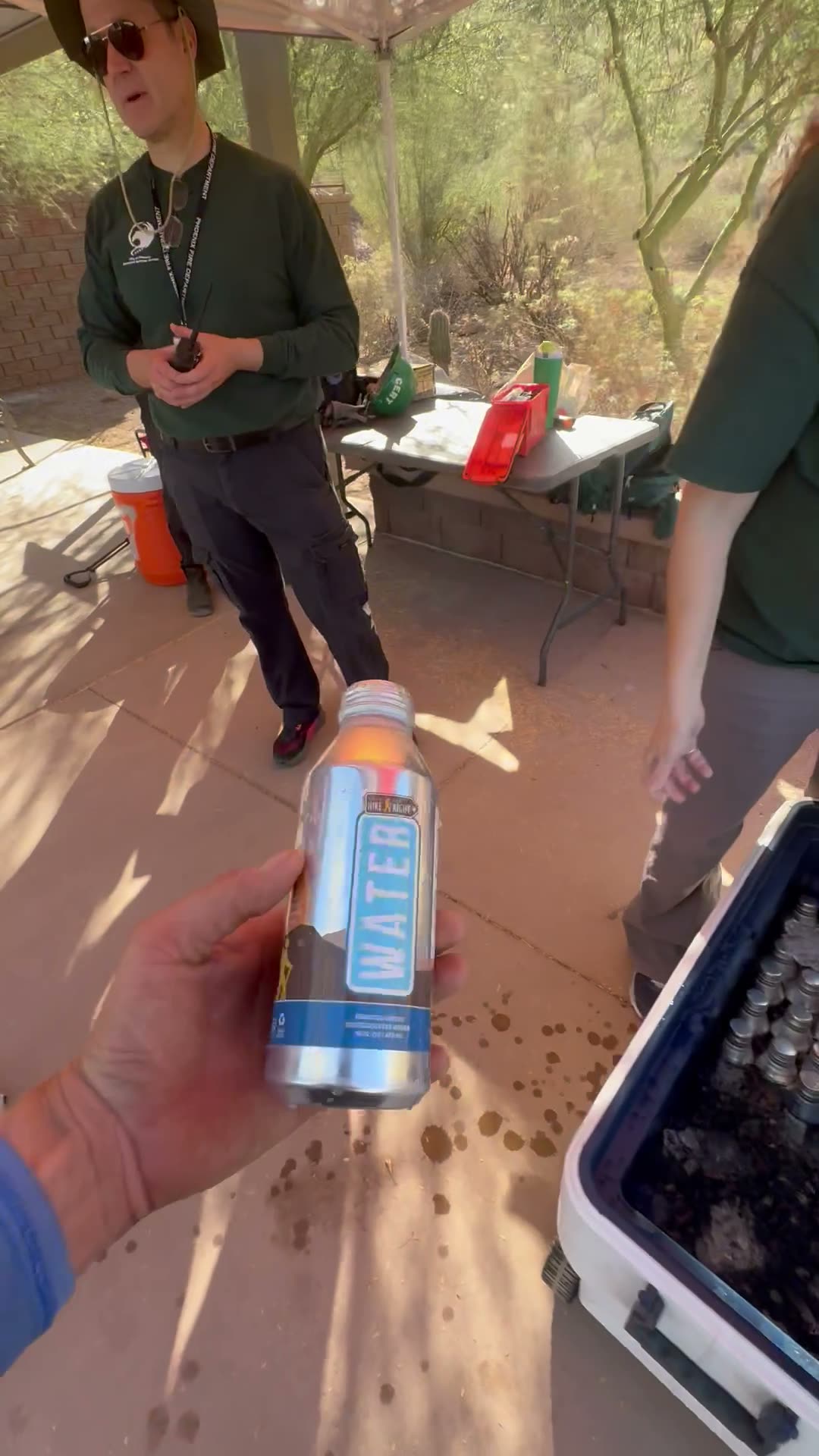
The four jobs (one person can hold two)
- Chief. Talks to the runner. Decides. Keeps the clock and the binder.
- Hands. Bottles, food, ice, trash. Never asks questions, just swaps.
- Feet. Kneels down. Socks, shoes, lube, tape, lights, layers.
- Driver. Drives, navigates, fuels the car, and sleeps on purpose. At a night stop the driver should be resting, not working the stop.
A pacer is a fifth job, and a pacer who just came off a 20-mile leg isn't a driver. With two people, the chief is also hands and the driver is also feet. With one person, skip to the crew-of-one plan near the end.
The binder
Print it. ATRA's article makes the point that paper works with no signal and a dead phone. On the Mogollon Rim that's not a hypothetical: Aravaipa's 2026 crew manual says there's no cell service at Buck Springs or Dickerson Flat and probably none at General Springs (details in our Mogollon Monster guide). A storage clipboard or a thin three-ring binder is enough. Seven tabs:
- The rules that get a runner disqualified. Every race has them. San Diego 100: crewing without the parking pass is an immediate DQ. Saddles 100: illegal parking can DQ your runner. Zion: crew and pacers have to register and wear a bib, and crewing anywhere but the designated access points is a DQ. Mogollon: one crew vehicle per runner, pass on the dash. Read the current runner guide and write the DQ rules on page one.
- The pace chart with an arrival window for every crew point (next section).
- Driving pages. The race's own written directions, not a navigation app's guess, plus drive times, parking notes, walk-in distances, gas stops and fees. Carry small bills: Maricopa County parks around Phoenix charge $10 a car per day, Willow Lake in Prescott is $5, and the national forest stops at San Diego need a $5 Adventure Pass.
- Stop cards. One half page per crew stop, in the order things happen.
- The runner's sheet. Medical info, allergies, emergency contact, foods that work, foods that never work, known low points, and the quit protocol the runner signed off on before the race.
- The log. Time in, time out, what they ate and drank, when they last peed, any problem and what you did about it.
- Numbers and the ending. Race director and medical phone numbers, every crew phone, the hotel address, and who is driving home.
The pace chart and arrival-window math
Most crews make one pace column: the goal, at even pace. Then the runner comes through the first crew stop an hour before anyone expected them, and spends the whole night "behind" while the crew panics. Neither one is a problem. You need a window, and the window changes shape as the race goes on.
Step 1: get the race's cutoff chart. Convert each cutoff to elapsed time from the start.
Step 2: scale it. Divide the goal finish time by the time limit. A 31-hour goal at a 38-hour race is 31 ÷ 38 = 0.82. Multiply every cutoff by that number. Call this the scaled time.
Step 3: correct for the fact that nobody runs even splits. This is the part people skip. Here is the scaled chart against my own Mogollon Monster. My official finish was 30:56:11 against a 38-hour limit, so the factor is 30:56 ÷ 38:00 = 0.814. The splits are approximate, from my watch, as published in our guide. The cutoffs are the 2026 chart and my race was 2025, so treat it as an illustration, not a lab result.
| Station (mile) | Cutoff, elapsed | Scaled × 0.814 | My approx. arrival | Arrival as % of scaled |
|---|---|---|---|---|
| Horton (21.7) | 8:15 | 6:43 | ~5:00 | 74% |
| Fish Hatchery (27.1) | 10:00 | 8:08 | ~6:30 | 80% |
| Buck Springs (43.1) | 16:00 | 13:02 | ~11:20 | 87% |
| Geronimo (71) | 26:30 | 21:34 | ~20:00 | 93% |
| Donahue (80.5) | 30:15 | 24:38 | ~24:10 | 98% |
| Pine Canyon (89.2) | 33:30 | 27:16 | ~27:15 | 100% |
Look at where the head start went. I was 1 hour 43 minutes ahead of the scaled time at mile 22 and still 1 hour 34 minutes ahead at mile 71. Then the 18 miles after Geronimo took nearly all of it back: 28 minutes ahead at Donahue, one minute ahead at Pine Canyon. Mogollon's cutoff chart is built on one even pace, about 22:30 a mile from start to finish. People don't run that way. One runner on one course isn't a law, but slowing down late is normal in 100-milers (at Javelina, race reports call loop 3 the slowest), so I'd build every window like this:
- Be-ready time (the early edge): scaled time × 0.75 through mile 25, × 0.85 around miles 40-45, × 0.90 by mile 70, and × 0.95 from mile 80 to the finish. That's roughly when a runner who is on goal pace and slows the way I did will show up. The buffer in Step 4 covers a runner having a better day than that.
- Late edge: the scaled time itself. A runner who comes in after it is behind goal pace, and that's fine. It's information for the next window, not an emergency.
- Hard stop: the real cutoff. The chief knows this number at all times and mentions it only when it matters.
Step 4: the leave-by time. Early edge, minus drive time, minus the walk in, minus 15 minutes of setup, minus a buffer (30 minutes on pavement, 45 on dirt at night). Walk-ins are real: Buck Springs at Mogollon can be half a mile, Green Valley at San Diego up to a mile. Example: General Springs, mile 57 at Mogollon, is 32.5 miles and about 1 hour 16 minutes from Pine per the crew manual, with parking strung along a third of a mile of road shoulder. If the early edge is 9:00 PM: 9:00 − 1:16 − 0:10 − 0:15 − 0:45 means wheels rolling out of Pine by 6:34 PM. The manual only lists that drive from Pine. If you're coming along the Rim Road straight from Buck Springs, get a drive time from your offline map before you lose signal and use that number.
Step 5: re-do it at every stop. When the runner leaves, take their real pace over the last leg and add 10 to 15 percent if the next leg is at night or past mile 60 (my rule of thumb; add more if the chart shows a big climb in that leg). Write the new window on the log.
How hard is each race on the crew?
Ratings are mine, 1 (set up a canopy and stay put) to 5 (dirt roads, no signal, long night drives). Details and sources are in each linked guide. Dates and rules change every year, so check the race's current runner guide.
| Race | Crew access | Roads | Crew difficulty | Guide |
|---|---|---|---|---|
| Desert Solstice (Phoenix track, Dec 19-20, 2026; invitational) | Canopy inside the fence; your runner passes about every two minutes | City streets | 1, but it's precision work | Desert Solstice guide |
| Fat Ox (Goodyear, Nov 20-22, 2026) | Free crew spot beside a 0.99-mile paved loop. No pacers | Paved; $10 per car per day | 1 | Fat Ox guide |
| Across the Years (Peoria, Dec 28, 2026 to Jan 3, 2027) | Camp beside a 1.42-mile loop. No pacers; ten guest bibs for single laps | City streets | 1 (the hard part is days of sleep management) | Across the Years guide |
| Javelina Jundred (Fountain Hills, Halloween weekend) | Only at Jeadquarters, about every 20 miles (the race page puts the loop ends at 22.3, 41.75, 61.2 and 80.65). $100 canopy reservations | Paved, but in 2026 no vehicles reached JQ on race day; everything rode the shuttle | 2 | Javelina guide |
| Coldwater Rumble 100 (Goodyear, Jan 16, 2027) | Rumble HQ (free canopy space) plus Horse Thief at about miles 39, 66 and 93 | All paved, short drive between the two | 2 (about 13 hours of dark, with nights around 40°F that the race guide says feel colder in the washes) | Coldwater guide |
| Saddles 100 (Prescott, early October) | Six crew aid stations plus the downtown start and finish, most 10 to 25 minutes apart | Mostly paved around town; Spruce Mountain is up a narrow, steep forest road. Fees and strict parking | 2 | Saddles guide |
| Stagecoach Line 100 (Flagstaff to Tusayan, September) | Seven aid-station stops plus a crew-only point, point to point | Forest and ranch roads. The manual recommends 4WD or AWD for the whole event and high clearance for the rough ranch road into Boundary (we estimate 60 to 90 minutes) | 4 | Stagecoach guide |
| Mogollon Monster 100 (Pine, Sept 11, 2027) | Five crew points on the chart plus the finish, one vehicle per runner | Forest Service dirt on the Rim. No facilities up top; no cell service at two crew stops and probably none at a third | 5 | Mogollon guide |
| Bradshaw Brute 100 (Black Canyon City to Prescott, May 2, 2027) | None on course. Start and finish only, no pacers | About 1.5 hours by road between start and finish | No crewing; a logistics job | Bradshaw Brute guide |
| Zion 100 (Apple Valley, Utah, Apr 10, 2027) | Three stops: Virgin Desert (42.9), Virgin BMX (69.1 and 87.5), plus a walk-in point by the start/finish ranch. Nothing on course for the first 43 miles. Crew must register and wear a bib | Paved highway to the three on-course stops | 2 | Zion guide |
| San Diego 100 (Lake Cuyamaca, California, Apr 30, 2027) | Six crew points, parking pass required | Paved, short hops on Sunrise Highway; tight parking and park fees | 3 | San Diego 100 guide |
Going longer? The Cocodona 250, Arizona Monster 300 and Sedona Canyons 125 guides have crew sections too. Still choosing a race? Loop or Line: Which 100 Is Harder? covers the runner's side.
The pit-stop script
Decide before each stop which kind it is. The runner doesn't get a vote once they arrive.
| Stop type | Clock | Use it when | What happens |
|---|---|---|---|
| Splash | Under 2 minutes | Daylight, things are working | Bottle swap, food in hand, ice, go. Nobody sits |
| Service | 4-5 minutes | Most stops | The full script below |
| Reset | 10-15 minutes, two per race at most | Dusk changeover; a real problem (feet, stomach, soaked clothes) | Seated, timed, everything fixed at once |
The service stop, minute by minute:
- Before they arrive. Duplicate bottles already filled. Food for the next leg in a zip bag. Stop card out. A chair exists but it's folded.
- 0:00. The chief meets the runner at the edge of the crew area and walks in with them. Hands takes the vest. The chief asks three things: "When did you last pee?" "What did you eat since I saw you?" "Anything rubbing?" Those answers go in the log.
- 0:30. Bottles in, trash out, food placed in their hand.
- 1:30. One fix only: sunscreen, lube, a sock change, or ice in the hat and bandana. If there are two problems, it has become a Reset. Say so and start the timer.
- 3:00. Next-leg kit goes in the vest: light, layer, extra calories.
- 3:30. The chief briefs the next leg from the card, with real numbers: "7.6 miles to Pinchot Cabin, about a thousand feet of climbing, we see you at 57."
- 4:00. Walk them out, still eating. Hands confirms the vest is zipped and the bottles are in it.
A stop card looks like this (Buck Springs, mile 43.1 at Mogollon, facts from the 2026 chart): Type: Reset, 12 minutes. First crew stop since mile 24, first pacer pickup, dusk. Race cutoff: runner out by 10:00 PM. No cell here. In order: dry shirt, warm layer in the vest, headlamp on head plus spare, hot food, sock check, pacer briefed. Next: Pinchot Cabin, 7.6 miles, 990 feet of climbing. Pinchot is a slow place to drop from; the runner guide says getting someone out and back to the finish takes two to three hours.
Write one for every stop, in the runner's own priorities, while the runner still has a clear head.
Driving and sleep: the part that can actually hurt someone
The runner is on a marked course with aid stations and a medical team on call. The crew is on dark roads in a car, short on sleep. Take this section more seriously than any other.
NIOSH, the federal workplace-safety institute, puts it in numbers: being awake 17 hours is similar to a 0.05% blood alcohol level, and 24 hours is similar to 0.10%, above the 0.08% U.S. drunk-driving limit. A crew that got up at 3 AM to make a 6 AM start hits 17 hours at 8 PM, before the hard part of the night has started.
- Schedule sleep the way you schedule stops. Every race has a long gap. At Mogollon it's General Springs (57) to Dickerson Flat (84.3). At Zion it's the 18.4 miles between the two Virgin BMX visits, which we estimate at 5 to 7 hours for a mid-pack runner. At San Diego it's the 23 miles from Sweetwater to Meadows, roughly 6 to 8 hours for most runners (the 2026 cutoffs at those two stations are 7 hours 45 minutes apart). Put the gap in the binder as a sleep block with a name on it.
- The driver sleeps first. Set the alarm from the leave-by time, not from a guess.
- Nobody drives alone between 1 and 6 AM if there's any way around it. Passenger stays awake and talks. If you catch yourself drifting, pull over and nap. A late crew only means the runner eats aid-station food.
- Dirt at night is half speed. Mogollon's Rim Road has washboard, blind hairpins, off-road vehicles, wildlife, and runners on the road. Stagecoach's ranch roads have gates, deep ruts and rocks. San Diego's race guide calls the Sunrise Highway extremely dangerous because of speeding traffic, and mentions wildlife strikes at past races. Anyone walking on a road shoulder wears a reflective vest and a light.
- Fuel at half a tank. Last gas for Mogollon is Pine, Payson, Star Valley or Forest Lakes. For Stagecoach it's Flagstaff and Valle. For San Diego it's Pine Valley, Descanso and Julian. A tire inflator and jump starter lives in the car on any dirt-road race.
- The drive home is part of the race. The runner never drives. A crew member who's been up 30 hours shouldn't either. Book a room for the night the race ends, or name one person whose whole job is to sleep during the race and drive after it.
This is the honest case for a crew van on a race like Mogollon or Stagecoach: the crew's sleep block happens in a bed instead of a reclined front seat, the food stays cold for 38 hours without an ice run, and the vehicle you're sleeping in is already parked at the next stop. (Check any vehicle's clearance against the Stagecoach manual before you point it at Boundary.) The card above is an interest list, not a booking.
What to say at 3 AM (and what never to say)
By 3 AM the runner has been awake 22 to 24 hours and their judgment is poor. We wrote about that state in The Altered State of Mile 80. The chief's voice has to do the thinking for both of you.
Say:
- Facts, then a task. "It's 3:10. Next aid is 6.3 miles. Eat this while we walk to the trail."
- Choices, not open questions. "Broth or potatoes?" works. "What sounds good?" gets "nothing."
- The sorting question. Mine is "Are you hurt, or just tired?" Tired leaves the aid station.
- Shrink the race. Nobody at mile 62 can face 38 more miles. They can face the next aid station.
- The truth about the clock, when it helps. "You're two hours up on the cutoff. You can walk this whole leg and still be fine."
- The quit protocol, read off the sheet. Agree on it before the race, in writing. A common one: no decision while sitting; eat 200 calories; walk to the next aid station; decide there. Medical problems skip the protocol and go straight to the race's medical staff.
Never say:
- "How do you feel?" (They feel terrible. Now they've said it out loud.)
- "You look rough," or anything else about how they look, unless it's a medical flag you're acting on.
- "It's all downhill from here," or any distance you haven't checked. They have a watch. The first lie about mileage is the last thing they believe from you.
- "You're almost there," before the last aid station.
- "Do you want to stop?" or "Nobody would blame you."
- "Take your time."
- Who dropped, who's in the medical tent, how cold you are, how tired you are, or how bad the road in was.
- "The car's warm."
And whatever the runner snaps at you at mile 75 doesn't count. Don't take any of it personally, and don't bring it up at the finish.
Feet triage
The chief's rule: a hot spot gets treated at the stop where it's reported, even if that turns a Splash into a Reset. Cheap prevention works: in a Stanford-led trial at 155-mile desert stage races, 98 of 128 runners got no blisters where plain paper tape had been applied, while 81 of the 128 blistered on untaped parts of the same foot.
The foot kit, in its own labeled bag: paper tape and sports tape, alcohol wipes, sterile lancets, lubricant, blister pads, nail clippers, a small towel, two pairs of dry socks, a headlamp for the person kneeling.
- Clean and dry the foot. Dust off, towel dry.
- Hot spot, no blister: tape it flat, lube over the top, fresh sock.
- Small intact blister: leave it alone, pad or tape over it. The American Academy of Dermatology's advice is to avoid popping blisters when you can, because of the infection risk.
- Big, painful blister that's changing how they walk: the same guidance allows draining it: pierce one edge with a needle or lancet cleaned with rubbing alcohol, let the fluid out, clean the skin, and leave the roof of the blister on. Then pad or tape over it. If the aid station has medical volunteers, let them do it.
- Blood blisters, anything open and dirty, signs of infection, or a toenail problem: race medical, not the crew.
John Vonhof's Fixing Your Feet is the standard reference if you want to practice taping before race day. Practice matters more than which tape you buy.
Stomach triage
In a study of 272 Western States runners (Stuempfle and Hoffman, 2015), 96 percent reported at least one GI symptom during the race and about 60 percent reported nausea, which was worst in the hottest, hardest part of the course. Stuempfle told the race's medical conference, in iRunFar's summary of her talk, that GI distress is the number-one reason runners drop from 100-milers. So plan for a bad stomach as a scheduled event.
The ladder. The first three steps follow coach Jason Koop's published advice; the last two are common aid-station practice.
- Stay calm and say so. In the research Koop cites, more than a third of finishers said nausea or vomiting hurt their race, and they finished anyway.
- Slow down for 15 to 30 minutes. Easing off lets blood flow back to the gut. Koop calls slowing down and cooling off the two fixes that should help almost anyone. Slowing down is also the one runners resist most.
- Cool them off if it's warm: ice in the bandana, wet hat, shade.
- Small and bland. Sips, not gulps. Broth, plain potatoes, crackers, ginger chews. Switch from sweet to salty. Only offer foods they tested in training; the runner's sheet tells you which. (Our cooler has whole chocolate milk in it for when solid food is done.)
- If they throw up once, some runners feel better afterward. Rinse, sip, walk ten minutes, then restart with small calories. Vomiting that keeps going, or comes with confusion, is a medical-tent problem.
Know the one that isn't a stomach problem. The Wilderness Medical Society's guidance on exercise-associated hyponatremia (low blood sodium, usually from drinking more water or sports drink than the body can clear) says to drink to thirst and not past it. A runner who is bloated, has gained weight, isn't thirsty, and has a headache or nausea should not be told to drink more. Stop pushing fluids and get race medical. Confusion at any point is an emergency, and it can look like heat stroke, which is one more reason the call belongs to medical and not to the crew.
The heat kit and the cold kit
Arizona 100s swing both ways. Javelina's average high is 82°F and it hit 98°F in 2024. Coldwater runs through about 13 hours of dark, with nights around 40°F that feel colder in the washes. Stagecoach makes every runner put tights or pants, a cold-weather jacket and a knit cap in a mandatory drop bag at Boundary, mile 58.
Heat kit: two coolers (one for drinks you open all day, one for ice you don't), an ice bandana, a sponge and a bucket, a spray bottle, sunscreen, a white long-sleeve sun shirt, spare hat, and shade. At Javelina in 2026 everything had to ride the shuttle, so the kit goes in a folding wagon.
Heat stroke is the emergency this kit exists for. If a hot runner is confused, irrational, staggering or collapses, get the aid station's medical lead immediately. If the station has no medical staff, call the race's emergency number or 911. Start cooling right there: shade, then ice water and cold wet towels over as much of the body as you can, and keep going until help takes over. The rule from the Korey Stringer Institute's Douglas Casa for exertional heat stroke is "cool first, transport second." Don't put them in a car and drive.
Cold kit: a dry base layer, puffy jacket, beanie, gloves, hand warmers, a big thermos of broth, and a blanket to wrap around a standing runner. Change the wet shirt at the dusk stop, before they're cold. Cold and wet is how hypothermia starts. A runner who is confused, clumsy, unusually sleepy, or shivering and can't stop needs medical and warmth now; the race plan can wait.
The crew needs the same two kits. People sitting still at 2 AM get cold well before the runner does, and a shivering chief makes bad calls. A red-light headlamp lets you work the bins without blinding everyone in the crew zone.
The crew-of-one plan
One person can crew a 100. One person can't crew every stop of a 100 and also drive safely. So:
- Pick three stops and do them well. The dusk changeover, the stop after the hardest section, and the last crew point. At Mogollon that could be Buck Springs (43.1) and General Springs (57), a real sleep, then Dickerson Flat (84.3). At San Diego: Sweetwater (41.4), Meadows (64.3), Sunrise (91.6).
- Drop bags cover the rest. Pack them like stop cards: one zip bag per station, labeled, with the next leg's food and light already inside.
- Your sleep block is not optional. Put it in the runner's pace chart so they know you won't be at the stop you're skipping.
- Build a self-serve table. Left to right: bottles, food, feet, layers. The runner works down the line while you do the one fix.
- Use what the race gives you. Javelina has Community Crew Zones and a Solo Runner Tent. Desert Solstice can arrange a handler if you ask more than a month ahead. On a loop like Fat Ox or Across the Years, one person beside the course is a full crew.
- Choose the race with this in mind. The 1s and 2s in the table above are good solo-crew races. I wouldn't send a first-time crew of one onto the Rim Road or into Lockwood Canyon at night.
Crew chief FAQ
How many people should crew a 100-miler? Two to four is the range I'd aim for. ATRA's crew article lists four roles (chief, driver, aid-station prepper, pacer) and notes one person can cover more than one. More than four and people start standing in the way. At Mogollon you're limited to one vehicle anyway.
Can we meet our runner somewhere that isn't an official crew point? No. It gets runners time penalties or disqualified, and it costs everyone later: San Diego 100's guide says the race lost Penny Pines as a crew station because of how crews behaved there in 2024. If you want to cheer, do it where the race says spectators are allowed.
Does the crew car need four-wheel drive in Arizona? For most of these races, no; the crew roads are paved or close to it. Mogollon's crew manual says you wouldn't need 4x4 on the Rim's forest roads, though high clearance gives more peace of mind. Stagecoach is the exception: the manual recommends 4WD or AWD for the whole event and highly recommends high clearance for the drive into Boundary.
Should we let the runner sleep? Decide the nap policy before the race and write it on the runner's sheet. If a nap is allowed, it's short, timed by the chief, with a warm layer on and food ready for when the alarm goes. An open-ended lie-down in a warm car at 3 AM usually ends the race.
When does the crew pull the runner? The crew doesn't diagnose; race medical does. But the chief walks the runner to medical, without debate, for confusion, signs of heat stroke, suspected hyponatremia, chest pain, trouble breathing, or an injury that's changing how they move. Everything else is "tired," and tired keeps going.
Which Arizona 100 is easiest to crew, and which is hardest? Easiest: the fixed-loop races (Fat Ox, Across the Years, Desert Solstice), then Javelina, Coldwater and Saddles. Hardest: Mogollon Monster, with Stagecoach close behind. Bradshaw Brute doesn't allow crew on course at all.
Who wrote this
Johnathon Lawson is a Gilbert, Arizona ultrarunner, middle school track and cross-country coach, and father of three. He has finished the Mogollon Monster 100 (2025, 30:56:11), Zion 100 (2025, 28:34:36) and San Diego 100 (2026, 28:37:12). Follow his training on Strava, see his race history on UltraSignup, and find AZ Ultra Adventure on YouTube and Instagram.
Sources: race facts come from our own guides linked above. The dates, crew rules and cutoffs quoted here were re-checked on November 15, 2026 against each race's official page, runner guide or crew manual (Aravaipa Running, San Diego 100, Saddles 100 and the Arizona Trail Association); drive-time and gap estimates are ours. Drowsy-driving figures: NIOSH/CDC training for emergency responders. Crew roles and printed plans: Tayte Pollmann, American Trail Running Association. GI distress: Stuempfle and Hoffman, Journal of Sports Sciences, 2015, and iRunFar's report from the Western States medical conference; Jason Koop, CTS. Blisters: Stanford Medicine on the paper-tape trial (Lipman et al., 2016) and the American Academy of Dermatology on treating blisters. Hyponatremia: Wilderness Medical Society guidelines, summarized by American Family Physician. Heat stroke: Korey Stringer Institute and NPR's 2014 report quoting Casa. Hypothermia: MedlinePlus. This is a crew guide, not medical advice. At a race, the medical team makes the call.
Some links are Amazon affiliate links. As an Amazon Associate we earn from qualifying purchases, at no extra cost to you.