 AZ Ultra Adventure
On this page
- How I counted
- The ranking
- Every edition, with its source
- Why the ranking looks upside down
- 1. Javelina Jundred: 56.5%, and 49.5% in 2026
- 2. Stagecoach Line 100: 58.1%, on one year of data
- 3. Mogollon Monster 100: 60.0%
- 4. Saddles 100: 62.8%
- 5. Coldwater Rumble 100: 65.0%
- 6. Fat Ox 100 Mile: 67.2%, tiny sample
- 7. Bradshaw Brute 100: 69.8%, one edition
- 8. Across the Years 100 Mile: 73.2%
- What actually ends a 100-miler
- For crews
- So which one should you pick?
- FAQ
Here is the result I didn't expect when I started counting. The Arizona trail 100 with the least climbing, the smoothest footing and an aid station every few miles has the lowest finish rate in the state over the last three years. The one with 20,838 feet of climbing, no crew and no pacers has one of the highest, in the one edition it has results for.
So "hardest by finish rate" and "hardest course" are two different lists. This post is the first list, with the numbers shown, and then an honest try at explaining why it doesn't match the second.
I've finished three 100s (Mogollon Monster, San Diego, Zion), and I'm inside one of these numbers. More on that under Mogollon.
How I counted
- Finish rate = finishers ÷ (finishers + DNF). People who never started (DNS) are left out.
- Source: the UltraSignup results page for each edition, which lists runners in groups: finishers, did not finish, did not start. I counted the rows in each group from the page's results data on November 15, 2026. UltraSignup's Mogollon Monster page returned no results list when I pulled it (the race registers through RaceGoat now), so those three years come from RaceGoat's results pages, which print the finisher, DNF and total counts at the top.
- Editions: the last three that have been run. If a race has fewer, or if a results page lists finishers only, I say so and don't fill the gap with a guess.
- Unofficial finishes: UltraSignup puts a few runners in a separate Unofficial Finish group: 3 at Javelina 2026 and 1 each at Javelina 2025, Coldwater 2026 and Coldwater 2025. Every one of those rows shows a time past the race's limit (30:07 to 30:51 at Javelina 2026, for example). They are in neither the finisher count nor the DNF count here, which matches the tables in our race guides. Counting them as starters who didn't officially finish would move Javelina 2026 from 49.5% to 49.3%, Javelina's pooled rate from 56.5% to 56.4% and Coldwater's from 65.0% to 64.6%. No race changes rank.
- Late finishers: I count whoever the results list as a finisher, even where the listed time is past the limit in our guide. That is one runner each at Saddles 2026 (36:50), Saddles 2025 (34:29) and the Brute (38:08), plus a few at Across the Years, covered below.
- Which races: every Arizona 100-mile race we have a guide for. Each race name below links to its guide.
Results pages get corrected after the fact. If a count here is off by one or two when you open the source, the page has probably been updated since I pulled it.
The ranking
Lowest finish rate first. "Pooled" means all the listed editions added together, so big years count for more than small ones.
| Rank | Race | Editions counted | Finishers / starters | Pooled finish rate | Time limit | Climbing |
|---|---|---|---|---|---|---|
| 1 | Javelina Jundred | 2024, 2025, 2026 | 1,287 / 2,276 | 56.5% | 30 h | about 6,300 ft |
| 2 | Stagecoach Line 100 | 2024 only | 61 / 105 | 58.1% | 32 h | about 7,000 ft |
| 3 | Mogollon Monster 100 | 2024, 2025, 2026 | 375 / 625 | 60.0% | 38 h | 15,900 ft |
| 4 | Saddles 100 | 2024, 2025, 2026 | 267 / 425 | 62.8% | 34 h | about 12,000 ft |
| 5 | Coldwater Rumble 100 | 2024, 2025, 2026 | 204 / 314 | 65.0% | 32 h | about 8,700 ft |
| 6 | Fat Ox 100 Mile | 2024, 2025 | 39 / 58 | 67.2% | about 47 h | flat loop |
| 7 | Bradshaw Brute 100 | 2026 only | 30 / 43 | 69.8% | 38 h | 20,838 ft |
| 8 | Across the Years 100 Mile | 2023-24, 2024-25, 2025-26 | 284 / 388 | 73.2% | 72 h | flat loop |
Time limits and climbing are the current figures on each race's official page or manual, which I rechecked on November 15, 2026. Limits in past editions may have been different. Stagecoach and the Brute each rest on a single edition, and Fat Ox on 58 starters. Treat those three as rough.
Every edition, with its source
| Race | Edition | Finishers | DNF | Starters | Finish rate | Source |
|---|---|---|---|---|---|---|
| Javelina Jundred | Oct 31, 2026 | 374 | 382 | 756 | 49.5% | UltraSignup |
| Javelina Jundred | Oct 25, 2025 | 492 | 283 | 775 | 63.5% | UltraSignup |
| Javelina Jundred | Oct 26, 2024 | 421 | 324 | 745 | 56.5% | UltraSignup |
| Stagecoach Line 100 | Sep 19, 2026 | 58 | not published | not published | cannot be computed | UltraSignup |
| Stagecoach Line 100 | Sep 20, 2025 | 61 | not published | not published | cannot be computed | UltraSignup |
| Stagecoach Line 100 | Sep 21, 2024 | 61 | 44 | 105 | 58.1% | UltraSignup |
| Mogollon Monster 100 | Sep 12, 2026 | 141 | 107 | 248 | 56.9% | RaceGoat |
| Mogollon Monster 100 | Sep 6, 2025 | 128 | 74 | 202 | 63.4% | RaceGoat |
| Mogollon Monster 100 | Sep 7, 2024 | 106 | 69 | 175 | 60.6% | RaceGoat |
| Saddles 100 | Oct 3, 2026 | 119 | 72 | 191 | 62.3% | UltraSignup |
| Saddles 100 | Oct 4, 2025 | 105 | 52 | 157 | 66.9% | UltraSignup |
| Saddles 100 | Oct 5, 2024 | 43 | 34 | 77 | 55.8% | UltraSignup |
| Coldwater Rumble 100 | Jan 17, 2026 | 91 | 56 | 147 | 61.9% | UltraSignup |
| Coldwater Rumble 100 | Jan 18, 2025 | 62 | 30 | 92 | 67.4% | UltraSignup |
| Coldwater Rumble 100 | Jan 20, 2024 | 51 | 24 | 75 | 68.0% | UltraSignup |
| Fat Ox 100 Mile | Nov 21-23, 2025 | 21 | 15 | 36 | 58.3% | UltraSignup |
| Fat Ox 100 Mile | Nov 22-24, 2024 | 18 | 4 | 22 | 81.8% | UltraSignup |
| Fat Ox 100 Mile | Nov 17-19, 2023 | 12 | not published | not published | cannot be computed | UltraSignup |
| Bradshaw Brute 100 | May 2026 | 30 | 13 | 43 | 69.8% | UltraSignup |
| Across the Years 100 Mile | Dec 28, 2025 to Jan 3, 2026 | 100 | 41 | 141 | 70.9% | UltraSignup |
| Across the Years 100 Mile | Dec 28, 2024 to Jan 3, 2025 | 100 | 32 | 132 | 75.8% | UltraSignup |
| Across the Years 100 Mile | Dec 28, 2023 to Jan 3, 2024 | 84 | 31 | 115 | 73.0% | UltraSignup |
What "not published" means here. The UltraSignup pages for Stagecoach 2025 and 2026 and Fat Ox 2023 list finishers only. There are no DNF rows, so no rate can be computed from them. The same goes for Stagecoach 2021, 2022 and 2023 (67, 48 and 37 finishers listed), which makes 2024 the only one of the last six Stagecoach editions with DNF rows. I also opened the Arizona Trail Association's own Stagecoach results page. It links back to UltraSignup and gives no starter counts. A finishers-only list is not a 100% finish rate.
Why the ranking looks upside down
Three things besides the course decide a finish rate.
Who signs up. Javelina puts about 750 people on the start line and is a popular choice for a first 100 (our 2026 recap covers Des Linden finishing her first one there). The Brute had 43 starters in 2026. It has no formal qualifier, but Aravaipa's runner guide recommends a 100-mile finish, or comparable backcountry experience, before you enter. Mogollon requires a previous finish of 50 miles or longer. A small, experienced field on a brutal course can out-finish a huge mixed field on a gentle one.
How long the clock runs. Across the Years gives you 72 hours for 100 miles. Fat Ox gives about 47. At those limits you can sleep twice and still finish, so I'd expect few of the people who stop to have been pulled by a cutoff. Javelina gives 30 hours, the shortest limit on this list.
What the sky did. Javelina's rate moved 14 points between 2025 and 2026 on the same course. The trail didn't change. The weather did.
With that in mind, here is each race.
1. Javelina Jundred: 56.5%, and 49.5% in 2026
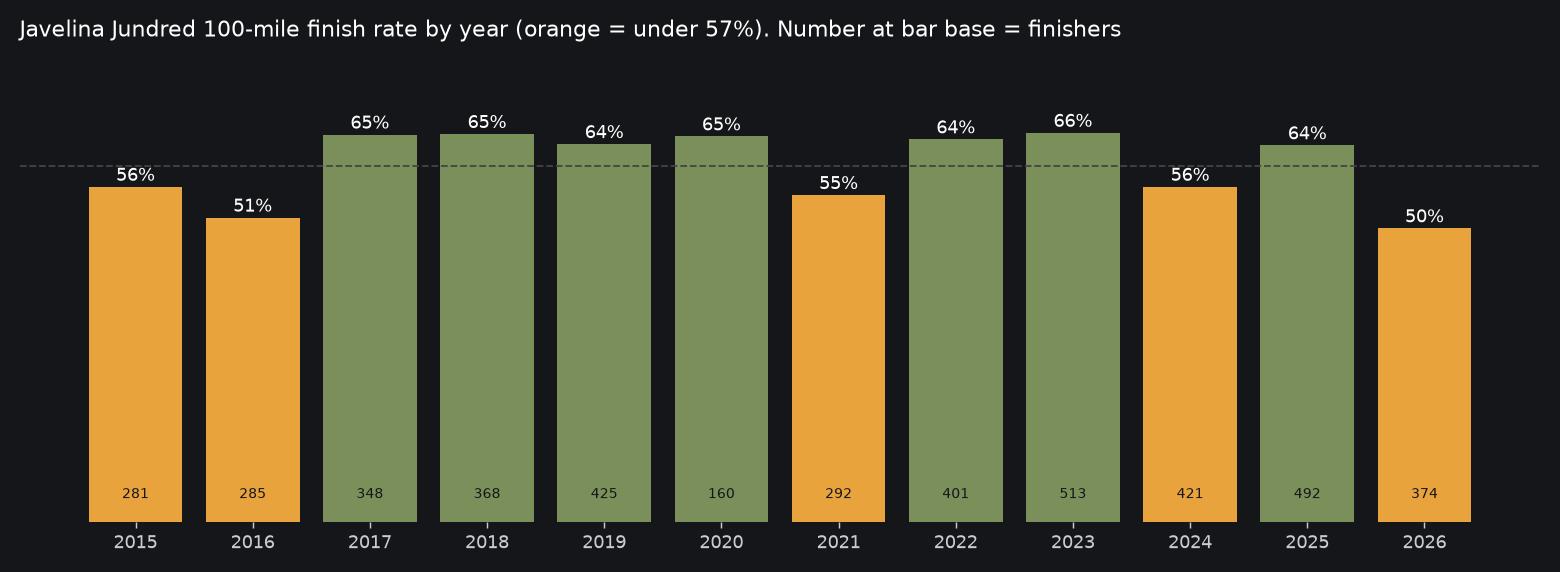
Chart: AZ Ultra Adventure, computed from UltraSignup results.
Five loops in McDowell Mountain Regional Park, about 6,300 feet of climbing, almost nothing technical. On paper it's the easiest trail 100 in Arizona. In the results it's the one that sends the most people home.
The three years tell three different stories. In 2024 the race-day high was 98°F, which Aravaipa's runner guide lists as the record high for the race, and 56.5% finished. In 2025 both 100-mile course records fell and 63.5% finished. In 2026, per our recap, heavy rain the night before left the course muddy and humid, and more people dropped (382) than finished (374). That is the lowest rate in the 12 years of results in our Javelina guide, where the full 2015-2026 table lives.
None of this surprises the organizer. Aravaipa's 2026 runner guide says the 100-mile finish rate has "hovered around 50%" and gives four reasons: heat, starting too fast, sandy washes and the temperature swing after sunset. Our 12-year table runs a little higher than that (49.5% to 65.6%), but the reasons hold up. Here is how I'd rank them, with two of my own added:
- No shade, on a 30-hour clock. Heat years and wet years both hurt. There is no cool canyon to recover in.
- Starting too fast. The smooth trail lets people run loop one at 100K pace.
- The sunset crash. The guide warns that the temperature can fall from the mid 80s to the mid 40s within a few hours of sunset, on runners who have been sweating all afternoon.
- The loop (my addition). Every lap ends at Jeadquarters, next to your crew, your chair and your car. Our guide's argument is that mile 61, the end of loop three, is where the race is won or lost, because you have to walk away from all of that into the night. I wrote about the same trap in loop or line.
- The field (my guess). It's big, and Javelina is widely recommended as a first 100, so I'd expect more first-timers here than at Mogollon or the Brute. I don't have entrant data to prove that.
The fix is boring: an ice bandana and a sun hoodie for the day, the fluid capacity the runner guide asks for (at least 50 ounces on loop one and 70 on loops two and three), a dry shirt and a real layer staged for loop four, and a crew that has been told not to offer the chair.
2. Stagecoach Line 100: 58.1%, on one year of data
Flagstaff to Tusayan on the Arizona Trail. The race manual lists about 7,000 feet of climbing, a start at 7,400 feet, a high point of 8,800 feet at mile 6 and a finish at 6,600 feet, so the whole course sits at altitude.
The only recent edition with DNF rows is 2024: 61 finishers, 44 DNFs, plus 3 who didn't start. That was a weather year. Our Stagecoach guide notes rain, sleet and hail. So 58.1% may be the bad end of this race's range, and I can't show you the good end because the other years list finishers only.
What drives it: a 32-hour limit with cutoffs that bite early (1 hour 45 minutes for the first 5 miles, which climb toward that high point), a hot exposed afternoon across Babbitt Ranch, then Boundary at mile 58, which back-of-pack runners reach hours after dark and close to its 11:00 PM cutoff. Per our guide, Boundary is where tired runners decide whether to face the night. The manual gives mid-September averages of about 70°F by day and 35°F at night, and the race makes a cold-weather drop bag at Boundary mandatory. A packable insulated jacket in that bag is cheap insurance.
3. Mogollon Monster 100: 60.0%
About 101 miles and 15,900 feet, six climbs up the Mogollon Rim, and the rocky Highline Trail in between. Rates of 60.6%, 63.4% and 56.9%. The field grew from 175 to 248 starters over those three years, and the newest, biggest year had the lowest rate.
I was one of the 128 finishers in 2025: 30:56:11, 39th. My watch data from that day, which is in our Mogollon guide, shows where this race does its damage. Fish Hatchery to Buck Springs, miles 27 to 43, took me close to five hours for 16 miles. That stretch includes the longest gap between aid stations on the course (12.5 miles), at the hottest part of the day, ending with the Myrtle climb. The race's runner guide singles it out too: it says runners have left Fish Hatchery underprepared for the hot, exposed miles, and that one handheld bottle will not be enough.
What drives it:
- Terrain first. This is the one race on the list where the course itself is the main reason.
- Afternoon heat at mile 27-40, followed by a cold night on top of the Rim at 7,500 feet and higher.
- A 38-hour limit that is fair but not soft. The last 30 miles took me about 11 hours.
- Remote aid. The runner guide calls Pinchot Cabin (mile 50.7) a no-drop aid station except for medical emergencies, because getting a runner from the top of the Rim back to the finish takes 2 to 3 hours. My guess is that it keeps some people moving who would otherwise stop.
Carry more water than feels reasonable out of Fish Hatchery. An extra pair of soft flasks and folding carbon poles earn their weight here.
4. Saddles 100: 62.8%
Prescott's grassroots single-loop 100, about 12,000 feet of gain, 34 hours. The field has quadrupled: 45 starters in 2023 (34 finished, 75.6%), then 77, 157 and 191. Rates since then: 55.8%, 66.9%, 62.3%.
What drives it is the cutoff design. Per the 2026 race manual in our Saddles guide, cutoffs are set at 3 mph and measured as the time you must leave each aid station. Three miles an hour sounds gentle. But every minute in a chair counts against you, and the early ones (Copper Basin at 8:00 AM, White Rock at 10:30 AM, after a 5:00 AM start) leave back-of-pack runners very little room. The night section through the Granite Dells is slow too, so bring a headlamp with real burn time and plan to eat while walking.
5. Coldwater Rumble 100: 65.0%
Javelina's January sister at Estrella Mountain Regional Park in Goodyear. More climbing than Javelina (about 8,700 feet), rockier, and by our guide's map measurements it has three gaps of about 8 miles between aid stations. And yet it finished a higher share of its field than Javelina in all three years on the current course: 68.0%, 67.4%, 61.9%.
Why it beats Javelina:
- Cool days. Even 2026, which the race's runner guide called a little warmer than usual, had a forecast high of about 75°F. Heat is mostly off the table.
- Two more hours. 32-hour limit against Javelina's 30.
- A smaller field. 75 to 147 starters. My guess is that people who pick a January desert 100 usually know what they signed up for.
What still takes out a third of the field is the night: about 13 hours of dark, with the race director warning that 40°F feels cold in the washes. The biggest field (2026) also had the lowest rate, as at Mogollon. The Coldwater guide has the full table back to 2014. Next race: January 16, 2027.
6. Fat Ox 100 Mile: 67.2%, tiny sample
A 0.99-mile loop on paved sidewalk, also at Estrella. Aravaipa's page doesn't publish a separate 100-mile cutoff. The 100 starts Friday at 9:00 AM and every race ends Sunday at 8:00 AM, which our Fat Ox guide works out to about 47 hours.
With 22 and 36 starters, one runner stopping moves the rate by three to five points. It went from 81.8% (2024) to 58.3% (2025). Don't read a trend into that.
Results can't tell me why the DNFs stopped. But 20 of the 21 finishers in 2025 were done inside 38 hours of a roughly 47-hour window, and our guide's view is that motivation and feet end more Fat Ox 100s than the clock does. A hundred miles of sidewalk is its own problem: a blister kit with real tape and a second pair of shoes a half size up matter more here than anywhere else on this list. The 2026 edition runs November 20-22, so there will be a new row for this table in about a week.
7. Bradshaw Brute 100: 69.8%, one edition
The opening 100 miles of the Cocodona 250 route, Black Canyon City to Prescott: 20,838 feet of climbing, a 25-mile section with more than 9,500 feet of it, no crew, no pacers, 38 hours.
UltraSignup's 2026 Cocodona results list the Brute with 30 finishers and 13 DNFs. The 2025 and 2024 Cocodona results pages don't list the distance at all, so as far as I can confirm, 2026 is the only edition with results.
Thirty of 43 is nearly 70% on what is, on paper, the hardest course on this list. I read that as a statement about the 43 people, not the course. A new, no-crew mountain 100 attached to Cocodona week, with an organizer recommending a previous 100, is likely to draw runners who already know how to look after themselves for 30-plus hours. If the field triples, I'd expect this number to fall, as Mogollon's and Coldwater's did in their biggest years. Our Brute guide has the aid stations and cutoffs. Next race: May 2, 2027.
8. Across the Years 100 Mile: 73.2%
A 1.42-mile loop at the Peoria Sports Complex over New Year's. Per our Across the Years guide, the race moved to Peoria for 2024-25, so the 2023-24 row above was run on the old Camelback Ranch loop in Glendale. For 2026-27, Aravaipa's page gives 100-mile runners 72 hours if they start December 28-31 and 48 hours if they start January 1. Rates: 73.0%, 75.8%, 70.9%, the steadiest line in the table.
It's the highest finish rate on this list, and still more than one runner in four stops short with three days on the clock. That says a lot about 100 miles. Very few people here are chased by a cutoff. From what our guide describes, they stop because of the cold (it notes past nights near 20°F), their feet, or the 60th identical lap.
Two more numbers from the same pages. In 2025-26, 15 of the 100 finishers ran under 24 hours, and in 2024-25 it was 17 of 100. And each of the three results lists shows at least one finish time past 72 hours (one in 2025-26, four in 2024-25, one in 2023-24). Either the limit was longer in those years or it wasn't applied to those rows. I couldn't confirm which.
What actually ends a 100-miler
The best survey I know of asked entrants at the 2009 Western States and Vermont 100s what went wrong, and got 500 responses from 701 entries. It's Hoffman and Fogard, 2011, in the International Journal of Sports Physiology and Performance (abstract on PubMed, full citation). Three findings from the abstract:
- Among non-finishers, the most common main reason for dropping was nausea or vomiting, at 23%.
- Nausea was not only a non-finisher problem. About the same share of finishers (36.8%) and non-finishers (39.6%) said it hurt their race. A lot of people finish through a bad stomach.
- Finishers were more likely than non-finishers to report blisters (40.1% against 17.3%) and muscle pain (36.5% against 20.1%). Wrecked feet are common at the finish line too.
The study also found nausea was no more common at the hotter of its two races. So it doesn't support the simple idea that heat alone wrecks stomachs, and it can't tell you why one Arizona race finishes 57% of its field and another 73%.
My own read of the Arizona table goes beyond the study, so treat it as opinion. The difference looks like recovery time. Nearly everyone has a bad patch. At Across the Years or Fat Ox you can sit down, eat, sleep for two hours and start again. At Javelina, Stagecoach and Saddles the clock doesn't leave room for that. At Mogollon the bad patch tends to arrive in the 12.5 miles between Fish Hatchery and Myrtle, where there is nowhere to sit it out.
What I'd take from the data, as a runner:
- Have a plan for your stomach. It was the top stated reason for dropping in that survey. Race on the food and the electrolyte mix you have trained with, and slow down in the hottest hours instead of pushing through them. Talk to your doctor before a hot 100 if you have any medical condition or take medication that affects how you handle heat.
- Know your race's real cutoff. At Saddles and Stagecoach it's the early aid stations. At Javelina it's the 30-hour total, plus the rule that you must start loop five by 6:00 AM Sunday (6:30 for wave two).
- Decide at home what would make you stop. On a loop course the chair, the crew and the car are all in one place. Related reading: the altered state of mile 80.
- Pack for the wrong weather. Javelina's worst year in 12 was a rain year. A light rain shell belongs in the bag even in the desert. See rain forecasts and drop-bag myths.
For crews
Look at which races sit at the hard end: an exposed loop where the crew area is the temptation, and two point-to-point races where the crew drives dirt roads for 30 hours. A crew with shade, ice, hot food and a dry place to change clothes can fix a lot of what ends races. A crew that agreed beforehand not to offer the chair can fix some of the rest.
That is what the AZ Ultra Van is meant to be: a base camp with a bed, a fridge and power at the crew zones where there is nothing else. It's a reservation-interest list right now. I'm not promising availability.
So which one should you pick?
- First 100, want the best odds: Coldwater in January or Across the Years. Cool weather and a longer clock.
- First 100, want the party: Javelina. Go in knowing that more than four in ten starters haven't finished over the last three years, and have a plan for leaving Jeadquarters at mile 61.
- Want the hardest course with fair odds: Mogollon Monster, once you have a 50-miler behind you.
- Want solitude and no crew logistics: the Brute, after another 100 or comparable backcountry experience, which is what Aravaipa recommends.
Two notes on what's not here. Antelope Canyon no longer has a 100, which our Antelope Canyon guide explains. And Desert Solstice is a track invitational with entry by invitation or qualifying standard, so a finish rate doesn't mean much there. For an out-of-state comparison, our San Diego 100 guide has that race at 67% in 2026 and 59% in 2025.
FAQ
What is the hardest 100-mile race in Arizona? By finish rate over the last three editions, Javelina Jundred at 56.5% (49.5% in 2026). By course, the Bradshaw Brute (20,838 ft, no crew or pacers) and the Mogollon Monster (15,900 ft). Those are different questions with different answers.
What is the Javelina Jundred finish rate? 49.5% in 2026, 63.5% in 2025 and 56.5% in 2024, counting finishers against finishers plus DNFs on UltraSignup. Over 2015-2026 it has ranged from 49.5% to 65.6%.
What is the Mogollon Monster finish rate? 56.9% in 2026 (141 of 248), 63.4% in 2025 (128 of 202) and 60.6% in 2024 (106 of 175), from RaceGoat's results pages.
Which Arizona 100-miler is easiest to finish? Across the Years has the highest rate, 73.2% over three editions, and a 72-hour limit for most start days. Among trail 100s with three editions counted, Coldwater Rumble is highest at 65.0%. The Bradshaw Brute's single edition came in at 69.8%.
Why do so many people DNF at Javelina if the course is easy? Aravaipa's runner guide lists heat, starting too fast, sandy washes and the temperature drop after sunset. Add a 30-hour limit and a loop that brings you past your crew and car about every 20 miles. The rate has moved as much as 14 points from one year to the next.
Is a DNS counted as a DNF? Not here. Runners who never started are excluded. Only people who started and didn't finish count against the rate.
Why are some finish rates missing? Some results pages list finishers only. For Stagecoach 2025 and 2026 and Fat Ox 2023, no DNF or starter count is published where I could find it, so I left those rates blank.
Who wrote this
Johnathon Lawson is a Gilbert, Arizona ultrarunner and the person behind AZ Ultra Adventure. He's a three-time 100-mile finisher: Zion 100 (2025, 28:34:36), Mogollon Monster 100 (2025, 30:56:11) and San Diego 100 (2026, 28:37:12). He ran the Pass Mountain 50 Miler on November 14, 2026. Of the eight Arizona races ranked here he has run only Mogollon; the rest is built from results pages, official race materials and our race guides. Follow his training on Strava, see his race history on UltraSignup, and find AZ Ultra Adventure on YouTube and Instagram.
Sources: UltraSignup results pages linked in the table (rows counted November 15, 2026); RaceGoat Mogollon Monster results for 2024-2026; the Arizona Trail Association's Stagecoach results page and 2026 runner manual; Aravaipa Running's pages for Javelina, Mogollon Monster, Coldwater, Cocodona and the Bradshaw Brute, Fat Ox and Across the Years, plus its 2026 Javelina, Coldwater and Mogollon runner guides and the 2027 Cocodona runner guide; the 2026 Saddles 100 race manual at saddles100.com; Hoffman and Fogard, "Factors related to successful completion of a 161-km ultramarathon," Int J Sports Physiol Perform, 2011;6(1):25-37. Time limits and climbing were checked against those official pages on November 15, 2026; other course details come from our race guides. Rates are computed by us. Check each race's current runner guide before you enter.
Some links are Amazon affiliate links. As an Amazon Associate we earn from qualifying purchases, at no extra cost to you.