 AZ Ultra Adventure
On this page
- What the van actually replaces
- Where a van can and can't go at Arizona races
- Setting it up: three zones, one rule
- The fridge and ice plan
- Power: lights, boots, phones, and no generator
- Sleeping the crew in shifts
- What to pack that the van doesn't come with
- Rent a van or book a hotel? The actual math
- When a van is the wrong call
- FAQ
The runner gets the buckle. The crew gets a camp chair, a gas-station sandwich and a race that can run 30 hours or more, most of it spent in a parking area.
Your runner has a plan for every mile. The crew usually has a sedan with a cooler wedged behind the driver's seat and four people's jackets on top of the food. By midnight nobody can find the headlamp batteries, the ice is water, and the person who has to drive a forest road at 3 AM hasn't slept since Friday.
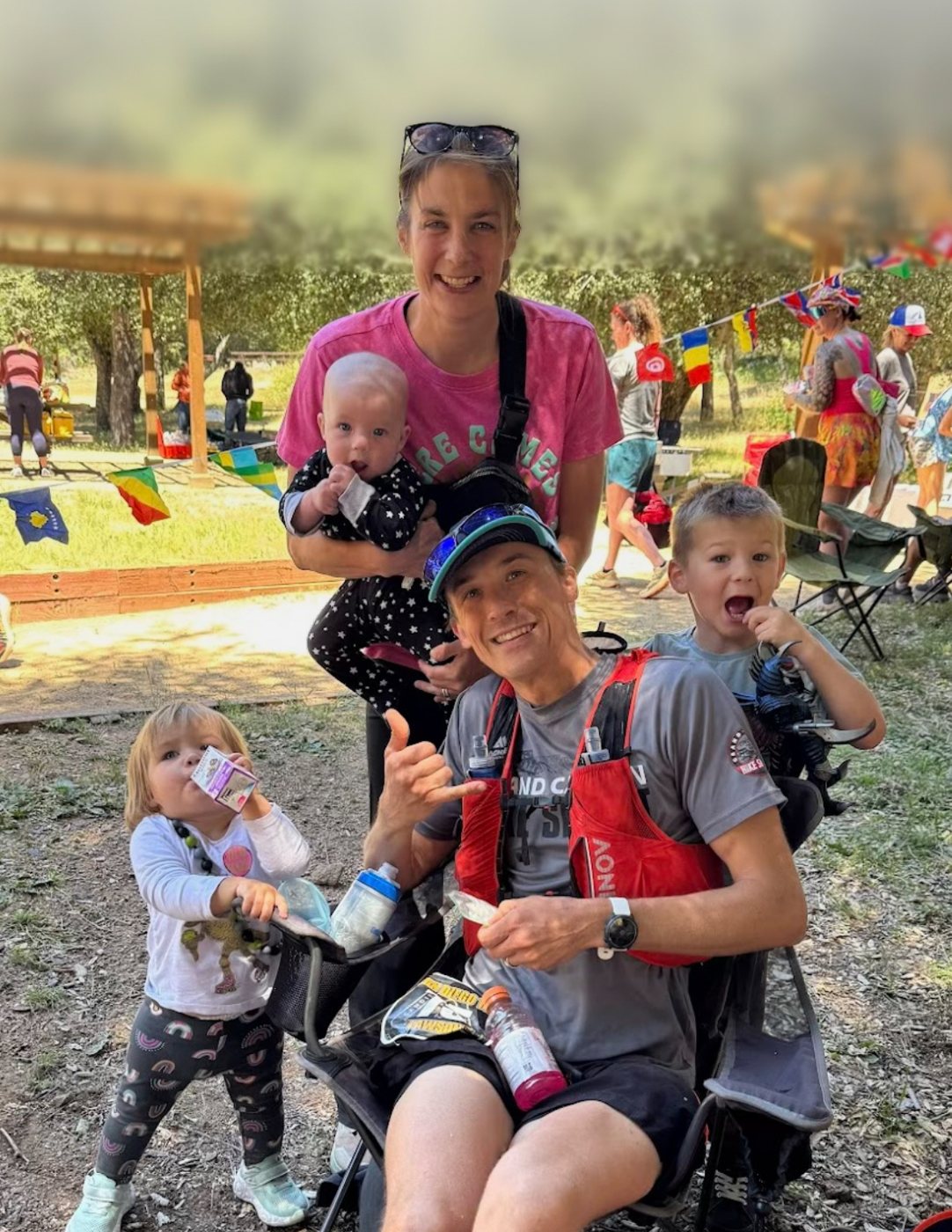
A camper van fixes most of that, and it creates a few new problems you need to know about before you rent one. This guide covers both, built from the crew and camping rules in our Arizona race guides, each race's official pages, and published specs for the gear. I'll be straight about my own experience: I've finished three 100-milers, and I have not crewed one out of a camper van yet. When I ran the San Diego 100 in May 2026, my wife Claire and our three kids crewed me from a cooler of cold chocolate milk. So this is a researched setup guide from the runner's side of the crew stop, not a van-life memoir.
What the van actually replaces
Think of a crew weekend as six jobs: shelter, cold storage, a kitchen, a bedroom, a power source and a gear closet. A car does none of them well. A van does five of them well and one of them (shelter at the course) only sometimes.
| Job | The usual way | With a camper van | What you still need |
|---|---|---|---|
| Bedroom | A hotel a drive away, or a tent | A real bed, parked where the race allows camping | A camping pass or a legal place to park overnight |
| Shade | 10x10 canopy | Awning at the sliding door | A canopy anyway at races where vehicles can't reach the crew zone |
| Cold storage | Cooler and daily ice runs | Powered fridge for food and drinks | A cooler for loose ice. A fridge keeps things cold, it doesn't make ice |
| Kitchen | Camp stove on a tailgate | Burner and sink inside, out of the wind | Fuel, a pot, broth, instant noodles |
| Power | Car USB port, a pile of battery packs | House battery and inverter | A written power budget (below) |
| Gear closet | Duffels on the back seat | Labeled bins on shelves or under the bed | Labels. Seriously |
The bedroom is the big one. A hotel puts your crew's sleep a drive away from where they need to be, so tired people skip it. A bed that's already at the race gets used.
Where a van can and can't go at Arizona races
Read this before you put a deposit on anything. Vehicle rules differ race to race and change by year. Everything below comes from our guides, which were built from each race's 2026 or 2027 official materials. Check the current runner guide and crew manual before race week.
| Race | Can you sleep in a van at the race? | The catch |
|---|---|---|
| Javelina Jundred | Yes, with a pass: RV dry camping (from Thursday in 2026) or a Fri-Sun car camping pass | No hookups, and no in-and-out on race day. In 2026 everyone without a camping permit parked on the park road and rode shuttles. Crew canopy spaces are a separate $100 reservation |
| Coldwater Rumble | Yes: tent, RV and car camping at the Competitive Track, $36 for Friday and Saturday nights | Crew is allowed at Horse Thief Aid, but no canopies and no camping there |
| Fat Ox | Yes: vans and car camping in the lot beside the venue, first come first served, one space per vehicle | RVs have to be reserved through the county park. $10 per car per day at the gate |
| Across the Years | Yes: free to bring a tent, canopy or RV | The RV lot opens Dec 27 at 2:00 PM for the 2026-27 race |
| Mogollon Monster | Crew zones are on Forest Service dirt roads on the Rim | One crew vehicle per runner with the pass on the dash. No 4x4 required, but the crew manual says high clearance makes it less stressful. No parking at Horton Trailhead or Geronimo |
| Stagecoach Line 100 | Backcountry crewing on ranch and forest roads | The RD recommends 4WD or AWD all weekend and strongly recommends high clearance for Boundary (mile 58). Low-clearance crews can skip Boundary and drive around to Russell Tank |
| Cocodona 250 and Sedona Canyons 125 | A crew vehicle within a quarter mile of a crew-access aid station counts as on course | One vehicle per runner, 25 feet max, no trailers. The Whiskey Row parking garage in Prescott has a 7'10" clearance |
| Arizona Monster 300 | Runners may sleep in the crew vehicle at an aid station | 20 feet long and 8.5 feet wide, maximum. No RVs or trailers. Arrive no more than 30 minutes before your runner. No crew camping at aid stations |
| Bradshaw Brute 100 | Camping at the start from 1:00 PM Saturday (cars, vans, trailers, RVs) | No crew access on the course at all. The van is for the start and the finish |
Three numbers to get from the rental listing
- Length. Many long-wheelbase conversions run past 20 feet. That matters for the Arizona Monster's 20-foot limit and Cocodona's 25. Get the exact number.
- Height. Our Cocodona guide notes tall vans won't fit the 7'10" Whiskey Row garage. In Prescott that means a surface lot or the street.
- Clearance and drive wheels. One 2026 Cocodona crew report in our guide needed 90 minutes in a low 2WD van for the Bumble Bee to Crown King road, which the race lists at about an hour. A low van should not be your plan for Lockwood Canyon at the Stagecoach.
Also ask the rental company about unpaved roads before you book. The Mogollon Rim crew zones are all on dirt, and I couldn't check every company's terms.
That card is for the AZ Ultra Van, so here is exactly what it is. AZ Ultra Vans is my project, and it's a reservation-interest waitlist. The first van is being built for the 2027 race season. The van site shows a planned layout (a high-roof Sprinter with a fridge, a galley, a bed over a gear garage, an awning and a battery bank) and says plainly that the first van may differ in details. Joining the list is free, takes no payment and commits you to nothing. It also isn't a booking. We'll reach out if a van is available for your dates, and I can't promise one will be. If no van is available, everything in this guide works with any rental.
Setting it up: three zones, one rule
The rule: the runner never has to step inside the van during the race. Everything they need comes out to them.
Zone 1, the pit (outside the sliding door). Awning out, two chairs, a small table. On the table: the next two bottles already filled, the food for this stop, and one bin for the next section (night, heat or feet). The chair faces the trail, not the bed. Our first-time crew guide covers how to run the stop itself.
Zone 2, the kitchen (just inside the door). Fridge, burner, a pot of broth on low during the cold hours, and the sink for refilling flasks. Whoever is on shift stands here, with a trash bag clipped by the door.
Zone 3, the bedroom (the back). This belongs to the off-shift crew member. Cover the windows, crack the vent fan, and keep race gear out of it. If bins live on the bed, nobody sleeps.
Label bins by need, not by owner: heat, night, feet, fuel, finish. At 2 AM, asking for the feet bin gets you the feet bin. Asking for the blue bag starts a search.
At a loop race like Javelina, the van and the pit may be in two different places. Camping vehicles park in their assigned lots, and the reserved canopy spaces are in the crew zones, where no tents are allowed. There, the van is your bedroom, kitchen and fridge, and a folding wagon runs supplies to the canopy.
The fridge and ice plan
A fridge and a cooler do different jobs, and you want both.
The fridge holds food and drinks. Real food for the crew, plus the runner's cold calories. Mine is whole chocolate milk, and I've written up why. Pre-chill everything at home, so the fridge only has to keep cold things cold.
The cooler holds ice. Loose ice for bandanas, hats, arm sleeves and bottles, plus backup ice for drinks. A few ways to stretch it:
- Freeze water jugs solid at home and use them as the base layer. They become cold drinking water on Sunday.
- Keep the ice cooler closed and in the van's shade. Use a small second cooler for the pit so the main one isn't opened every stop.
- Know your resupply. Our Cocodona guide notes the Crown King General Store has gas, food and ice. On the Mogollon Rim there are no services for about 30 hours, so what you bring is what you have.
I'm not giving a pounds-of-ice-per-hour number, because I couldn't find one I'd trust. Check the runner guide for whether aid stations provide ice, then plan your own supply for crew stops.
If your rental has no fridge, a 12V compressor fridge runs from a power station and is the single most useful add-on for a desert race.
Power: lights, boots, phones, and no generator
Start with the rule that surprises people: Javelina's camping rules say no generators or open flames. Assume battery power at any race until the runner guide says otherwise. That's fine, because a crew base camp needs less power than you'd think, as long as you keep the big loads off.
The math is watts times hours equals watt-hours. Add up a day, then compare it to the battery.
| Load | What published numbers say | What it means for race weekend |
|---|---|---|
| 12V compressor fridge | Power-station makers' guides disagree. The estimates I found ran from about 250 to more than 800 watt-hours a day for a mid-size fridge, with heat pushing it up | The biggest steady draw. Plan on the high end in the desert: at 800 Wh a day, a 1,000 Wh station lasts a little over one day. At 400, about two and a half |
| Compression boots | Normatec 3 listings claim up to about 3 hours per charge on the built-in battery. One retailer spec lists a 15-volt, 1-amp charger | Tiny. Charge them at home and they may not need the van's power at all |
| Phones, watches, headlamps, LED string lights | Small. Check each label | One charging hub so nothing gets lost. Light the pit so your runner can spot it |
| Rooftop AC, electric heater, electric kettle | Large. Check the label | These drain a house battery overnight. Use the vent fan, sleeping bags and a gas burner instead |
Two Arizona notes. First, Rogue Fitness's Normatec 3 product guide warns against leaving the unit in extreme temperatures such as a hot car, and that goes for every lithium battery you bring. Keep them in the shade. Second, if you're adding your own portable power station, charge it to full before you leave and treat it as a fixed budget.
About the boots: I'm not making a recovery claim for them here, because I didn't pull a study I'd stake one on. What they do is keep a finisher lying down with their legs up for half an hour. If you want a pair, leg compression boots with a built-in battery are the easy kind to use at a race.
Sleeping the crew in shifts
This is the real reason to bring a bed. The CDC's NIOSH training materials say being awake for 17 hours is similar to a blood alcohol concentration of 0.05%, and 24 hours is similar to 0.10%. A solo crew chief at a 30-hour race passes both marks and then drives home.
Take the Mogollon Monster, which I finished in 30:56:11 in 2025. Per the crew manual details in our Mogollon guide, the crew day starts by dropping the runner at the shuttle around 4:15 AM. The runner reaches Black Mesa 4 to 6 hours in, Buck Springs (mile 43) usually 5 to 7 hours after that, General Springs (mile 57) late at night, and then there's a long gap until Dickerson Flat (mile 84.3) on Sunday morning. That overnight gap is the only real rest a Mogollon crew gets. A two-person crew with a bed can use every gap instead of just that one.
| Window | Driver A | Driver B |
|---|---|---|
| Shuttle drop to Black Mesa | Drives and leads the stop | Naps on the drive up, helps at the stop |
| Black Mesa to Buck Springs (the long afternoon gap) | Sleeps 2-3 hours once you're parked | Restocks the pit, fills bottles, watches tracking |
| Buck Springs and General Springs (evening into night) | Leads both stops | Drives between them |
| General Springs to Dickerson Flat (overnight gap) | First watch, then sleeps | Sleeps first, then takes over and drives |
| Dickerson Flat to the finish in Pine | Leads the stop | Drives. Whoever slept most recently drives home |
The rules that make it work:
- Assign shifts before the race, on paper, taped inside the van. Tired people don't volunteer to sleep.
- The person who slept most recently drives. No exceptions.
- Set two alarms and work backward from the tracker. Be set up at the next stop before your runner's fastest estimate.
- Make the bed dark and quiet. Earplugs and an eye mask cost almost nothing.
- Park legally. Sleep only where the race allows it. On national forest land, check the ranger district's dispersed camping rules and fire restrictions first.
Can the runner sleep in the van?
At a 100-miler, usually they shouldn't. Our race guides keep making the same point: the chair is where races end, and a bed is a chair with a blanket. Keep the runner outside in Zone 1.
Multi-day races are different. Cocodona and the Sedona Canyons 125 treat a crew vehicle parked within a quarter mile of a crew-access aid station as on course, and the Arizona Monster lets runners sleep in the crew vehicle at an aid station. Crew reports in our Cocodona guide say several runners slept far better in the crew vehicle than in a loud sleep station. There, a bed is race equipment.
What to pack that the van doesn't come with
Rentals vary a lot. Ask for an inventory, then fill the gaps:
- Chairs for the pit. Two lightweight folding camp chairs, one for the runner and one for whoever is working on their feet.
- Bins. Five stackable clear bins with lids and a marker.
- Light. USB string lights for the awning and a rechargeable headlamp with a red mode for each crew member, so nobody blinds the runner.
- Hot drinks. An insulated beverage dispenser filled with broth before the cold hours, so nobody is boiling water mid-stop.
- Warm sleep gear. Javelina drops into the 40s at night, Coldwater sits near freezing, and Mogollon crews are at about 7,500 feet at 3 AM. Bring real sleeping bags even if the listing includes bedding.
- Paper. The printed crew manual and written directions. Several Arizona crew zones have little or no cell signal, and the Stagecoach RD says to follow the manual on forest roads instead of your phone.
- The boring kit. Trash bags, paper towels, a tarp for muddy shoes, and cash for park gates. Javelina's page says $7 per vehicle per day and its guide says $10. Coldwater and Fat Ox list $10.
Rent a van or book a hotel? The actual math
Prices I could confirm, as of November 2026:
- Peer-to-peer rentals in Phoenix. Camper Champ lists Class B rentals in Phoenix from $75 a night, with an average of $169. Sample RVnGO listings showed ProMaster-style vans at $180 a night with a 3-night minimum, and a 2024 Sprinter at $249.
- Rental companies. Escape Campervans' Phoenix page says camper vans in Arizona average $90 to $160 a day, with prices rising January through April. That's Coldwater (January), Black Canyon (February) and the spring races.
- Mileage. The same Escape page says most camper vans carry a fee of about 30 to 40 cents a mile. One Phoenix listing charged $0.35 per extra mile. At that rate, 400 miles over your allowance is $140.
- AZ Ultra Vans. The planned launch rate for a race weekend (2-3 nights) is from $225 a night, with a crew kit and recovery kit included. That's a planned rate. It may change, and the van isn't bookable yet.
- Extras. Cleaning fees, a protection plan, fuel, and a camping pass. Race camping runs from free (Across the Years) or included with entry (Fat Ox) to $36 for the weekend (Coldwater). The Zion 100 ranch charged $125 to $165 a site in 2026. Javelina's page didn't list camping prices when I checked.
I couldn't confirm a hotel rate worth printing, so use your own quote. Here's the break-even:
Van total ÷ (rooms × nights) = the room rate where the van wins.
A three-night rental at the $169 Phoenix average is $507 before fees. If your crew would otherwise need two rooms for two nights, that's four room-nights, and the van breaks even at about $127 a room. At $225 a night ($675), it breaks even near $169 a room. Add the rental's fees to the van side before you compare.
A van rarely wins on price for one crew person at a race 30 minutes from home. It makes the most sense when there are three or more of you, the race is remote, and the alternative is a hotel nobody will sleep in.
When a van is the wrong call
- The race is close to home. Coldwater is 30 to 40 minutes from most of the Phoenix metro. A second crew member who shows up fresh at midnight beats a bed.
- The roads are the problem. At the Stagecoach, a high-clearance truck and a tent can beat a low van.
- Parking is tiny. Walnut Canyon at Cocodona and Green Valley at the San Diego 100 are tight, and a long vehicle makes them tighter.
- Nobody on the crew wants to drive it. A tall, unfamiliar vehicle on a dark forest road is its own risk. Practice in daylight first.
Still choosing a race? Our comparison of which Arizona 100-miler to run first covers how crew-friendly each one is, and the 2027 Arizona ultra calendar has the dates.
FAQ
Can I sleep in a camper van at Javelina Jundred? Yes, with a camping pass bought at registration. In 2026 the options were RV dry camping (no hookups, check-in from Thursday) and a Friday-to-Sunday car camping pass with no in-and-out on race day. Vehicles without a camping permit parked on the main park road and used the shuttles. Check the current Javelina page for 2027.
Can I run a generator at the race? Not at Javelina, where the camping rules say no generators or open flames. Other races vary, so read the runner guide. Plan on battery power.
Do I need 4WD or high clearance to crew from a van in Arizona? For most races, no. Javelina, Coldwater and Fat Ox are in county regional parks and Across the Years is at a city sports complex. Mogollon doesn't require 4x4, though its crew manual favors high clearance. The Stagecoach Line 100 is the exception: the RD strongly recommends high clearance for Boundary.
What does it cost to rent a camper van for a race weekend in Phoenix? Listings I checked in November 2026 ran from about $75 to $250 a night, with an average of $169 on one aggregator, a 3-night minimum on some, and per-mile fees around 30 to 40 cents. Cleaning and protection plans are extra.
Can I book the AZ Ultra Van right now? No. It's a reservation-interest waitlist. The first van is being built for the 2027 season, joining is free with no payment, and it isn't a booking or a promise that a van will be available for your race.
Who wrote this
Johnathon Lawson is a trail runner from Gilbert, Arizona, and the person behind AZ Ultra Adventure and AZ Ultra Vans. He has finished the Zion 100 (2025, 28:34:36), the Mogollon Monster 100 (2025, 30:56:11) and the San Diego 100 (2026, 28:37:12). He has not yet crewed a race from a camper van; this guide is research from race rules and published specs. Follow his training on Strava, see his results on UltraSignup, and find AZ Ultra Adventure on YouTube and Instagram.
Sources: our race guides linked above and the official materials they cite; Aravaipa's Javelina Jundred page (camping, parking and generator rule, checked Nov 15, 2026); CDC NIOSH on hours awake; Escape Campervans Phoenix, Camper Champ and RVnGO (rental price snapshots); fridge estimates from Bluetti and Anker; the Rogue Fitness Normatec 3 guide; and the AZ Ultra Vans site (planned layout and rates). Rules and prices change. Check the current runner guide and crew manual before race week. AZ Ultra Vans is not affiliated with Aravaipa Running or any race.
Some links are Amazon affiliate links. As an Amazon Associate we earn from qualifying purchases, at no extra cost to you.