 AZ Ultra Adventure
On this page
Javelina Jundred doesn't have a mountain in it. It's five loops of smooth desert trail north of Fountain Hills, your crew never moves the car, and in 2026 only 49.5% of the people who started the 100 finished it. The average high on race day is 82°F, the record is 98°F (2024), and there is no shade anywhere on the loop. The heat is the mountain.
That's true of more Arizona races than people expect, including some in February and March. This page is the heat companion to our race guides. It covers what the research says about getting your body ready, what to do with ice at an aid station, how much to drink and how much sodium to take with it, and the part nobody likes to plan for: the signs that mean your race is over for today.
I live and train in Gilbert, so heat is most of my year. But I'm a runner and a coach, not a doctor. Every medical claim below is tied to a source listed at the bottom, and where the sources disagree or don't say, I've told you that instead of guessing.
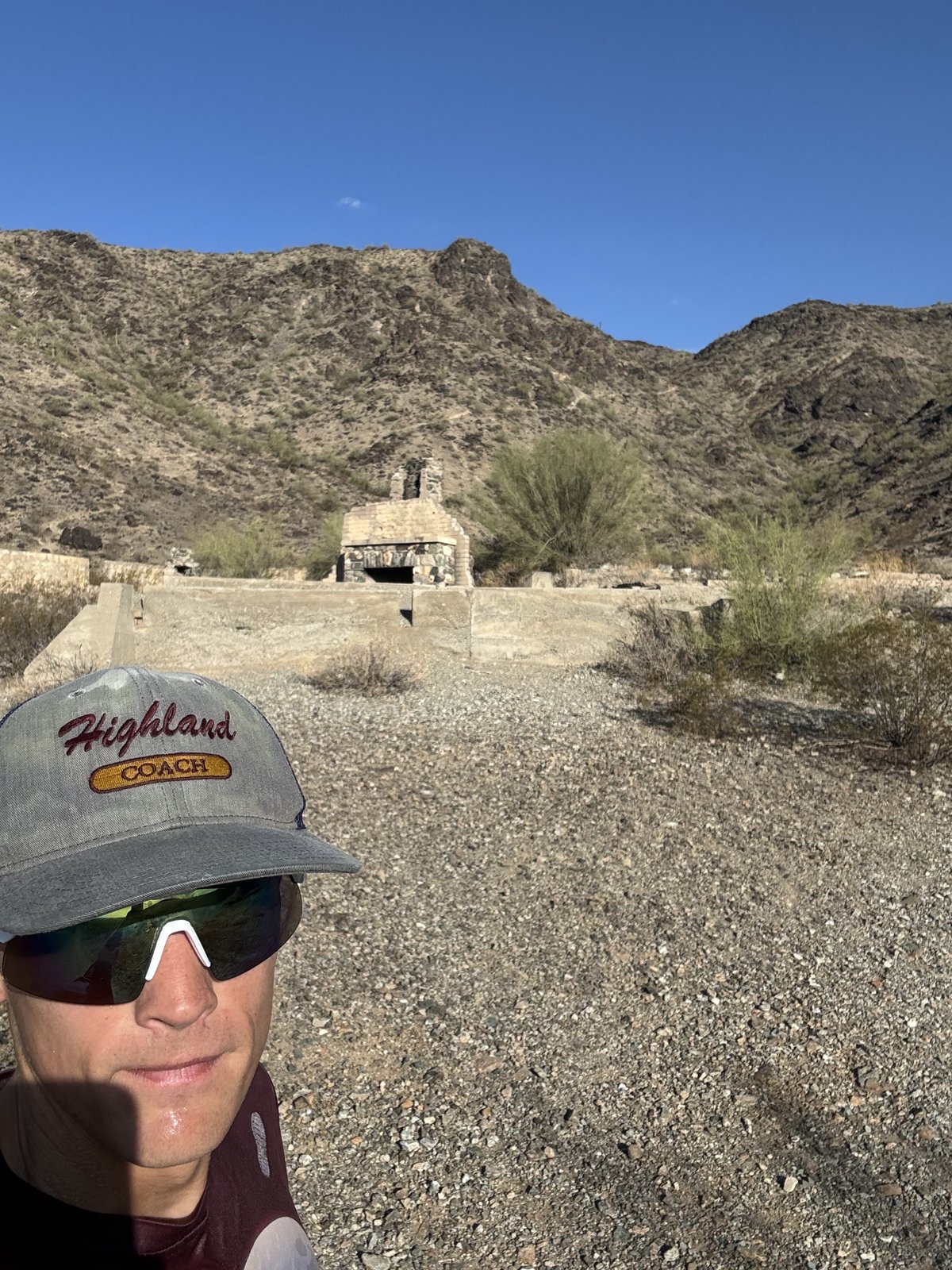
Which Arizona races are the hot ones
Race facts here come from our own guides, which are built from each race's official pages. Dates change every year, so follow the link and check the race site before you plan around one.
| Race | Next edition | Where the heat gets you |
|---|---|---|
| Javelina Jundred | Halloween weekend 2027 (date not announced) | Everywhere in daylight. Loops 2 and 3 run midday to dusk, and the 6.5 miles from Coyote Camp to Jackass Junction is the longest gap. The race guide says to carry at least 50 oz on loop 1 and 70 oz on loops 2 and 3 |
| Aravaipa's summer night series (Sinister through Jangover) | Apr 24 to Sep 18, 2027 | Sunset starts, usually in the 90s or hotter. The first loop is the hot one, then it cools |
| Arizona Monster 300 | Mar 29 to Apr 4, 2027 | The first 100 miles, and about 22 dry miles from Gila River to Picket Post at the end. In 2026, two runners went to the hospital with heat stroke early in the race |
| Cocodona 250 and Bradshaw Brute 100 | Start May 2, 2027 | Day one. Cottonwood Creek to Lane Mountain is 25.1 miles with about 9,500 feet of climbing and only two 1-liter water stops |
| Sedona Canyons 125 | May 4-7, 2027 | Deer Pass to Sedona Ranger Station, miles 24 to 40, with no crew until mile 40.3 |
| Mogollon Monster 100 | Sep 11, 2027 | Fish Hatchery (27.1) along the Highline and up Myrtle to Buck Springs (43.1), in the middle of the afternoon |
| Black Canyon 100K | Feb 13, 2027 | It starts in the 30s, which is the trick. The exposed back half is the hot part, and runners drop near mile 46 with heat and nausea |
| Zion 100 (Utah) | Apr 10, 2027 | The desert floor after Virgin Desert (42.9), then about 2,500 feet up Smith Mesa in the late afternoon |
| San Diego 100 (California) | Apr 30, 2027 | Miles 29 to 41 and the bottom of Noble Canyon. The official guide still says to expect highs in the mid-80s |
| Coldwater Rumble 100 | Jan 16, 2027 | A winter race with a shadeless afternoon in the 60s to mid-70s, then a 30 to 40 degree drop after dark |
| Crown King Scramble 50K | Mar 20, 2027 | The first 17 miles of low desert before the climb into the pines |
Two things stand out in that table. First, the spring races are the sneaky ones. By March and April most of us have spent four months running in cool mornings, and whatever heat tolerance we built last summer has faded. Then the Arizona Monster or Zion hands us an 85-degree afternoon. Second, the hot section is almost never at the start. It's 25 to 45 miles in, when you're already behind on food.
For the far end of the scale, there's Badwater 135 in Death Valley in July, where the crew handles ice with a scoop and gloves and heat-trains alongside the runner. Our 2027 Arizona calendar has every race by month if you want to plan around the season.
Heat acclimation: what was actually tested
Heat training gets passed around as folk wisdom, so here are the protocols that researchers ran, with their numbers.
| Method | What the study did | What changed | Limits |
|---|---|---|---|
| Hot bath after a run | A 40-minute treadmill run at moderate effort in a cool room, then straight into a 40°C (104°F) bath for 40 minutes, six days in a row | Resting core temperature dropped 0.27°C, and 5 km time-trial performance in 33°C (91°F) heat improved 4.9%. No change in the cool-room time trial | 17 men who weren't heat-acclimated. Zurawlew and colleagues, 2016 |
| Sauna after training | About 30 minutes in a humid sauna at roughly 90°C (194°F) right after training, about 13 sessions over three weeks | Plasma volume rose 7.1% and run time to exhaustion rose 32%, which the authors put at about 1.9% in a time trial | Six male distance runners. Scoon and colleagues, 2007 |
| Training in the heat | The 2015 consensus recommendation: at least 60 minutes a day of exercise that raises core and skin temperature and makes you sweat, for one to two weeks | Most adaptations show up in the first week, and the rest come more slowly over the next two | Trained athletes adapt faster. This is the standard method |
The 2015 consensus statement is by Racinais and colleagues, a sports-medicine panel. Three cautions before you copy any of it.
These are small studies on healthy men, supervised by researchers. Neither one tested a 55-year-old with high blood pressure, and neither one tested a 100-mile race. The principle carries over. The exact numbers may not.
The bath and the sauna come after the run, not instead of it. In both studies the heat exposure followed normal training. You go in already warm, which is the point, and it's also why you need to be careful.
Start shorter than the protocol. Forty minutes at 104°F is a long time. Ten to fifteen minutes is a sensible first session, building over a week (that's my caution, not the study's). Get out if you feel dizzy, sick, or get a headache. Don't do it home alone, stand up slowly, and drink afterward. If you have a heart or kidney condition, are pregnant, or take medication that affects how you handle heat, ask your doctor before trying any of this.
Timing it before race day
The consensus statement gives two numbers that set the schedule: adaptation takes one to two weeks, and most of the benefit is kept for two to four weeks afterward. It also says getting it back a second time is quicker than building it the first time.
The studies don't lay out a race calendar, so the schedule below is my reading of those numbers and not a tested protocol:
- Three weeks out: start. Three or four sessions in the first week, short ones.
- Two weeks out: the main block. Five or six sessions, building toward 30 to 40 minutes if you're tolerating it.
- Race week: stop or cut to one or two short sessions. I'd rather show up rested and hydrated than squeeze in one more sauna on Thursday.
If you live here and your race is in September or October, you may not need any of this, as long as some of your summer running happened in actual sun and not only at 4 AM. If your race is in spring, or you're flying to Javelina from somewhere that's already had frost, the bath protocol is the cheapest tool there is. It costs a tub and a bath thermometer.
Cooling at aid stations: the 90-second ice routine
The Javelina race guide makes a point worth repeating: put the ice on your skin and not in your stomach. It warns that ice-cold water in the heat causes GI trouble. The consensus statement lists cold garments and ice vests as practical tools too. They lower skin temperature, which is the part you can change at an aid station, even though they don't cool the working muscle.
So the aim at a hot aid station isn't a break. It's to leave colder than you came in. In order:
- Hat off, ice in. A handful in the crown of the hat, hat back on. It melts down your head and neck for the next 20 minutes.
- Neck. Refill an ice bandana and tie it so the ice sits against the back and sides of your neck. Our Javelina guide notes that former course record holder Patrick Reagan swore by this in an UltraRunning column.
- Sleeves. White cooling arm sleeves or a light sun hoodie hold water against your skin, and in dry Arizona air that water evaporates fast, which is what cools you. Soak them. A few cubes down each sleeve at the wrist is a bonus.
- Bottles. One water, one drink mix, mixed weaker than the label. In our San Diego 100 guide there's a 2026 finisher whose drink mix, mixed too strong in the sun, came back up in Noble Canyon.
- Head and shirt. A sponge or a cup of water over the head and down the back. At a creek crossing, do the same. The Mogollon guide says to soak in any water you cross between Fish Hatchery and Myrtle.
- Walk out eating. The San Diego 100's advice is to eat before the heat, because eating gets hard once you're hot. The few minutes after an ice-up are your next best window.
Practice it on a long run before race day with a bag of gas-station ice in the car. The first time takes four minutes and you'll drop half of it.
Covering up beats stripping down. On a course with no shade, a hat with a brim or a cap with a neck cape and a long-sleeve sun layer give you something to keep wet. Reapply a sweat-resistant sunscreen stick at crew stops.
Slowing down is cooling too. Your muscles make the heat. The same warning shows up in the Javelina, Black Canyon and Bradshaw Brute guides: people run the easy early miles too fast and pay for it in the hot section. At Mogollon in 2025, the 16 miles from Fish Hatchery to Buck Springs took me close to five hours. That's what an afternoon on the Highline costs, and trying to make it cost less is how people end up in a chair at mile 43.
Fluid and sodium math
There are two ways to get this wrong, and they're opposites.
Too little. The consensus statement says performance starts to suffer once you've lost more than about 2% of your body weight in fluid, and that drinking to thirst usually lands people at a 2 to 3% loss. For a 165-pound runner, 2% is 3.3 pounds.
Too much. Exercise-associated hyponatremia is low blood sodium, and the Wilderness Medical Society guidelines (summarized in American Family Physician, 2021) say the usual cause is drinking more than you need, of water or sports drink. Their prevention advice is short: drink when you're thirsty. They add that no specific fluid volume has been shown to prevent it, and that sodium supplements won't prevent it if you're overdrinking. Bloating, puffy hands, weight gain and no thirst point toward too much fluid, not too little. The same summary lists common anti-inflammatory painkillers among the things that can make the problem more likely.
So the plan is thirst, checked against a number you measured.
Find your sweat rate
- Weigh yourself without clothes before a one-hour run in conditions like your race. A basic bathroom scale is fine.
- Run for an hour. Keep track of exactly how much you drink.
- Towel off and weigh again.
Each pound lost is about 16 oz of sweat. Add what you drank. Say you lost 1.5 pounds and drank 16 oz: that's 24 + 16 = 40 oz an hour (about 1.2 liters).
You are not trying to drink 40 oz an hour. You're trying to stay inside that 2 to 3% window over a long day, and 40 oz is a lot to ask of a stomach hour after hour. What the number tells you is whether your race plan is realistic. If you sweat 40 oz an hour and the next aid station is two hours away, two 17 oz flasks aren't enough. That's the logic behind Javelina's 50 and 70 oz recommendation, and behind runners filling up to 4 liters at Cottonwood Creek at Cocodona.
Sodium
The consensus statement's range for exercise lasting over an hour is 0.5 to 0.7 grams of sodium per liter of fluid, and up to 1.5 g per liter for people prone to cramping. It puts sweat sodium anywhere from 20 to 70 mEq per liter, which works out to roughly 460 to 1,610 mg per liter. That's a huge spread between people, which is why your training partner's salt plan may not be yours.
Here's the standard range turned into per-hour numbers:
| If you drink this much per hour | Sodium at 500 to 700 mg per liter |
|---|---|
| 16 oz (0.47 L) | 235 to 330 mg |
| 24 oz (0.71 L) | 355 to 500 mg |
| 32 oz (0.95 L) | 475 to 665 mg |
| 40 oz (1.18 L) | 590 to 830 mg |
Count everything: the electrolyte drink mix in your bottle, plus broth, pickles, chips and whatever else you eat at the table. Read the label on your mix, because sodium per serving varies a lot between brands. NIOSH's first-aid page for heat cramps, written for outdoor workers, says to use water plus a snack or an electrolyte drink and to avoid salt tablets. Ultra aid stations work the same way, with broth, pickles and chips on the table.
For the food side of this, see our 50-mile calorie budget.
Warning signs: slow down, stop, or get help
This table combines the CDC/NIOSH heat illness list, the Korey Stringer Institute's heat stroke guidance and the Wilderness Medical Society's hyponatremia guidelines. Race medical staff outrank this page every time.
| What you see | What it may be | What to do |
|---|---|---|
| Cramps, heavy sweating, feeling flat | Heat cramps or early heat strain | Slow to a walk. Fluids and salty food at the next aid. Ice up. NIOSH says to get medical help if cramps don't ease within an hour |
| Dizzy or briefly faint when you stop or stand up | Heat syncope | Sit or lie down in shade and sip fluids. Don't leave until you can stand without it coming back |
| Headache, nausea, weakness, irritability, heavy sweating, very little urine | Heat exhaustion | Stop. Shade, ice, wet cloths on head and neck, sips of cool fluid, extra clothing off. Have someone stay with you and get checked by medical, which is what NIOSH advises. If it isn't clearly improving, your race is done |
| Confusion, slurred speech, stumbling, strange behavior, collapse, seizure. Skin may be dry or still pouring sweat | Heat stroke | Emergency. Get medical or call 911. Start cooling right away with ice water, wet towels and ice at the neck, armpits and groin, and don't wait for the ambulance |
| Bloated, puffy hands, weight up, not thirsty, nausea or headache, drank a lot | Possible hyponatremia | Stop drinking plain water and get to medical. The guidelines list salty broth for mild cases. Confusion or vomiting makes it an emergency |
| Dark, tea- or cola-colored urine with muscle pain or weakness | Possible rhabdomyolysis | Stop. NIOSH says to seek immediate medical care and ask for a creatine kinase blood test |
The row that matters most is heat stroke. The Korey Stringer Institute defines it as a core temperature above 105°F with brain symptoms (other sources draw the line at 104°F), and says survival has been 100% when aggressive cooling started within 10 minutes of collapse. Their instruction is to begin whole-body cold-water cooling within 30 minutes and to keep cooling instead of rushing to move the person: "cool first, transport second." At a desert aid station that means every cooler of ice water and every wet towel goes on the runner while someone else gets medical.
Notice that the person in trouble is the last to know. A confused runner will tell you they're fine. That's why this section is for pacers and crew as much as runners, and why the chief in our crew chief playbook can overrule the runner on everything except medical, where the medical team decides.
Simple rules for stopping. If your thinking or your balance changes in the heat, you're done, and you say so out loud to a volunteer. Stomach trouble that eases after 15 minutes of shade and ice is something to manage. Symptoms that keep getting worse in the shade are a reason to stop and get checked. No finish is worth a hospital bed, and both Arizona Monster runners who were hospitalized in 2026 were near the start of a 300-mile race.
For the crew
Heat makes the crew's job simple: your runner needs cold and shade, and both are hard to keep going in a dirt lot for 30 hours.
- Ice discipline. The system from our Badwater guide works anywhere: one cooler for clean ice that only a scoop touches, one for drinks, one for food. A 5-gallon cooler with a spigot of ice water fills bottles and soaks sleeves fast.
- Shade first. A pop-up canopy if the race allows one. For Javelina, the crew canopy and shuttle setup is in our Javelina guide, and First-Time Crew at Javelina covers the weekend from the crew's side.
- Run the ice routine for them. Hat, bandana, sleeves, bottles. The runner shouldn't have to ask.
- Watch how they talk. You know how your runner sounds at mile 20. If the words come out wrong at mile 45, find medical.
- Don't cook yourselves. The crew stands in the same sun for longer than the runner does.
That card is the idea we're testing with AZ Ultra Vans: a crew base with real shade at 2 PM, a fridge so the ice is still ice on Sunday morning, and a bed for whoever isn't on shift. It's a reservation-interest waitlist for now, and availability isn't guaranteed.
The heat kit
Everything linked above, in one checklist:
- On you: ice bandana, a hat that holds ice, a sun hoodie or white arm sleeves, sunscreen stick.
- To carry water: a hydration vest with two soft flasks and room for a third bottle on long gaps, like Javelina's 6.5 miles or the 11.9-mile Telegraph Canyon stretch at Copper Corridor.
- In the bottle: electrolyte drink mix with a sodium number you know.
- For the crew: a spigot cooler of ice water, a clean ice scoop and a canopy.
- At home: a bath thermometer and a bathroom scale.
FAQ
How long does heat acclimation take? One to two weeks of daily exposure, according to the 2015 consensus statement, with most of the adaptation in the first week. It recommends sessions of at least 60 minutes when the method is training in the heat. Trained athletes adapt faster.
Does a hot bath work as well as a sauna? Nobody has run them head to head in the studies cited here, so I can't tell you which is better. Both have published results: the bath study showed a 4.9% improvement in a hot 5 km time trial after six days, and the sauna study showed a 7.1% rise in plasma volume after three weeks. Use whichever one you'll actually do and can do safely.
How much sodium do I need per hour in a hot ultra? The consensus range is 500 to 700 mg per liter of fluid. At 24 oz an hour that's roughly 355 to 500 mg. People vary a lot, and no amount of sodium makes overdrinking safe.
How hot is Javelina Jundred? The average race-day high is 82°F and the record is 98°F, set in 2024, on a course with no shade. After sunset it drops 20 to 30 degrees, so you need a warm layer too. The full breakdown is in our Javelina guide.
What's the difference between heat exhaustion and heat stroke? The brain. Heat exhaustion is headache, nausea, weakness and heavy sweating in someone who is still thinking clearly. Heat stroke adds confusion, slurred speech, collapse or seizures, and it's a life-threatening emergency. Sweating doesn't rule it out.
I'm from somewhere cold and I'm running an Arizona race. What's the minimum? Start a post-run hot bath or sauna routine about three weeks out, practice the ice routine once, carry more water than the distance seems to need, and start slower than feels reasonable. Then read the guide for your race, because the hot section is different on every course. Still picking one? See our hardest Arizona 100s by finish rate.
Who wrote this
Johnathon Lawson is a Gilbert, Arizona ultrarunner, middle school track and cross-country coach, and father of three. He has finished the Mogollon Monster 100 (2025, 30:56:11), Zion 100 (2025, 28:34:36) and San Diego 100 (2026, 28:37:12), and ran the Adrenaline Night Runs 50K in May 2026. Follow his training on Strava, see his race history on UltraSignup, and find AZ Ultra Adventure on YouTube and Instagram.
Sources: race facts come from our own guides linked above, which cite each race's official pages and runner guides. Heat acclimation, hydration, sodium and cooling: Racinais et al., Consensus recommendations on training and competing in the heat, 2015. Hot bath: Zurawlew, Walsh, Fortes and Potter, Scandinavian Journal of Medicine and Science in Sports, 2016 (PubMed 26661992). Sauna: Scoon, Hopkins, Mayhew and Cotter, Journal of Science and Medicine in Sport, 2007 (PubMed 16877041). Heat illness signs and first aid: CDC/NIOSH heat-related illnesses. Heat stroke: Korey Stringer Institute. Hyponatremia: Wilderness Medical Society guidelines, summarized by American Family Physician, 2021. This is a runner's guide, not medical advice. Talk to your doctor before starting heat training, and at a race, the medical team makes the call.
Some links are Amazon affiliate links. As an Amazon Associate we earn from qualifying purchases, at no extra cost to you.