 AZ Ultra Adventure
On this page
- First question: does the race even allow you?
- How long is a pacing leg, really?
- The interview (do this a week out, not at the aid station)
- The 90-second handoff
- Job 1: navigation
- Job 2: the food clock
- Job 3: cutoff math
- Job 4: mood
- Night tactics
- Muling: what you can't carry
- When your runner says "I'm done"
- What a 100-mile pacer carries
- Pacer FAQ
Two weeks ago I wrote a job posting for a first-time pacer at a 50-miler: six miles, one sunset, home by ten. This is the next job up. A 100-mile pacing leg is often 14 to 27 miles, it usually starts after dark, and it can last longer than the pacer has ever been on their feet.
So this isn't the pep talk. It's the manual: which races let you in and where, how long you'll really be out there, the four jobs you're doing at once, and what to do in the hour when your runner stops believing they can finish.
First question: does the race even allow you?
Pacer rules are set race by race, and Arizona covers the whole range. Two of our 100s start pacers before the halfway point. One makes you wait for mile 61 or sunset. Four don't allow pacers at all. Everything in this table comes from our race guides, which cite each race's official page or runner guide. Rules change every year, so read the current guide before you plan a leg.
| Race | First pickup | Where pacers can swap | Bib or sign-in | Know this |
|---|---|---|---|---|
| Javelina Jundred | After 3 loops (mile 61) or sunset, whichever is first | Jeadquarters only | Waiver and a "Pacer" bib | You commit to a full loop, about 19.4 miles |
| Coldwater Rumble | Mile 47.1 (last two Blue loops) | Rumble HQ or Horse Thief | None needed | No pacer shuttles. Your crew moves you |
| Mogollon Monster | Buck Springs, mile 43.1 | General Springs (57), Geronimo (71), Dickerson Flat (84.3), Pine Trailhead (99.8) | Bib and waiver, per the runner guide | Geronimo is drop-off and pickup only. No parking |
| Saddles 100 | Willow Lake, mile 50.4 | Any aid station after that | Check the race manual | The Granite Dells night miles are the navigation test |
| Stagecoach Line 100 | Chapel Mountain, mile 44 | Boundary (58), Russell Tank (70), Hull Cabin (83), Watson Tank (89) | Waiver. One pacer bib per runner, handed from pacer to pacer | Pacers stay behind the runner |
| Zion 100 (Utah) | Virgin Desert, mile 42.9 | Virgin BMX, both visits (69.1 and 87.5) | Register, waiver, visible bib | First leg is 26.2 miles |
| San Diego 100 (California) | Sweetwater, mile 41.4 | Meadows, Red Tail, Pioneer Mail, Sunrise | No bibs. Check in and out with your runner | Solo division runners can't have pacers |
| Bradshaw Brute 100 | Not allowed | No crew on course either | ||
| Fat Ox | Not allowed | 0.99-mile loop, crew spot beside the course | ||
| Across the Years | No pacers | Guest bib | A friend can join for one lap on one of 10 guest bibs | |
| Desert Solstice | Unclear | The official page says two different things. Ask the race directors |
Javelina, Coldwater, Mogollon, Zion and San Diego all say the same two things in plain words: one pacer at a time, and no muling. Stagecoach gets there with its single shared bib and a ban on carrying the runner's gear. The Saddles material we read didn't spell it out, so assume both apply and confirm in the manual. More on muling below.
If your runner hasn't picked a race yet, pacer access is a real factor. We compared the options in Which Arizona 100-miler should be your first?
How long is a pacing leg, really?
New pacers think in miles. Think in hours. Late in a 100, a runner near the cutoffs moves at 20 to 23 minutes a mile, and that includes every stop to dig in a vest. Saddles builds its cutoffs on 3 miles an hour. Mogollon's chart works out to about 22:30 a mile.
Here's what that does to real legs:
- A Javelina loop, 19.4 miles: about 6.5 hours at 20-minute miles.
- Mogollon, Buck Springs to General Springs, 13.9 miles: about 5 hours 15 minutes at cutoff pace.
- Stagecoach, Chapel Mountain to Boundary, 14 miles with no aid station between: about 4 hours 40 minutes.
- A Coldwater Blue loop, 27 miles: about 9 hours. Split at Horse Thief, it's 19 miles and then 8.
- Zion, Virgin Desert to Virgin BMX, 26.2 miles: close to 9 hours, with the Smith Mesa climb and a rope descent in it.
When I ran Mogollon in 2025, my last 30 miles took about 11 hours. That's a normal number for that course. A pacer who signs up for "Dickerson Flat to the finish, 17 miles" should plan on six hours of moving, not three.
So train for time. Before race day, do at least one outing as long in hours as your leg, part of it in the dark, carrying everything you'll carry. A fast road half marathon doesn't prepare you for nine hours of walking with purpose at 2 AM.
How to choose the leg if you only get one. Our guides agree more than you'd expect: take the dark one. At Javelina that's loop 4 (miles 61 to 80), which usually decides whether there's a loop 5. At Coldwater it's the second Blue loop. At Saddles it's Willow Lake through the Dells to the Ranch trailhead. The finish-line leg is the fun one, so give it to the friend who can only do 10 miles.
The interview (do this a week out, not at the aid station)
The 50-mile post gave you three questions. A 100 needs more, and the answers go on a card in your vest.
- What's the goal, and what's the fallback? A buckle time, a qualifier, or just the finish. You'll make different calls for each.
- What do you eat when everything sounds awful? Get three foods and the hourly calorie number they trained with.
- What's your tell? Everyone has one before a low: going quiet, tripping, getting mean, getting weepy.
- Do you want the truth about the cutoffs? Some runners want the numbers. Some want "we're fine, keep moving." Find out now.
- Front or back? Talking or quiet?
- What's the quit agreement? Write it down together. The crew chief playbook has a version: no decision while sitting, eat first, walk to the next aid station, decide there.
- Anything medical I should know, and who do I call?
- Where are my car keys going to be when I finish? Mogollon ends in Pine and Stagecoach ends in Tusayan. Your car is not where you stop.
The 90-second handoff
When your runner comes into the aid station, the crew or the pacer before you owes you six facts before you leave. Ask for them in this order:
- When did they last eat, and what stayed down?
- When did they last pee?
- What hurts, and is it getting worse or holding?
- How much cushion on the cutoff, in minutes?
- What's in the vest right now (water, food, light, layers)?
- Mood, in one word.
Then you leave with them. Western States and Stagecoach both require pacers to enter and leave aid stations with their runner, and San Diego has pacers check in and out with them. Treat that as the rule everywhere.
Job 1: navigation
Your runner has followed markers for 50 miles and will walk past the next one. You're the fresh eyes.
- Load the GPX offline on your phone and your watch. Saddles and Zion already require runners to carry the course on a device. You should have it too.
- Use the last-marker rule. If neither of you has seen a marker in a few minutes, stop. Don't push on and hope. Go back to the last one you both saw.
- Know the bad spots before you start. Our guides flag them: the slickrock in the Granite Dells at Saddles, the last 12 miles from Watson Tank at Stagecoach, the culvert under AZ-87 at Pine Trailhead on Mogollon, and the streets of downtown Prescott in the last mile of Saddles.
- Carry a power bank and a short cable. A phone running GPS in the cold drains quickly.
Job 2: the food clock
Your runner's stomach has stopped sending useful signals, so you run the schedule for them.
Set a repeating 30-minute timer on your watch. When it goes off, don't ask "are you hungry?" Hand over the choice instead: "Chews or the potato?" Count what goes in, because the aid station captain or the crew chief will ask you.
Watch the drinking, too, in both directions. The Wilderness Medical Society's guidance on exercise-associated hyponatremia, as summarized by American Family Physician, says the main cause is overdrinking and the prevention is simple: drink to thirst. So you aren't there to force a bottle down every mile. You're there to notice. If your runner has been drinking a lot and now has a headache, bloating, dizziness or nausea, stop pushing fluids and tell the medical staff at the next aid station.
Two Arizona-specific notes:
- Javelina, Coldwater and Zion are cupless. Bring your own collapsible cup.
- Javelina's rules say aid station food is for runners and pacers, and Coldwater lets pacers eat at aid stations. Elsewhere, check the guide. Either way, carry enough food and electrolyte mix to feed yourself for the whole leg.
Job 3: cutoff math
By mile 70 your runner can't subtract. You can, so the cutoff card is your job.
Know whether the times are arrive-by or leave-by. Mogollon, Saddles and Stagecoach all publish leave-by times. That means the minutes spent sitting in the aid station come out of the cushion.
Do the math per leg, not for the whole race. Two worked examples from the 2026 charts in our guides:
Mogollon, Washington Park to Geronimo. Leave-by 4:15 AM at mile 59.4, leave-by 8:30 AM at mile 71. That's 11.6 miles in 4 hours 15 minutes, or about 22 minutes a mile including the stop at Geronimo. Say your runner leaves Washington Park at 3:30 AM with a 45-minute cushion and moves at 25-minute miles. You reach Geronimo at 8:20. The cushion is now 10 minutes, and nobody felt it happen. If you're the pacer, you saw it coming at mile 63 and said, "We run the flats to that tree."
Stagecoach, Watson Tank to the finish. The Watson Tank cutoff is 10:00 AM and the course closes at 1:00 PM. That's 12 miles in 3 hours, which is 15-minute miles on the hardest navigation of the race. A runner moving at 20-minute miles needs four hours, so their real deadline at Watson Tank is 9:00 AM. The printed cutoff tells you when the race stops you. It doesn't tell you when you're safe.
Write the leave-by times on a card or on your forearm. A waterproof pocket notebook and a golf pencil weigh nothing.
Job 4: mood
The crew chief playbook has the full list of what to say and never say at 3 AM, and it applies to you word for word. A pacer's version is different in one way: the crew gets ten minutes, and you get six hours.
- Bring material. Three long stories, a podcast you can retell, the plot of a movie. You will run out of small talk by mile two.
- Silence is fine. If they asked for quiet, stay close and stay quiet.
- Praise what they did, not how they look. "You ran that whole downhill" works. "You look great" doesn't, because they know better.
- Never yo-yo. If you drift 30 feet ahead, they feel towed and slow. Match them.
- Keep your own problems to yourself. Your blister, your cold hands and how tired you are from crewing don't get mentioned.
- Never lie about distance. Read the mileage off your watch or don't say it.
Night tactics
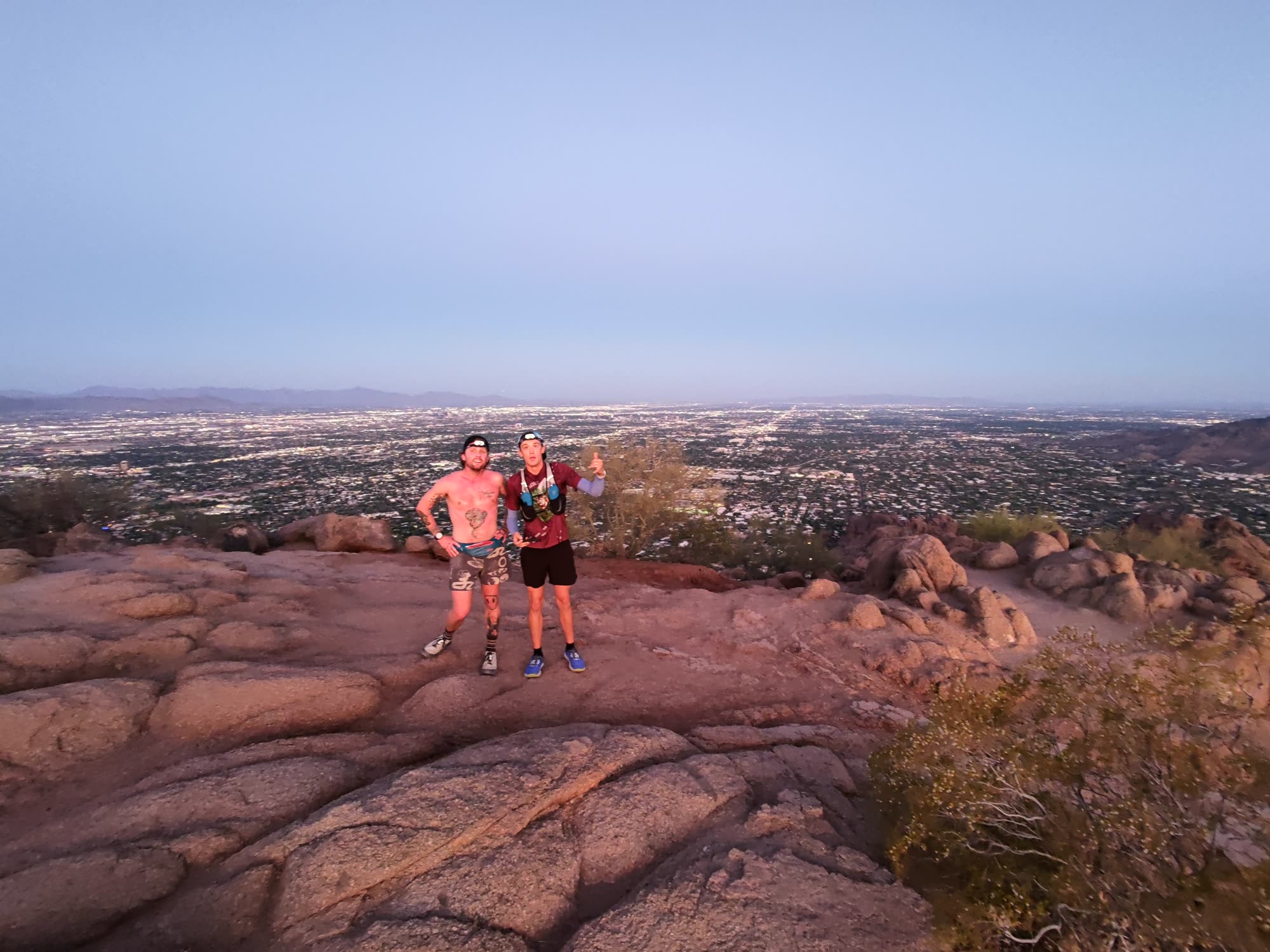
Most pacing happens in the dark, and the dark is where a pacer does the most good.
Light. You carry your own headlamp with a spare battery plus a second small light. Many runners add a waist light because a low beam throws shadows behind rocks and makes them easier to see. Don't turn your head to talk and blind your runner. Change batteries at an aid station, before the beam fades.
Position. On climbs, stay behind and let them set the effort. On rocky descents, many pacers go a few steps ahead to light the line. Stagecoach's rules say the pacer stays behind the runner, so check your race before you make that a habit.
Cold. Desert and high-country nights fall hard. The Coldwater race director warns about 40°F in the washes. Stagecoach makes every runner pick up a cold-weather kit at Boundary, mile 58. The rule for both of you is to put the layer on at the aid station, before you're cold. A packable wind jacket, thin gloves and a beanie cover most Arizona nights. An emergency bivvy in your vest covers the night when someone turns an ankle six miles from the next aid.
Sleepiness. The signs are weaving, long blinks and answers that don't match the question. (We wrote about what that state feels like from the inside in The Altered State of Mile 80.) First try food, then conversation that needs real answers: have them tell you a story. If they're still weaving, the fix is at the next aid station. A short timed nap in a chair, with you awake and holding the alarm, is a tool a lot of finishers use. Never let them lie down beside the trail near a drop, and never in the cold without a layer on.
Your own sleep. If you crewed all day and start pacing at 1 AM, you're impaired too. The federal fatigue numbers are in the playbook's driving and sleep section. Nap before your leg. It's part of the job.
That nap is the honest reason a pacer wants a van at a race like Mogollon. Your pickup at General Springs or Geronimo might be at 2 AM or 7 AM, depending on how the Rim treats your runner. A real bed parked at the crew zone means you start your leg rested. The card above is an interest list, not a booking.
Muling: what you can't carry
Muling means carrying your runner's gear, food or water for them. Javelina, Coldwater, Mogollon, Zion and San Diego ban it by name, and Stagecoach bans it in other words.
Western States has the most detailed wording, and a lot of races borrow its spirit. Its rules say pacers may not carry the runner's water, food, lights, shoes, clothing or other supplies, and may not give mechanical or physical help. One line sums it up: "Muling is expressly forbidden." For reference, Western States pacers start at Foresthill, mile 62 (or at Michigan Bluff, mile 56, for runners leaving after 8 PM), must be 18, and can't go into an aid station ahead of their runner to speed things up.
What that means on the trail:
- Your runner wears their own vest, with their own water, food, light and jacket in it, the whole way.
- No pushing, pulling or towing. No hand on the back up a climb.
- Inside the aid station, help is normal. Filling bottles and restocking a vest with them is allowed at Western States and is standard practice. Stagecoach is strict that help happens in sight of an aid station, not out on the course.
- You carry your own supplies, and only yours.
One limit on all of this: a runner in real trouble gets your jacket and your water. Safety comes before the rule. Then you tell the aid station captain at the next stop exactly what happened and let the race decide.
When your runner says "I'm done"
It will probably happen. Your first move is to work out which kind of "done" it is.
| What you see or hear | What it usually is | Your move | End the race? |
|---|---|---|---|
| "I can't. I'm done." Slow, flat, still making sense | A calorie or sleep low | Feed them, walk 15 minutes, ask again | No. Decide at the next aid, standing up |
| Threw up once, feels a bit better | Stomach, common late in a 100 | Walk, small sips, bland food when it settles | Not yet |
| Can't keep anything down for hours | Needs help | Get to the aid station and ask for medical | Their call with medical staff |
| Sharp pain in one spot that changes their stride, or can't put weight on it | Possible injury | Stop running. Walk to aid | Probably. No finish is worth a surgery |
| Shivering that won't stop, clumsy hands | Getting too cold | Every layer on, keep moving, hot food at aid | If it doesn't stop once warm and fed |
| Confused, slurring, doesn't know where they are, or acting strangely on a hot day | Medical emergency | Get help now. The Korey Stringer Institute says heat stroke can show as confusion or odd behavior with no collapse, and that cooling comes first | Yes. This is no longer a race |
| Missed the cutoff | The clock | Tell them you're proud. Mean it | The race decides |
A few rules for that hour:
- You can't finish for them and you can't quit for them. The runner decides, and the medical staff can overrule. Your job is to get them to the place where a good decision can be made, which is an aid station and never the side of the trail.
- Never decide in a chair. Walk out of the aid station and decide a mile later. Most runners don't turn around.
- Use the agreement. "You told me last week you'd say this, and you told me to say: eat, then walk to the next one."
- If they do stop, do it officially. Tell the aid station captain and hand in the bib or timing chip the way the race asks, so nobody goes looking for a runner who's asleep in a car.
- Then be kind. A runner who made it 70 miles and stopped still did something most people never try. Our look at finish rates at Arizona's hardest 100s shows how normal a DNF is.
What a 100-mile pacer carries
The 50-mile post covered the basics. For a long night leg, add to it:
- A running vest with 1.5 liters of your own water and food for every hour of the leg, plus one extra hour.
- Headlamp, spare battery, second light.
- Wind jacket, gloves, beanie, emergency bivvy.
- Phone with the GPX offline, power bank, cable.
- The cutoff card and the interview card.
- A few feet of tape, lube and wipes for your own feet.
- Your own cup, ID, cash and a car key.
- Trekking poles for you if the leg has a big climb, such as Donahue at Mogollon or Smith Mesa at Zion. Check that the race allows them.
Last thing: have a plan for when you're the problem. If you roll an ankle or can't keep up, your runner goes on without you and you walk to the next aid station. Agree on that before the start, so nobody stands on a trail arguing about it at 4 AM.
Pacer FAQ
Do I have to be faster than my runner? No. You have to be fresher. Late in a 100, most pacing is walking fast with short runs. What you need is the ability to stay on your feet for the hours your leg takes, at night, while still thinking clearly.
Can a pacer carry the runner's water or food? No. That's muling. Javelina, Coldwater, Mogollon, Zion and San Diego ban it by name, and Stagecoach bans carrying the runner's gear. Western States spells it out item by item: no carrying the runner's water, food, lights, shoes or clothing.
Which Arizona 100-milers don't allow pacers? Bradshaw Brute 100, Fat Ox and Across the Years (which offers single-lap guest bibs instead). Desert Solstice's page was contradictory when we checked, so ask the race directors.
Do pacers need a bib or have to pay? It depends. Javelina, Zion and Mogollon use pacer bibs and a waiver. Stagecoach gives each runner one bib that pacers hand off. Coldwater and San Diego don't use pacer bibs. I haven't seen a pacer fee at any of them, but check the current runner guide.
How far should a first-time pacer go? Pick a leg you could cover on your own on a bad day. For most people who run but haven't done an ultra, that's 8 to 14 miles: Horse Thief to Rumble HQ at Coldwater (8), Virgin BMX to the finish at Zion (9.5), or Watson Tank to Tusayan at Stagecoach (12, with the GPX open).
Can the pacer cross the finish line with the runner? Race rules differ, so ask at check-in. San Diego 100 invites family and friends to run the last half mile in. When in doubt, drop back a few steps at the line. It's their finish.
Who wrote this
Johnathon Lawson is a Gilbert, Arizona ultrarunner, middle school track and cross-country coach, and father of three. He has finished the Mogollon Monster 100 (2025, 30:56:11), Zion 100 (2025, 28:34:36) and San Diego 100 (2026, 28:37:12). Follow his training on Strava, see his race history on UltraSignup, and find AZ Ultra Adventure on YouTube and Instagram.
Sources: pacer rules, aid station miles and cutoffs come from our race guides linked above, which cite each race's official page and runner guide, with spot checks against Aravaipa's Javelina Jundred page and Mogollon Monster page. Western States rules: wser.org pacer rules. Hyponatremia: Wilderness Medical Society guidelines, summarized by American Family Physician. Heat stroke: Korey Stringer Institute. Leg times are our own arithmetic from published distances and cutoffs. This is a pacer's guide, not medical advice. At a race, the medical team makes the call.
Some links are Amazon affiliate links. As an Amazon Associate we earn from qualifying purchases, at no extra cost to you.